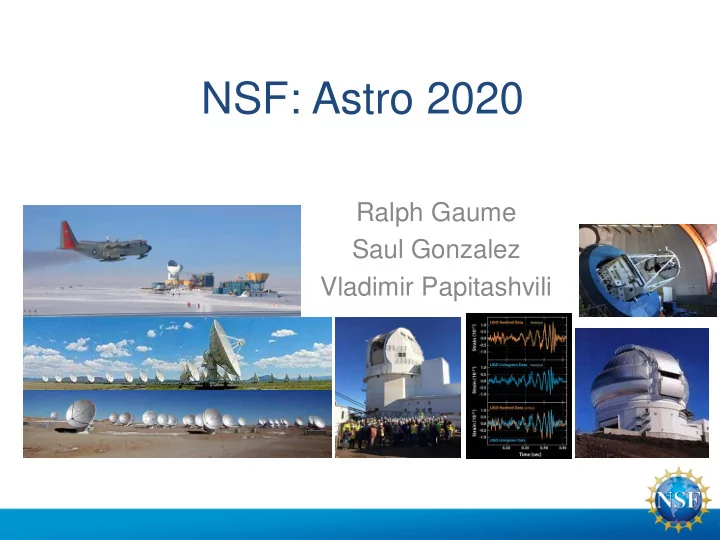
NSF: Astro 2020 Ralph Gaume Saul Gonzalez Vladimir Papitashvili - - PowerPoint PPT Presentation

nsf astro 2020
SMART_READER_LITE
LIVE PREVIEW

NSF: Astro 2020 Ralph Gaume Saul Gonzalez Vladimir Papitashvili - - PowerPoint PPT Presentation

NSF: Astro 2020 Ralph Gaume Saul Gonzalez Vladimir Papitashvili Outline NSF Goals for Astro2020 Notional NSF Budgets: Construction and Operations Highlights of AST Response to Astro2010 Highlights of AST Program Status


slide-1
SLIDE 1

NSF: Astro 2020

Ralph Gaume Saul Gonzalez Vladimir Papitashvili

slide-2
SLIDE 2

Outline

  • NSF Goals for Astro2020
  • Notional NSF Budgets: Construction and

Operations

  • Highlights of AST Response to Astro2010
  • Highlights of AST Program Status
  • PHY Perspective
  • OPP Perspective
  • Science, Big Ideas, Summary

July 15, 2019 NSF: Astro2020 2

slide-3
SLIDE 3

NSF Goals for Astro2020

July 15, 2019 NSF: Astro2020

slide-4
SLIDE 4

NSF Goals for Astro2020

  • Astro2020 will be most effective if it is aspirational,

inspirational, and transformative.

  • Astro2020 will be most effective if it is based on

community consensus science priorities.

  • The agencies are the customers. Astro2020 will be

conducted independently of the customer, but must provide recommendations, clear priorities, and actionable advice to the customer.

July 15, 2019 NSF: Astro2020 4

slide-5
SLIDE 5

NSF Goals for Astro2020

  • NSF wants to know:

– What are science priorities for next decade? – What projects address these priorities? – Which projects are ready to go now and later? When? – What are costs, risks, development needs of projects? – What is the priority order for these projects? – What budgets are needed to support the priorities, and are they realistic?

July 15, 2019 NSF: Astro2020 5

slide-6
SLIDE 6

NSF Goals for Astro2020

  • NSF wants to know (continued):

– How does the current NSF portfolio address priorities? – What is the state of the profession?

  • Recommendations for the agencies.

– Division specific:

  • AST: Decision rules for MSIP.
  • PHY: Welcome recommendations on promising

Technology R&D for next gen. facilities

  • Let NSF sweat implementation details.

– One NSF Astronomy/Astrophysics program

  • Provide clear priorities with explanatory decision rules

leading to the priorities.

July 15, 2019 NSF: Astro2020 6

slide-7
SLIDE 7

Notional NSF Budgets: Construction and Operations

July 15, 2019 NSF: Astro2020

slide-8
SLIDE 8

July 15, 2019 NSF: Astro2020

  • $100

$200 $300 $400 $500 $600 $700 2017 2018 2019 2020 2021 2022 2023 2024 2025 2026 2027 2028 2029 2030

Million $ Fiscal Year

Notional (Ambitious) Future NSF MREFC Account Profile

Horizon (est)

NEON DKIST

LSST RCRV AIMS

LHC

Mid-scale (est) LCC (est)

8

slide-9
SLIDE 9

NSF Operations and Maintenance

  • NSB: Study of O & M costs for NSF Facilities May 2018
  • Recommendation 1: NSB and the NSF Director should continue to

enhance agency-level ownership of the facility portfolio through processes that elevate strategic and budgetary decision-making. – …a scientifically robust Foundation-wide strategy that is both transparent and fiscally responsible is critical. – Planning horizons that are longer than the current 5-year projections required by statute could inform this strategy. The Department of Energy’s Office of Science has found notable success using a 10-year planning model. – While NSB does not believe that it is necessary to establish a central O&M account at this time, greater flexibility in use of the MREFC account would enhance visibility and agency-level

  • wnership.

July 15, 2019 NSF: Astro2020 9

slide-10
SLIDE 10

July 15, 2019 NSF: Astro2020

  • $500

$1,000 $1,500 $2,000 $2,500 2017 2018 2019 2020 2021 2022 2023 2024 2025 2026 2027 2028 2029 2030

Million $ Fiscal Year

Notional (Ambitious) Total NSF Facility + Mid-scale Funding

R&RA (All NSF O&M + small mid-scale)

MREFC (from previous chart)

10

slide-11
SLIDE 11

Highlights of NSF Response to Astro2010

July 15, 2019 NSF: Astro2020

slide-12
SLIDE 12

Astro2010: Recommendations for new large projects

  • Priority 1: LSST

– In construction phase, operations ramp began in FY 2019, beginning 10-yr survey in FY2023.

July 15, 2019 NSF: Astro2020 12

slide-13
SLIDE 13

LSST Current Construction Site

July 15, 2019 NSF: Astro2020

On budget and on schedule for full operations in FY 2023.

13

slide-14
SLIDE 14

Astro2010: Recommendations for new large projects

  • Priority 1: LSST

– In construction phase, operations ramp began in FY 2019, beginning operations in FY2023.

  • Priority 2: Initiate MSIP, reach annual budget of $40M/yr

– Constrained budget and priority choices led to $15-$20M/yr in alternate year solicitations during mid-decade – FY 18 appropriation allowed $25M/yr – MSRI-1 and 2 hold the potential for further AST support – MSIP will be continued as well as MSRI, potential for MSRI to replace MSIP in future years. Decision rules for MSIP?

  • Other large project priorities not addressed due to budgetary
  • constraints. (CTA team was instructed to apply to MSIP.)

July 15, 2019 NSF: Astro2020 14

slide-15
SLIDE 15

Astro2010: Medium project and other

  • Medium Project:

– CCAT  a wide field-of-view 25m telescope to be constructed near ALMA. – Astro2020 estimated total construction cost at $140M. – Astro2020 recommended NSF share of construction $37M. – Astro2020 recommended $7.5M/year NSF share of

  • perations.

– Funding was insufficient for to address CCAT, CCAT team instructed to apply to MSIP.

  • Other:

– Conduct mid-decadal progress study on Astro2010

  • recommendations. NWNH: A Midterm Assessment.

– Conduct Senior Review of AST portfolio prior to mid-

  • decadal. AST Portfolio Review (2012).

July 15, 2019 NSF: Astro2020 15

slide-16
SLIDE 16

Astro2010: Recommendations for AST core program

  • ATI – 50% increase over $10M/yr.

– Budgetary limitations reduced to ~$8M every other year.

  • AAG – increase to $54M/yr.

– Dipped to $42M in FY13, recovered to $51M in FY18.

  • Gemini augmentation - gain increased share for slight increase in

budget. – That was essentially the outcome of the UK withdrawal.

  • TSIP – increase from $2-3M/yr to $5M/yr.

– TSIP program discontinued; subsumed in MSIP as recommended by Portfolio Review.

  • Theory and Computation Networks – fund at $2.5M/yr.

– Joint solicitation with NASA, one round funded, then folded into AAG due to funding constraints. – Several programs jointly funded with CISE. – HDR Big Idea is latest agency-level commitment.

July 15, 2019 NSF: Astro2020 16

slide-17
SLIDE 17

Highlights of AST Program Status

July 15, 2019 NSF: Astro2020

slide-18
SLIDE 18

AAG AAPF ATI CAREER MRI REU

ALMA Arecibo NRAO Gemini NOAO LSST NSO GBO

MSIP

Individual Investigators Mid-scale Facilities

AST Division Programs

Technology/ Instrumentation

Research

Education and Special Programs

July 15, 2019 NSF: Astro2020 18

* * * *NSF Wide

slide-19
SLIDE 19

NSF and AST Support for Workforce

  • NSF has provided leadership in ensuring the research and

learning environments its supports are free from harassment.

– Awardee organizations must notify NSF of findings, determinations, admin leave and/or action for funded PIs and CoPIs.

  • NSF recognizes the need to promote a diverse and

inclusive workforce in our quest to promote the progress of science.

  • NSF and AST: AAPF, CAREER, INCLUDES, RUI, REU

sites, GRFP, HBCU, EPSCoR, Educ. and Special Pgms, facility awardee’s programs

July 15, 2019 NSF: Astro2020 19

slide-20
SLIDE 20

Forefront Facilities

  • Radio-Millimeter-Submillimeter
  • Atacama Large Millimeter-Submillimeter Array
  • Jansky Very Large Array
  • Very Long Baseline Array
  • Green Bank Observatory
  • Arecibo Observatory
  • Optical/Infrared
  • Gemini 8-m North and South (+Subaru exchange)
  • Blanco 4-m
  • SOAR 4.2-m
  • WIYN 3.5-m
  • Community access to SMARTS, LBT, CHARA, LCO, AAT
  • Solar
  • GONG, SOLIS, DKIST

July 15, 2019 NSF: Astro2020 20

slide-21
SLIDE 21

DKIST Telescope

July 15, 2019

  • Telescope optics in place, M1 & M2 aligned.
  • Current challenges largely with instrument

completion and delivery, as well as data policy.

  • Commissioning of thermal control loops also a

significant task.

  • Still on schedule and within budget contingency.

NSF: Astro2020 21

slide-22
SLIDE 22

AS T Facility Transition S ummary

July 15, 2019 NSF: Astro2020

Telescope Status KPNO 2.1m Caltech-led consortium operating for FY 2016-2020. Mayall 4m DESI; NSF to DOE; NSF/DOE MOA for operations . WIYN 3.5m NOAO share to NASA-NSF Exoplanet Observational Research Program; NSF/NASA MOU in place; NASA instrument under development. GBO Separation from NRAO in FY 2017; Collaborations in place for

  • perations; MOA for new partner; more new partners desired.

LBO/VLBA Reintegrated into NRAO; MOA with US Navy in place for 50%. McMath-Pierce Funding for utilization as science outreach center. GONG/SOLIS GONG refurbishment; Interagency Agreement with NOAA signed to share GONG operations costs. SOLIS moved from Kitt Peak to Big Bear. Sacramento Pk. Initial NSF and State funding for consortium led by NMSU; NSO to provide continuing site support; NSB approval for ROD. Arecibo UCF new operator, plans to increase funding share from UCF partners; hurricane recovery funding being deployed; staffing challenges. SOAR AAAC subcommittee recommended continuing renewal

22

slide-23
SLIDE 23

FY 2018 Budget (AST)

  • Very good outcome in the end for AST – total $307M,

compared to FY17 actual of $252M.

  • Much of the increase went to one-time specific projects

(some dependent on FY19 availability of funds to complete):

  • MSIP, for total funding close to aspirations in NWNH
  • Multi-messenger astrophysics grants
  • Major upgrade to Gemini N Adaptive Optics system in

service of time domain follow-up, stellar populations studies

  • Early funding of DKIST operations for timely completion of

data center, supplement for Level 2 data products.

  • Initial funding of LSST operations ramp for three years.

July 15, 2019 NSF: Astro2020 23

slide-24
SLIDE 24

50.4 48.0 45.1 29.5 45.1 29.3 24.9 31.2 27.6 26.7 31.2 34.3 38.1 36.8 28.8 28.5 24.4 23.9 20.7 36.3 22.4 19.9 14.8 15.4 16.7 18.6 18.8 19.3 22.3

Proposal Funding Rate, %

16.2 17.0 18.2 17.1 20.2 18.6 17.5 19.3 19.7 18.8 20.9 22.7 29.4 32.4 30.7 34.0 38.9 41.5 42.1 79.6 49.4 48.1 44.5 42.4 43.7 48.4 48.5 48.7 50.9

AAG Budget, $M

July 15, 2019 NSF: Astro2020

slide-25
SLIDE 25

NSF FY 2019 Budget

  • Enacted appropriation increases R&RA by 3%.
  • MREFC line re-incorporates Antarctic infrastructure; DKIST (final

year, Ops begin June 2020) and LSST at requested levels.

  • NSF’s bill was not under consideration for passage before the

end of FY 18, so operations after October 1, 2018 were under a Continuing Resolution until Dec 21st.

  • Major 35-day shutdown challenge for NSF was maintaining flow
  • f funds to facilities awardees, particularly those with Chilean

labor contracts. OMB allowed cash draws for previously allocated funding, unlike the 2013 shutdown.

  • FY 20 President’s Budget Request public last winter. Now

preparing FY 2021 PBR for release in early CY 2020.

  • FY 2019 Directorate and Divisional allocations being executed

(spend plan approved by Congress in June 2019). FY 2019 is not yet over, so will not discuss details of FY 2019 budget.

July 15, 2019 NSF: Astro2020 25

slide-26
SLIDE 26

NSF Division of Physics Perspective

slide-27
SLIDE 27

Division of Physics –2019 - Programs

July 15, 2019 NSF: Astro2020

Particle Astrophysics; IceCube Physics at the Information Frontier

Q

Midscale Instrumentation

Atomic, Molecular, & Optical Physics

Plasma Physics Integrative Activities in Physics

(REU Sites, MRI, CAREER, BP org)

Elementary Particle Physics; LHC Gravitational Physics; LIGO, AdvLIGO Nuclear Physics; NSCL

Theoretical Physics (AMO, Nuclear, EPP, AC) Physics of Living Systems Physics Frontiers Centers Quantum Information Science

27

slide-28
SLIDE 28

Division of Physics –2019 - Programs

July 15, 2019 NSF: Astro2020

Particle Astrophysics; IceCube Physics at the Information Frontier

Q

Midscale Instrumentation

Atomic, Molecular, & Optical Physics

Plasma Physics Integrative Activities in Physics

(REU Sites, MRI, CAREER, BP org)

Elementary Particle Physics; LHC Gravitational Physics; LIGO, AdvLIGO Nuclear Physics; NSCL

Theoretical Physics (AMO, Nuclear, EPP, AC) Physics of Living Systems Physics Frontiers Centers Quantum Information Science*

* * * * * *

Program with relevance to Astro2020

28

slide-29
SLIDE 29

Facilities in the Physics Division

July 15, 2019 NSF: Astro2020

Laser Interferometer Gravitational Wave Observatory (LIGO) National Superconducting Cyclotron Laboratory (NSCL) ATLAS and CMS Detectors at Large Hadron Collider (LHC) IceCube (joint with OPP)

29

slide-30
SLIDE 30

Current Status of PHY Facilities

July 15, 2019 NSF: Astro2020

LIGO O3 Run Started April 1; A+ Upgrade underway NSCL Transfer to FRIB (DOE) in 2021 Progressing Smoothly LHC Planning for MREFC High-Luminosity Upgrade Underway ($150 M); IRIS Award to Address Computational Challenges IceCube Upgrade Underway (joint with OPP)

Photos courtesy of facilities, resp. 30

slide-31
SLIDE 31

Physics Division Budgets

July 15, 2019 NSF: Astro2020

50 100 150 200 250 300 350 FY 2015 FY 2016 FY 2017 FY 2018 $ million / FY Individual Investigator Centers O&M Infrastructure Other

Individual Investigators Centers O&M Infrastructure

31

slide-32
SLIDE 32

Astrophysics-related Programs in PHY

July 15, 2019 NSF: Astro2020

20 40 60 80 100 120 FY 2015 FY 2016 FY 2017 FY 2018 $ million / FY Individual Investigator Centers O&M Infrastructure

Individual Investigators Centers O&M Infrastructure

32

slide-33
SLIDE 33

South Pole Palmer McMurdo NSF Denver ASC Port Hueneme

U.S. Antarctic Program

July 15, 2019 NSF: Astro2020 33

slide-34
SLIDE 34

USAP Logistics System

Continental System

(Military/Commercial)

Peninsula System

(Commercial)

Challenges: Global Scale Supply Chains Aging Infrastructure/Assets Fuel Dependency Power Limitations Icebreaker Requirements

July 15, 2019 NSF: Astro2020 34

slide-35
SLIDE 35

NSF/Office of Polar Programs Antarctic Sciences and Logistics

Instrumentation and Facilities Glaciology Ocean Atmosphere Earth sciences Integrated System Science Organisms and Ecosystems Astrophysics $9.0M & Geospace $2.5M Infrastructure and Logistical Support

Annual budget ~$4 per each science dollar

July 15, 2019 NSF: Astro2020 35

slide-36
SLIDE 36

DSL SPT BICEP QUaD MAPO

IceCube Neutrino Observatory ($272M, NSF/MREFC project, 2002-2010) O&M $7M/year (GEO/OPP & MPS/PHY) Since 2002, total NSF investments in IceCube science ~$120M Mid-scale ICNO Upgrade $23M funded in 2018 plus ~$5M for logistical support High-energy cosmic neutrinos (100 TeV – 1 PeV) are detected and one source is pinpointed (Science, 2013; 2018) Community plans IceCube Gen2 in 2020s

Neutrino Astrophysics at South Pole

A New Windows on the Universe Multimessenger Astrophysics

July 15, 2019 NSF: Astro2020 36

slide-37
SLIDE 37

South Pole Telescope BICEP Array of telescopes

Since 2002, total NSF investments in Antarctic Cosmology ~$100M Community plans CMB-S4 program in 2020s 10m South Pole sub-mm Telescope: Origin and Early History of the Universe CMB E & B modes polarization BICEP small aperture telescopes: Imprints of Primordial Gravitational Waves in CMB polarization

Cosmology and CMB Research at South Pole

A workhorse of the Antarctic: LC-130 All cargo to South Pole is delivered by this aircraft!

July 15, 2019 NSF: Astro2020 37

slide-38
SLIDE 38

Science, Big Ideas, Summary

July 15, 2019 NSF: Astro2020

slide-39
SLIDE 39

NSF’s 10 “Big Ideas” for Future Investment

July 15, 2019 NSF: Astro2020 39

RESEARCH IDEAS

Window s on the Universe: The Era of Multi- messenger Astrophysics

The Quantum Leap: Leading the Next Quantum Revolution Navigating the New Arctic Understanding the Rules of Life: Predicting Phenotype

PROCESS IDEAS

Mid-scale Research Infrastructure Grow ing Convergence Research at NSF NSF 2026 NSF INCLUDES: Enhancing STEM through Diversity and Inclusion Harnessing Data for 21 st Century Science and Engineering Work at the Human- Technology Frontier: Shaping the Future

slide-40
SLIDE 40

The Era of Multi-MessengerAstrophysics (MMA)

Focus Areas:

  • Enhancing and accelerating the theoretical, computational, and
  • bservational activities within the scientific community
  • Building dedicated midscale experiments and instrumentation
  • Exploiting current facilities and developing the next generation of
  • bservatories

Artist’s illustration of binary neutron star merger Goal: To build the capabilities and accelerate the synergy and interoperability of the three messengers, realizing integrated, multi-messenger explorations of the universe Electromagnetic

Waves High-energy Particles Gravitational Waves

July 15, 2019 NSF: Astro2020 40

slide-41
SLIDE 41

Highlight: LIGO

July 15, 2019 NSF: Astro2020 41

First Direct detection of Gravitational Waves

2017 Nobel Prize

September 14, 2015 at 5:51 a.m. Eastern Daylight Time “LIGO scientists estimate that the black holes for this event were about 29 and 36 times the mass of the sun, and the event took place 1.3 billion years ago. About 3 times the mass of the sun was converted into gravitational waves in a fraction of a second”

(B. P. Abbott et al. (LIGO and Virgo Scientific Collaborations, Phys. Rev. Lett. 116, 061102 (2016) )

[Press Release]

slide-42
SLIDE 42

IceCube 170922 290 TeV

Gamma rays energy spectrum 80-400 GeV

Flaring blazar within 0.1o

Fermi-LAT gamma-ray space telescope

MAGIC - Major Atmospheric Gamma Imaging Cherenkov Telescopes (La Palma)

NSF Press Release 18-050 (July 12, 2018) Neutrino observation points to one source of high-energy cosmic rays (Science, 2018)

# 4 in Top 10 stories of 2018 by http://www.sciencenews.org

July 15, 2019 NSF: Astro2020 42

slide-43
SLIDE 43

Image of M87 from Event Horizon Telescope

  • NSF (AST) invested some $28M in EHT research over the last two

decades, including hardware and algorithm development as well as theoretical modeling (PIRE grant for international collaboration).

  • ALMA observations were critical for closing phase; South Pole

telescope provided critical baselines.

  • Doeleman et al. team

with 8 telescope VLBI at 1.3 mm.

  • Black hole shadow with

inferred angular gravitational radius of 3.4±0.4μas.

  • Assumed distance yields

M=(6.5±0.7)x109M⊙

  • Crescent brightness

distribution consistent with Kerr Black Hole.

July 15, 2019 NSF: Astro2020

slide-44
SLIDE 44

Summary

  • Astro2020 will be most effective if it is aspirational,

inspirational, and transformative.

  • Astro2020 will be most effective if it is based on

community consensus science priorities.

  • Let NSF sweat implementation details.
  • Provide clear priorities with explanatory decision

rules leading to the priorities.

July 15, 2019 NSF: Astro2020 44