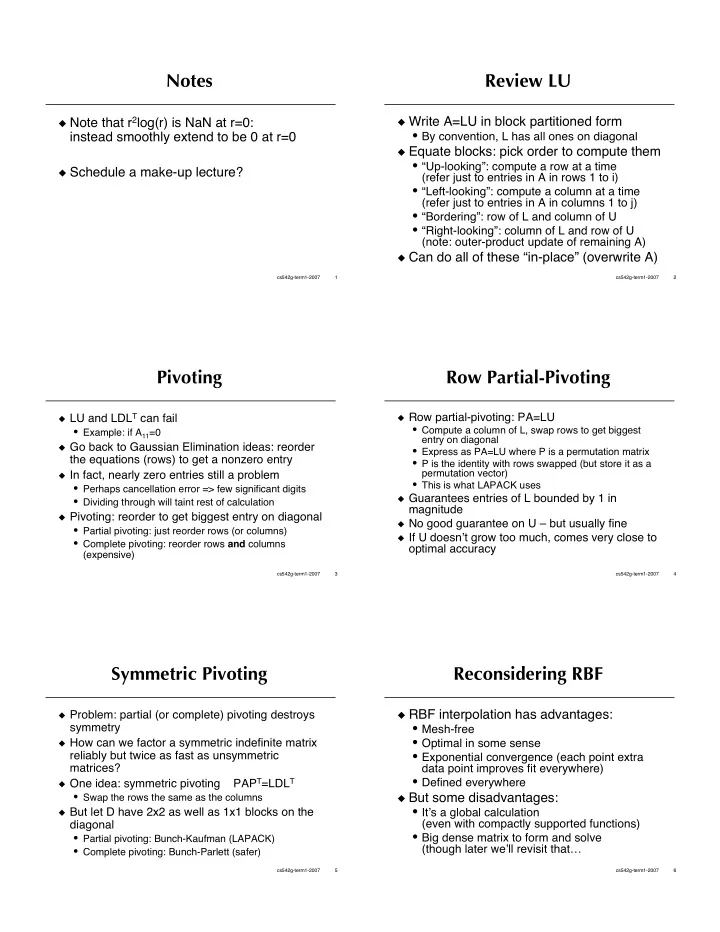

SLIDE 1
1 cs542g-term1-2007
Notes
Note that r2log(r) is NaN at r=0:
instead smoothly extend to be 0 at r=0
Schedule a make-up lecture?
2 cs542g-term1-2007
Review LU
Write A=LU in block partitioned form
- By convention, L has all ones on diagonal
Equate blocks: pick order to compute them
- “Up-looking”: compute a row at a time
(refer just to entries in A in rows 1 to i)
- “Left-looking”: compute a column at a time
(refer just to entries in A in columns 1 to j)
- “Bordering”: row of L and column of U
- “Right-looking”: column of L and row of U
(note: outer-product update of remaining A)
Can do all of these “in-place” (overwrite A)
3 cs542g-term1-2007
Pivoting
LU and LDLT can fail
- Example: if A11=0
Go back to Gaussian Elimination ideas: reorder
the equations (rows) to get a nonzero entry
In fact, nearly zero entries still a problem
- Perhaps cancellation error => few significant digits
- Dividing through will taint rest of calculation
Pivoting: reorder to get biggest entry on diagonal
- Partial pivoting: just reorder rows (or columns)
- Complete pivoting: reorder rows and columns
(expensive)
4 cs542g-term1-2007
Row Partial-Pivoting
Row partial-pivoting: PA=LU
- Compute a column of L, swap rows to get biggest
entry on diagonal
- Express as PA=LU where P is a permutation matrix
- P is the identity with rows swapped (but store it as a
permutation vector)
- This is what LAPACK uses
Guarantees entries of L bounded by 1 in
magnitude
No good guarantee on U –but usually fine If U doesnt grow too much, comes very close to
- ptimal accuracy
5 cs542g-term1-2007
Symmetric Pivoting
Problem: partial (or complete) pivoting destroys
symmetry
How can we factor a symmetric indefinite matrix
reliably but twice as fast as unsymmetric matrices?
One idea: symmetric pivoting PAPT=LDLT
- Swap the rows the same as the columns
But let D have 2x2 as well as 1x1 blocks on the
diagonal
- Partial pivoting: Bunch-Kaufman (LAPACK)
- Complete pivoting: Bunch-Parlett (safer)
6 cs542g-term1-2007
Reconsidering RBF
RBF interpolation has advantages:
- Mesh-free
- Optimal in some sense
- Exponential convergence (each point extra
data point improves fit everywhere)
- Defined everywhere
But some disadvantages:
- Its a global calculation
(even with compactly supported functions)
- Big dense matrix to form and solve