Notes: Introduction of the tools used in GIS for Emergency - - PDF document

notes
SMART_READER_LITE
LIVE PREVIEW

Notes: Introduction of the tools used in GIS for Emergency - - PDF document

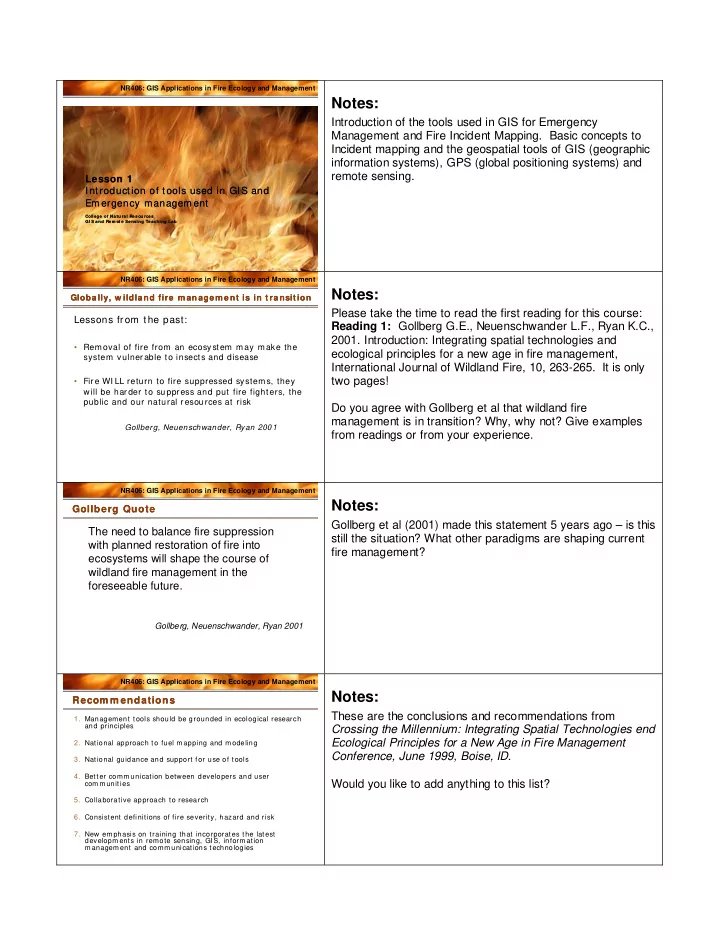
NR406: GIS Applications in Fire Ecology and Management Notes: Introduction of the tools used in GIS for Emergency Management and Fire Incident Mapping. Basic concepts to Incident mapping and the geospatial tools of GIS (geographic information


slide-1
SLIDE 1

NR406: GIS Applications in Fire Ecology and Management

Lesson 1 Introduction of tools used in GIS and Em ergency managem ent

College of Natu ral Resou rces GI S and Rem ot e Sensing Teaching Lab

Lesson 1 Introduction of tools used in GIS and Em ergency managem ent

College of Natu ral Resou rces GI S and Rem ot e Sensing Teaching Lab

Notes:

Introduction of the tools used in GIS for Emergency Management and Fire Incident Mapping. Basic concepts to Incident mapping and the geospatial tools of GIS (geographic information systems), GPS (global positioning systems) and remote sensing.

NR406: GIS Applications in Fire Ecology and Management

Lessons from the past:

  • Removal of fire from an ecosystem may make the

system vulner able to insects and disease

  • Fir e WI LL return to fire suppressed systems, they

will be har der to suppr ess and put fire fighters, the public and our natural r esources at risk

Gollberg, Neuenschwander, Ryan 2001

Globally, w ildland fire m an agem ent is in t ransit ion Globally, w ildland fire m an agem ent is in t ransit ion

Notes:

Please take the time to read the first reading for this course: Reading 1: Gollberg G.E., Neuenschwander L.F., Ryan K.C.,

  • 2001. Introduction: Integrating spatial technologies and

ecological principles for a new age in fire management, International Journal of Wildland Fire, 10, 263-265. It is only two pages! Do you agree with Gollberg et al that wildland fire management is in transition? Why, why not? Give examples from readings or from your experience.

NR406: GIS Applications in Fire Ecology and Management

The need to balance fire suppression with planned restoration of fire into ecosystems will shape the course of wildland fire management in the foreseeable future.

Gollberg, Neuenschwander, Ryan 2001

Gollberg Quote Gollberg Quote

Notes:

Gollberg et al (2001) made this statement 5 years ago – is this still the situation? What other paradigms are shaping current fire management?

NR406: GIS Applications in Fire Ecology and Management

Recom m endations Recom m endations

  • 1. Management tools should be grounded in ecological research

and principles

  • 2. National approach to fuel m apping and m odeling
  • 3. National guidance and support for use of tools
  • 4. Better comm unication between developers and user

com m unities

  • 5. Collaborative approach to research
  • 6. Consistent definitions of fire severity, hazard and risk
  • 7. New em phasis on training that incorporates the latest

developm ents in remote sensing, GIS, inform ation m anagem ent and comm unications technologies

Notes:

These are the conclusions and recommendations from Crossing the Millennium: Integrating Spatial Technologies end Ecological Principles for a New Age in Fire Management Conference, June 1999, Boise, ID. Would you like to add anything to this list?

slide-2
SLIDE 2

NR406: GIS Applications in Fire Ecology and Management

GI S & RS in Fire Applica tions GI S & RS in Fire Applica tions

  • Field mapping – Incident mapping
  • Fuels mapping
  • Analysis – Fire ecology & Mgt.
  • Fire history – fire atlas
  • Fire risk/ probability assessm ents
  • Fire sim ulation (FARSITE etc.)
  • Prescribed burn planning
  • Post-fire assessm ent

Notes:

Throughout this course we will address most of the above topics in readings, demonstrations, discussions, and hands-on exercises.

NR406: GIS Applications in Fire Ecology and Management

I ncident Mapping Outline I ncident Mapping Outline I. I ncident Comm and Systems (ICS) II. Geographic Information System s Technician (GIST)

  • III. GIS Tools

IV. GIS Data Managem ent V. Standard Mapping Products

Notes:

The next few slides will talk about fire incident mapping The incident mapping outline incorporates the following steps from the beginning of the incident to the daily products that are produced for the morning and afternoon briefing at a fire incident. NR406

GIS Applications in Fire Ecology & Management I ncident Comm and System ( I CS) A Structure to help organize resources during a emergency m anagement situation or incident.

Notes:

The Incident Command System provides for the single jurisdiction/single agency command structure with multi- agency involvement. This structured system expands in a logical manner from an initial response situation into a major

  • incident. ICS has common elements in organization,

terminology and procedures nationwide.

NR406: GIS Applications in Fire Ecology and Management

I ncident Com m and System ( I CS) I ncident Com m and System ( I CS)

Based on Em ergency Response t o life or resour ce t hreatening sit uation s. Based on Em ergency Response t o life or r esource th reat en in g situ at ions.

Notes:

slide-3
SLIDE 3

NR406: GIS Applications in Fire Ecology and Management

Cha racteristics of I CS Cha racteristics of I CS

  • ICS provides and adapts it’s organizational

structure to any emergency or incident to which emergency response agencies would be expected to respond

  • ICS Expands in a logical manner from an

initial response situation into a m ajor incident.

  • ICS Designates a clear chain of command

* Information provided by 2001 911GIS/ICS training M anual

Notes:

The ICS organizational structure develops in a modular fashion based upon the kind and size of the incident. The

  • rganization staff builds from a top down hierarchy

maintaining responsibility and performance placed initially with the Incident Commander.

NR406: GIS Applications in Fire Ecology and Management

I CS levels of Organization I CS levels of Organization Incident Comm ander Comm and Staff: GI ST Section supervisor Branch supervisor Division Supervisor Unit leaders

Notes:

For ease of reference and understanding of the role of GIS in the ICS system, the following incident Command list describes personal assigned to manage at each level of the ICS

  • rganization. The Geographic Information Systems

Technician (GIST) personnel falls under Incident Command

  • staff. This position is linked to the communications and aerial

support crews and is constantly called upon by the Incident Commander and the situation unit leaders.

NR406: GIS Applications in Fire Ecology and Management

Fire I ncident Pla ns Cycle GPS Field Work GIS Data Transfer

Notes:

Many of you are familiar with this chart (may be already plotted on a nearby wall). This depicts a typical 24-hour Fire Incident Planning Cycle. Although this cycle varies considerably among size of fires and how they change over time, it still can be used to depict how GPS Field Work fits into the general design. Used by mostly field observers and others, Data collection

  • ccurs in the daylight hours and are fed into a GIS after some

sort of Data Transfer (digital or handwritten) and then passed into the GIS for IAP’s (Incident Action Plans). Depending on size of fires, this cycle may occur twice (IAP in afternoon and morning). GPS in this graphic is depicted as the first part of this cycle. Different kinds of GPS receivers are available. The yare selected based on the ease of use, field durability and reliability, ability to connect to a computer, cost, spatial accuracy, and the type of data that needs to be recorded.

slide-4
SLIDE 4

NR406: GIS Applications in Fire Ecology and Management

Definition of GI S

  • a GIS is a computer

system capable of assembling, storing, manipulating, and displaying geographically r eferenced infor mation, i.e. data identified according to their locations

Notes:

  • A definition of GIS.

NR406: GIS Applications in Fire Ecology and Management

The role of GI S in I CS The role of GI S in I CS

Notes:

GIS Applications to emergency response situations and disaster relief has advanced to a level that major software tools have been developed to better facilitate incident

  • mapping. GIS technicians are now able to produce detailed

maps that can aide the Incident Commander in making split second decisions.

NR406: GIS Applications in Fire Ecology and Management

GI S Technician ( GI ST) GI S Technician ( GI ST)

  • GIST work from the Incident Com mand

Center during m ajor incidents.

  • GIST’s are usual point contact to Situation

Unit Leaders and Incident Comm anders.

  • Provides Cartographic Mapping Illustrations
  • f the major incident for Information Officers

and Incident Comm anders.

http://www.osha.gov/SLTC/etools/ics/tech_special.html

Notes:

The GIST is responsible for spatial information collection, display, analysis, and dissemination. The GIST will provide Global Positioning System (GPS) support, integrate infrared data, and incorporate all relevant incident command data to produce chronological mapping products.

NR406: GIS Applications in Fire Ecology and Management

  • Also includes operating personnel and the

data that go into the system Definition of GI S

Hardware Software Data People Methods

Notes:

  • Folks also regard the total GIS as including operating

personnel and the data that go into the system

slide-5
SLIDE 5

NR406: GIS Applications in Fire Ecology and Management

How Does GI S W ork? How Does GI S W ork?

  • Real world features are represent ed as

individual layers according t o feature type.

  • GIS port rays feat ures as points, lines, and

polygons.

  • Coincident layers answer questions and solve

problems according t o geographic location.

GIS Tasks

Input Manipulation Management Query & Analysis Visualization Output

Notes:

Overview of GIS. In a GIS real world features are represented by points, lines, polygons or pixels (raster data). Tabular data is associated with the features in the attribute tables. GIS layers can be stacked based on geographic location to answer questions and solve problems.

NR406: GIS Applications in Fire Ecology and Management

How GI S Represents Fe atures How GI S Represents Fe atures

  • Raster Data Model ( e.g.

photography or grids)

  • Vector Data Model ( e.g.

roads)

  • Real World

Notes:

Data in a GIS is represented as raster data (pixel based data such as images and grids) or vector data (points, lines polygons) to model the real world to the extent necessary for the task at hand.

NR406: GIS Applications in Fire Ecology and Management

Standard Mapping Products Standard Mapping Products

  • Wildfire Situation Analysis Map:
  • Morning Brief ing Maps
  • Perim et er maps
  • Division m aps
  • Sit uat ion Unit Maps
  • Fire History Map
  • Fuels Map
  • Vegetation Map
  • Areas of Special Concern: Archeological Sites,

Fuel and electrical lines, Resource Tracking.

  • Hillshade Maps: Slope and Aspect

Notes:

Many map products are produced in wildfire situations, for example morning briefing maps, fire perimeter maps, division maps, and situation unit maps. Other maps are more commonly used in research such as fire history maps, fuel maps, vegetation maps, maps displaying areas f special concern, and topographic maps.

NR406: GIS Applications in Fire Ecology and Management

Data Manage ment Data Manage ment

24 hour data structure: Every 24 hours a new perim eter and situation m apping data folder is built.

Standard GIS library data structure:

Basedata:

  • 1. Im ages(rasters) Satellite, aerial, DRG’s, DoQQ’s, &

Modis.

  • 2. All static Vector data such as road, streams,

administrative boundaries, and ancillary local data. Incident data:

  • 1. Date subdirectories to represent each day of the

incident.

  • 2. Progression Data: Fire progression and spread data.
  • 3. Infrared Data and perim eter data.

Products:

  • 1. 24 hour date convention. 6am m orning briefing and

situation m ap, Noon resources and situation perimeter m aps, evening progression and briefing maps.

http://www.osha.gov/SLTC/etools/ics/card_common.html

Notes:

Data Management for the ICS System requires organization and structure. During an incident, each day has folder dated for that particular day with all the data management notes and directories associated with it. All products, briefing and situation maps, are all incorporated into the date folder closed for that date. Each day relies on the previous 24 data acquisition of GPS perimeter files, IR interpretation, and Remotely Sensed satellite data.

slide-6
SLIDE 6

NR406: GIS Applications in Fire Ecology and Management

Typ es of Dat a collect ed d uring an I ncid ent : Typ es of Dat a collect ed d uring an I ncid ent :

  • GPS, Flown Perimeter.
  • IR Thematic Mapper. Aerial Acquisition.
  • Modis (http:/ /modis.gsfc.nasa.gov/)
  • Burn Ar ea Reflectance Classification(BARC)
  • Maps. Pr oduced by RSAC( USDA) . Based on Satellite

imager y.

Notes:

Large amounts of spatial data is collected during an Incident. GPS data collected by foot, vehicle or from the air are recorded in databases and incorporated in maps. Remotely sensed imagery from satellite and aerial sensors are acquired. Satellite imagery from the Landsat (30 m resolution) and MODIS (250-1000 m resolution) are commonly used in mapping and analysis. Landsat data is acquired approximately every 16 days while MODIS data can be obtained daily. IR Thematic mapper images can be acquired from the air.

NR406: GIS Applications in Fire Ecology and Management

http://www.firelogistics.com/gis.htm Mobilization In Region 6 hr Out of Region 12 hr

GI S I ncident Mapping Unit GI S I ncident Mapping Unit

Notes:

An example of a mobile GIS Incident Mapping Unit

NR406: GIS Applications in Fire Ecology and Management

Fire Logistics I nc. GI S Un it has the follow ing equipm ent: Fire Logistics I nc. GI S Un it has the follow ing equipm ent:

  • 2 high- speed ( 1.7GHZ) Pentium 4 computer w ork stations (CD-Burner,

DVD, Zip Drive, 40 G Hard Drive, 17” Monitors) running MS Windows 2000

  • 2 additional netw orked work stations for use by incident personnel, such

as the Situation Unit and Fir e Behavior Analy st

  • 1 Plotter ( HP 1055CM) - – 36” pr int capability
  • 1 Pr inter, color ( HP 1220CM) – 11” X 17”
  • 1 Pr inter, laser (HP 1200 CXI )
  • 1 Scanner (HP 7400C)
  • Modems for each computer
  • 4 phone line capability
  • Fax- copier
  • Garmin GPS Map 76 units
  • Digitizer
  • Digital Camera
  • Internet Access – Both har dwire and two way high speed satellite.
  • Batter y back- up power supplies ( UPS) for all computers and the plotter
  • 24gb DAT Tape Dr iv e
  • Dedicated Power Generator (15KW minimum) , trailer mounted
  • Air conditioner and heater.
  • 160 squar e feet of work space w it h 5½ of headr oom.

Notes:

This is the equipment necessary to run the mobile GIS Incident mapping unit.

NR406: GIS Applications in Fire Ecology and Management

Fire Logistics I nc. soft w are on w or kstat ion s: Fire Logistics I nc. soft w are on w or kstat ion s:

  • Ar cGIS 9.1 ( ArcInfo) with extensions
  • Ar cView ( 3.x and 9.x)
  • Spatial Analyst
  • 3D Analyst
  • Network Analyst
  • Ar c Press
  • Ventura Fire Tools ArcView Extensions
  • Ozi Explorer GPS Software
  • Farsite
  • I Suite Software
  • DeLorme Topo USA
  • Adobe Acrobat ( PDF ICS Form s)
  • Corel WordPerfect ( ICS Forms)
  • Microsoft Office XP Professional (Word ICS Form s)
  • Paint Shop Pro
  • Norton Anti- virus software

Notes:

Software typically used by mobile GIS Incident mapping units. Have you used any of these software programs?

slide-7
SLIDE 7

NR406: GIS Applications in Fire Ecology and Management

Maps produce d by Fire Logistics I nc. Maps produce d by Fire Logistics I nc.

  • Situation Unit Map – work in progress 1: 24,000 scale
  • Planning Map
  • I ncident Action Plan (I AP) Map – published daily for each

shift

  • Traffic Map – road restrict ions and limitations
  • Vicinity Map – serves as a locator map
  • Fire Progression Map – daily change in fire perimeter
  • Topography Map – overview of local t errain for ground

and air

  • Fire History Map – fires in the past
  • Veget at ion and/ or Fuels Map – to help predict fire

behavior

  • Farsite Maps – modeled rat e of spread etc.
  • Public I nformat ion Briefing Maps
  • Burned Area Emergency Rehabilitat ion (BAER) Maps

Notes:

Examples of maps produced in the Incident mapping unit

NR406: GIS Applications in Fire Ecology and Management

GI S Horsepow er GI S Horsepow er

GIS T’s Digitizer Scanner

GIS

GPS

Output

Notes:

You need Horsepower and a set of tools including hardware, software and people to make it happen.

NR406: GIS Applications in Fire Ecology and Management

GI S: An An alysis Tool for Fire Man ag em ent GI S: An An alysis Tool for Fire Man ag em ent

  • Data Visualization
  • Map dem ographics,

topography or vegetation

  • Inquir e detailed questions
  • f the attribute inform ation

Notes:

How GIS is used for Fire Management? Data visualization Provide maps for navigation Provide maps for fire spread and behavior predictions Provide briefing maps Provide detailed information from the GIS attribute tables

NR406: GIS Applications in Fire Ecology and Management

Decision Fact ors for t he Fire Mapping Program Decision Fact ors for t he Fire Mapping Program

  • Handle data from various sources
  • Universally accepted
  • Visual tool IC’s and division Supervisors
  • Historical Fire Data Collection
  • Costs

Notes:

Can the software you choose for mapping :

  • 1. handle data from various sources
  • 2. Have a universal acceptance especially important with

multiple agencies from the Feds to State to County

  • 3. Note that the Costs and Nerd Factors are not showing
  • n this list. The reasons will be seen in the next few

slides.

slide-8
SLIDE 8

NR406: GIS Applications in Fire Ecology and Management

Unique Aspe cts of Fire Mapping

Scale Mode of Collection Quantity of Units Technical Skill Levels Environment

Notes:

This Slide is a Review of what makes Mapping Fires Unique. A quick Review here also will help us in our decision for which GPS Programs to use.

  • Scale: Since consumer grade GPS is the preference

for this mapping effort, scale and aerial mapping nature of these cases tend to concentrate data types into simple features. The accuracy of consumer grade GPS is at best 2-3 meters, more commonly 7-15 meters.

  • The mode of Collection with the good satellite

environment allow a simple software interface.

  • With so many GPS units required for the Incident

mapping operation, there is good reason to also keep the costs of a GPS communication Programs low.

  • Keeping things simple is also imperative. A highly

complex Programs for processing data will hamper collection and migration of data to the GIS.

NR406: GIS Applications in Fire Ecology and Management

Unique Aspects of Fire Mapping

Complexity Environment Scrutiny

The Governor pays a Visit

Notes:

This Slide is a Review of what makes Mapping Fires Unique.

  • Complexity: Data from different sources are acquired

and must be processed quickly

  • Environment: this part of the cycle occurs in the warm
  • ffice back at headquarters. The group of people,

machines, scanners, communications that comprise an active incident. Often stressful though, maps must be ready for the morning briefing!

  • Scrutiny: Intensive pressures to supply accurate, up-

to-date information in easy to understand formats are critical in any Incident. from big to small, the portrayal

  • f maps and data right now and in the future will live
  • n beyond the scope of the fire.
  • From the side of mapping these issues bring to bear a

level of complexity that border on a set of technologies that in use is just exploding. Making the right decision on the information highway you quickly find yourself on is critical.

NR406: GIS Applications in Fire Ecology and Management

  • GPS and Fire

Applications

  • GPS and N avigation
  • GPS and Digital Data Collection
  • GPS and Burne d Area Rehab ( BAER)

GPS - The Big Picture

Notes:

The next few slides will address the role of GPS in fire incident mapping

slide-9
SLIDE 9

NR406: GIS Applications in Fire Ecology and Management

GPS - The Big Picture GPS - The Big Picture

  • Depending on size of fire, GPS will play

a critical role in...

  • Mar king location
  • Updating fire perimeter
  • Mapping fire effects
  • Mapping r esources

at risk

  • Data depicted in

IAP next morning

Notes:

GPS is critical in all mapping to mark locations, update fire perimeters, record locations where fire effects have been estimated, map features that may be at risk….and last but not least…..put all the data together on a map for the next days incident action plan.

NR406: GIS Applications in Fire Ecology and Management

  • Data

Transfer Typica l Use on a Fire Typica l Use on a Fire

Download Upload

Notes:

GPS units that can interface directly with a computer via an interface cable is necessary for quick data transfer. The DNR- Garmin software is commonly used since it is capable of interfacing the GPS unit directly into the GIS software. DNR-Garmin (http://www.dnr.state.mn.us/mis/gis/tools/arcview/extensions/ DNRGarmin/DNRGarmin.html) can convert data between different map projections.

NR406: GIS Applications in Fire Ecology and Management

W here They W ork Great W here They W ork Great

  • Type 3 Fires
  • Size Up Fires
  • Initially Slow

growth

  • Resource

Collection Simple

  • Topo Product

Current

RALEIGH, N. CAROLINA 611234-0983 2001 - Revised 2002

Notes:

Lets say you are on a small Type 3 Fire under 20 acres in size, Or you are on a Size-up. Field equipment needs small, one or two of you with a laptop, field printer and need to generate a 8x11 map product for headquarters tonight. The resource collection is simple - one fire perimeter that was mapped by GPS. Also, the Topo Product that you have on your screen has a production date of this past summer or last year and infrastructure seems to be in place. You are ready to rock!

Notes:

R1: Garmin Map 76 Trimble GeoXT Trimble ProXRS R2: GPS Map 176 Garmin III or V PLGR (Federal use only) What determines the choice of GPS unit?

  • Accuracy
  • Cost
  • Ease of use
  • Field ruggedness
  • The ability to store attribute data
  • Battery power and powering options
  • Size and weight

Can you think of anything else?

slide-10
SLIDE 10

Notes:

http://www.garmin.com/outdoor/products.html

NR406: GIS Applications in Fire Ecology and Management

Rockw ell PLGR + 96 Rockw ell PLGR + 96

  • Advant ages
  • Reasonable $$ ( $2800)
  • Easy t o Use
  • Pr ov ides an Est imated Er ror!
  • 4m accur acy- aut onomous
  • Simple Point /Li ne/ Poly
  • Disadvant ages
  • 999 w ay point limit
  • N o At tri bution
  • Bulky
  • Poor battery life
  • Re- k eyi ng
  • Use Restr ict ions ( only feder al)
  • Movi ng off mark et

Notes:

NR406: GIS Applications in Fire Ecology and Management

Trim ble Ge oexplorer XT Trim ble Ge oexplorer XT

  • Advant ages
  • Great Softw are
  • Window s CE based
  • Por table
  • Attr ibut e stor age
  • Adv anced Point/ Line/ Poly
  • Scr een Navigation
  • Subm et er accuracy possible w /

differ ential corr ection

  • WAAS different ial capable
  • Disadvant ages
  • Expensive
  • Weight
  • Lim ited m ap memory
  • Scr een br ight ness
  • No por table r eplacement

batteries

Notes:

http://www.trimble.com/gps/index.shtml

NR406: GIS Applications in Fire Ecology and Management

Pathfinder Pro XR Pathfinder Pro XR Advantages

Handheld keyboard Reliable/trustworthy firmware/software Attribute storage Advanced Point/Line/Poly Screen Navigation Submeter accuracy possible w/ differential correction

Disadvantages

Expensive Limited map memory Not portable

Notes:

http://www.trimble.com/gps/index.shtml

slide-11
SLIDE 11

NR406: GIS Applications in Fire Ecology and Management

Mobile GPS/ GI S Pocket PC w ith GPS Mobile GPS/ GI S Pocket PC w ith GPS

  • Advantages
  • Flexible and pow er ful
  • Pow er ful attr ibut ion

capabilities

  • High storage cap. ( 5GI G

car ds)

  • Wor ks w it h nat ive SHP files
  • Form s and data dictionar ies
  • Disadvantages
  • Not field r ugged
  • Complex connection to GPS
  • Can be expensive
  • Best used w ith r eal- tim e

different ial

Notes:

To make the Pocket PC computers more field rugged there are durable cover boxes available http://www.otterbox.com

NR406: GIS Applications in Fire Ecology and Management

Sources of Map Errors Sources of Map Errors

  • Age of Data

Map Scale Digitizing Errors Georeferencing errors Map projections Mapsource data is 1:100,000 scale

Notes:

Age of DATA: An interpretation of a Topo map in relation to your GPS data may reveal the datedness of the map. Map Scale: The ability to show detail in a map is determined by its scale Scale restricts type, quantity, and quality of data (Star and Estes 1990). Enlarging a broad scale map does not increase its level of accuracy or detail. Fine scale maps contain more detail and have higher spatial accuracy. For example a map of the scale 1:24,000 contains more detail with higher spatial accuracy compared to a map of the scale 1:100,000. Digitizing Error: Maps are created by humans - or at least human input/QC. Errors can include digitizing a line, the process of generalization or booboos. Georeferencing errors: Data that lack map coordinates can be ‘matched’ to coincide with referenced data – this process is called georeferencing. Errors during the georeferencing process will result in spatial errors on the map. Map projections: All geographically referenced data are associated with a coordinate system. Data layers in different native coordinate systems can be overlayed in the same map but may not coincide perfectly with each other. Conversions between projections can introduce errors in the final map.

Notes:

The two red points in this map have the same UTM coordinates but where collected using different Datums, in this case one was collected in NAD27 and the other in NAD83. When collecting GPS data it is important to notice the datum setting of the GPS unit. Differences in datum can lead to errors of several hundred meters.

slide-12
SLIDE 12

NR406: GIS Applications in Fire Ecology and Management

Tips for Ma naging GPS Error Tips for Ma naging GPS Error

  • Use an external antenna
  • Select a unit with more

receiving channels

  • If possible, pr e- plan you

GPS collection and select times when satellites are available

  • Avoid GPS data collection

in a closed canopy – move to an

  • pening if possible
  • Choose the right GPS unit for the job!
  • Differentially correct your data if

possible

Notes:

NR406: GIS Applications in Fire Ecology and Management

  • GIS is a tool that provides cohesion in a

complex mapping environm ent

  • Use the GIS software that you are most

familiar with in ICS mapping

  • Use familiar equipment, do not experiment

while on a active incident

  • Most important tasks are situation maps,

Briefing maps, and progression maps Sum m ary

Notes:

  • In Summary,
  • This lesson we have spent working with the accepted

GPS receiver type and GPS communication program wrapped into a GIS framework.

  • Today we recognized that many consumer marketed

mapping programs are great tools and very efficient at handling GPS data on top of Topo or DRG (digital raster graphics), but also are a black box when it comes to sharing and dealing with data from various

  • sources. The ability to analyze, query and provide

ICS data in a constantly changing environment calls for a set of tools that are included in the acronym of a GIS.

  • ArcView’s huge support base and open structure has

allowed various agencies to develop highly targeted tools to assist in the integration of GPS data. Minnesota DNR Garmin written for the ArcView environment has provided the link between GPS and GIS.

NR406: GIS Applications in Fire Ecology and Management

End of Pre senta tion End of Pre senta tion

Notes:

  • Well, this is the end of this presentation
  • Today, I hope you can use some of this information in

fire management or research.

  • What geospatial tools are used in fire management

and mapping

  • How important Datums and Projections are!
  • Finally a message on how you can best beat the odds

and manage the common sources of GPS error in the field.