Notes Other Standard Approach Find where line intersects plane of - - PowerPoint PPT Presentation

notes other standard approach
SMART_READER_LITE
LIVE PREVIEW

Notes Other Standard Approach Find where line intersects plane of - - PowerPoint PPT Presentation

Notes Other Standard Approach Find where line intersects plane of triangle Email list Check if it s on the segment Even if you re just auditing! Find if that point is inside the triangle Use barycentric coordinates


slide-1
SLIDE 1

1 cs533d-term1-2005

Notes

Email list

  • Even if youre just auditing!

2 cs533d-term1-2005

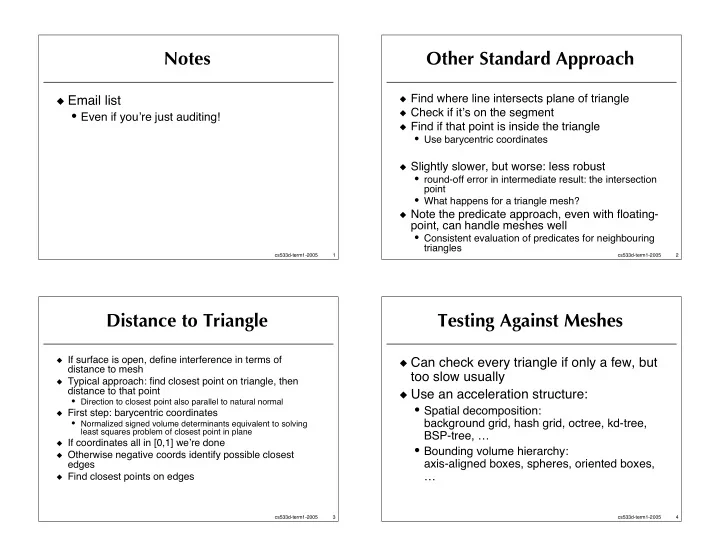
Other Standard Approach

Find where line intersects plane of triangle Check if its on the segment Find if that point is inside the triangle

  • Use barycentric coordinates

Slightly slower, but worse: less robust

  • round-off error in intermediate result: the intersection

point

  • What happens for a triangle mesh?

Note the predicate approach, even with floating-

point, can handle meshes well

  • Consistent evaluation of predicates for neighbouring

triangles

3 cs533d-term1-2005

Distance to Triangle

If surface is open, define interference in terms of

distance to mesh

Typical approach: find closest point on triangle, then

distance to that point

  • Direction to closest point also parallel to natural normal

First step: barycentric coordinates

  • Normalized signed volume determinants equivalent to solving

least squares problem of closest point in plane

If coordinates all in [0,1] were done Otherwise negative coords identify possible closest

edges

Find closest points on edges

4 cs533d-term1-2005

Testing Against Meshes

Can check every triangle if only a few, but

too slow usually

Use an acceleration structure:

  • Spatial decomposition:

background grid, hash grid, octree, kd-tree, BSP-tree, …

  • Bounding volume hierarchy:

axis-aligned boxes, spheres, oriented boxes, …

slide-2
SLIDE 2

5 cs533d-term1-2005

Moving Triangles

Collision detection: find a time at which particle

lies inside triangle

Need a model for what triangle looks like at

intermediate times

  • Simplest: vertices move with constant velocity,

triangle always just connects them up

Solve for intermediate time when four points are

coplanar (determinant is zero)

  • Gives a cubic equation to solve

Then check barycentric coordinates at that time

  • See e.g. X. Provot, “Collision and self-collision

handling in cloth model dedicated to design garment", Graphics Interface97

6 cs533d-term1-2005

For Later…

We now can do all the basic particle vs.

  • bject tests for repulsions and collisions

Once we get into simulating solid objects,

well need to do object vs. object instead

  • f just particle vs. object

Core ideas remain the same

7 cs533d-term1-2005

Elasticity

8 cs533d-term1-2005

Elastic objects

Simplest model: masses and springs Split up object into regions Integrate density in each region to get mass (if

things are uniform enough, perhaps equal mass)

Connect up neighbouring regions with springs

  • Careful: need chordal graph

Now its just a particle system

  • When you move a node, neighbours pulled along with

it, etc.

slide-3
SLIDE 3

9 cs533d-term1-2005

Masses and springs

But: how strong should the springs be? Is

this good in general?

  • [anisotropic examples]

General rule: we dont want to see the

mesh in the output

  • Avoid “grid artifacts”
  • We of course will have numerical error, but

lets avoid obvious patterns in the error

10 cs533d-term1-2005

1D masses and springs

Look at a homogeneous elastic rod, length 1,

linear density

Parameterize by p (x(p)=p in rest state) Split up into intervals/springs

  • 0 = p0 < p1 < … < pn = 1
  • Mass mi=(pi+1-pi-1)/2 (+ special cases for ends)
  • Spring i+1/2 has rest length

and force fi+ 12 = ki+ 12

xi+1 xi Li+ 12 Li+ 12

Li+ 12 = pi+1 pi

11 cs533d-term1-2005

Figuring out spring constants

So net force on i is We want mesh-independent response (roughly),

e.g. for static equilibrium

  • Rod stretched the same everywhere: xi=pi
  • Then net force on each node should be zero

(add in constraint force at ends…) Fi = ki+ 12 xi+1 xi Li+ 12 Li+ 12 ki 12 xi xi1 Li 12 Li 12 = ki+ 12 xi+1 xi pi+1 pi 1

  • ki 12

xi xi1 pi pi1 1

  • 12

cs533d-term1-2005

Young’s modulus

So each spring should have the same k

  • Note we divided by the rest length
  • Some people dont, so they have to make their

constant scale with rest length

The constant k is a material property (doesnt

depend on our discretization) called the Youngs modulus

  • Often written as E

The one-dimensional Youngs modulus is simply

force per percentage deformation

slide-4
SLIDE 4

13 cs533d-term1-2005

The continuum limit

Imagine p (or x) going to zero

  • Eventually can represent any kind of

deformation

  • [note force and mass go to zero too]
  • If density and Youngs modulus constant,

˙ ˙ x (p) = 1

  • p E(p)

a x(p) 1

  • 2x

t 2 = E

  • 2x

p2

14 cs533d-term1-2005

Sound waves

Try solution x(p,t)=x0(p-ct) And x(p,t)=x0(p+ct) So speed of “sound” in rod is Courant-Friedrichs-Levy (CFL) condition:

  • Numerical methods only will work if information

transmitted numerically at least as fast as in reality (here: the speed of sound)

  • Usually the same as stability limit for good explicit

methods [what are the eigenvalues here]

  • Implicit methods transmit information infinitely fast

E

  • 15

cs533d-term1-2005

Why?

Are sound waves important?

  • Visually? Usually not

However, since speed of sound is a material property, it

can help us get to higher dimensions

Speed of sound in terms of one spring is So in higher dimensions, just pick k so that c is constant

  • m is mass around spring [triangles, tets]
  • Optional reading: van Gelder

c = kL m