Notes Monotonicity Test equation with real, negative Assignment 1 - - PDF document

notes monotonicity
SMART_READER_LITE
LIVE PREVIEW

Notes Monotonicity Test equation with real, negative Assignment 1 - - PDF document

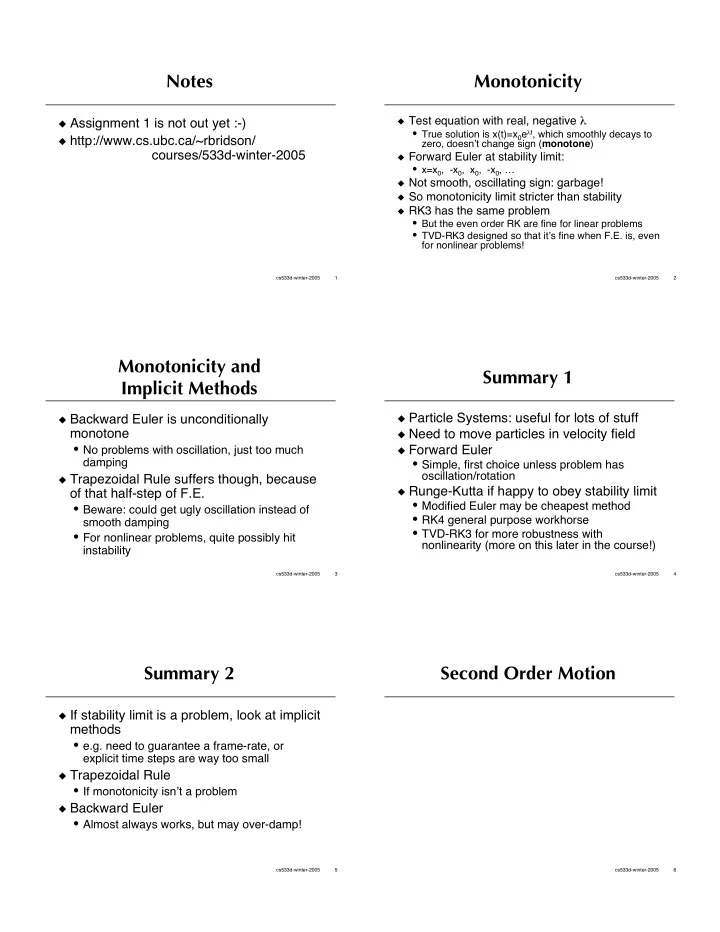
Notes Monotonicity Test equation with real, negative Assignment 1 is not out yet :-) True solution is x(t)=x 0 e t , which smoothly decays to http://www.cs.ubc.ca/~rbridson/ zero, doesnt change sign ( monotone )


slide-1
SLIDE 1

1 cs533d-winter-2005

Notes

Assignment 1 is not out yet :-) http://www.cs.ubc.ca/~rbridson/

courses/533d-winter-2005

2 cs533d-winter-2005

Monotonicity

Test equation with real, negative

  • True solution is x(t)=x0et, which smoothly decays to

zero, doesn’t change sign (monotone)

Forward Euler at stability limit:

  • x=x0, -x0, x0, -x0, …

Not smooth, oscillating sign: garbage! So monotonicity limit stricter than stability RK3 has the same problem

  • But the even order RK are fine for linear problems
  • TVD-RK3 designed so that it’s fine when F.E. is, even

for nonlinear problems!

3 cs533d-winter-2005

Monotonicity and Implicit Methods

Backward Euler is unconditionally

monotone

  • No problems with oscillation, just too much

damping

Trapezoidal Rule suffers though, because

  • f that half-step of F.E.
  • Beware: could get ugly oscillation instead of

smooth damping

  • For nonlinear problems, quite possibly hit

instability

4 cs533d-winter-2005

Summary 1

Particle Systems: useful for lots of stuff Need to move particles in velocity field Forward Euler

  • Simple, first choice unless problem has
  • scillation/rotation

Runge-Kutta if happy to obey stability limit

  • Modified Euler may be cheapest method
  • RK4 general purpose workhorse
  • TVD-RK3 for more robustness with

nonlinearity (more on this later in the course!)

5 cs533d-winter-2005

Summary 2

If stability limit is a problem, look at implicit

methods

  • e.g. need to guarantee a frame-rate, or

explicit time steps are way too small

Trapezoidal Rule

  • If monotonicity isn’t a problem

Backward Euler

  • Almost always works, but may over-damp!

6 cs533d-winter-2005

Second Order Motion

slide-2
SLIDE 2

7 cs533d-winter-2005

Second Order Motion

If particle state is just position (and colour, size, …) then

1st order motion

  • No inertia
  • Good for very light particles that stay suspended : smoke, dust…
  • Good for some special cases (hacks)

But most often, want inertia

  • State includes velocity, specify acceleration
  • Can then do parabolic arcs due to gravity, etc.

This puts us in the realm of standard Newtonian physics

  • F=ma

Alternatively put:

  • dx/dt=v
  • dv/dt=F(x,v,t)/m (i.e. a(x,v,t) )

For systems (with many masses) say dv/dt=M-1F(x,v,t)

where M is the “mass matrix” - masses on the diagonal

8 cs533d-winter-2005

What’s New?

If x=(x,v) this is just a special form of 1st

  • rder: dx/dt=v(x,t)

But since we know the special structure,

can we take advantage of it? (i.e. better time integration algorithms)

  • More stability for less cost?
  • Handle position and velocity differently to

better control error?

9 cs533d-winter-2005

Linear Analysis

Approximate acceleration: Split up analysis into different cases Begin with first term dominating:

constant acceleration

  • e.g. gravity is most important

a x,v

( ) a0 + a

x x + a v v

10 cs533d-winter-2005

Constant Acceleration

Solution is No problem to get v(t) right:

just need 1st order accuracy

But x(t) demands 2nd order accuracy So we can look at mixed methods:

  • 1st order in v
  • 2nd order in x

v(t) = v0 + a0t x(t) = x0 + v0t + 1

2 a0t 2

11 cs533d-winter-2005

Dependence on x and v dominates:

a(x,v)=-Kx-Dv

Do the analysis as before: Eigenvalues of this matrix?

d dt x v

  • =

I K D

  • x

v

  • Linear Acceleration

12 cs533d-winter-2005

More Approximations…

Typically K and D are symmetric semi-definite

(there are good reasons)

  • What does this mean about their eigenvalues?

Often, D is a linear combination of K and I

(“Rayleigh damping”), or at least close to it

  • Then K and D have the same eigenvectors

(but different eigenvalues)

  • Then the eigenvectors of the Jacobian are of the form

(u, u)T

  • [work out what is in terms of K and D]
slide-3
SLIDE 3

13 cs533d-winter-2005

Simplification

is the eigenvalue of the Jacobian, and Same as eigenvalues of Can replace K and D (matrices) with

corresponding eigenvalues (scalars)

  • Just have to analyze 2x2 system

= 1

2 D ± 1 2 D

( )

2 K

1 K D

  • 14

cs533d-winter-2005

Split Into More Cases

Still messy! Simplify further If D dominates (e.g. air drag, damping)

  • Exponential decay and constant

If K dominates (e.g. spring force)

D, 0

{ }

±i K

15 cs533d-winter-2005

Three Test Equations

Constant acceleration (e.g. gravity)

  • a(x,v,t)=g
  • Want exact (2nd order accurate) position

Position dependence (e.g. spring force)

  • a(x,v,t)=-Kx
  • Want stability but low damping
  • Look at imaginary axis

Velocity dependence (e.g. damping)

  • a(x,v,t)=-Dv
  • Want stability, smooth decay
  • Look at negative real axis

16 cs533d-winter-2005

Explicit methods from before

Forward Euler

  • Constant acceleration: bad (1st order)
  • Position dependence: very bad (unstable)
  • Velocity dependence: ok (conditionally

monotone/stable)

RK3 and RK4

  • Constant acceleration: great (high order)
  • Position dependence: ok (conditionally stable, but

damps out oscillation)

  • Velocity dependence: ok (conditionally

monotone/stable)

17 cs533d-winter-2005

Implicit methods from before

Backward Euler

  • Constant acceleration: bad (1st order)
  • Position dependence: ok (stable, but damps)
  • Velocity dependence: great (monotone)

Trapezoidal Rule

  • Constant acceleration: great (2nd order)
  • Position dependence: great (stable, no

damping)

  • Velocity dependence: good (stable but only

conditionally monotone)

18 cs533d-winter-2005

Setting Up Implicit Solves

Let’s take a look at actually using Backwards

Euler, for example

Eliminate position, solve for velocity: Linearize at guess vk, solving for vn+1 vk+v Collect terms, multiply by M

xn+1 = xn + t vn+1 vn+1 = vn + t M 1F xn+1,vn+1

( )

vn+1 = vn + t M 1F xn + t vn+1,vn+1

( )

vk + v = vn + t M 1 F xn + tvk,vk

( )+ t F

x v+ F v v

  • M t F

v t 2 F x

  • v = M vn vk

( )+ t F xn + tvk,vk ( )

slide-4
SLIDE 4

19 cs533d-winter-2005

Symmetry

Why multiply by M? Physics often demands that and

are symmetric

  • And M is symmetric, so this means matrix is

symmetric, hence easier to solve

  • (Actually, physics generally says matrix is SPD - even

better)

  • If the masses are not equal, the acceleration form of

the equations results in an unsymmetric matrix - bad.

Unfortunately the matrix is usually

unsymmetric

  • Makes solving with it considerably less efficient
  • See Baraff & Witkin, “Large steps in cloth simulation”,

SIGGRAPH ‘98 for one solution: throw out bad part Fposition x F

velocity

v F

velocity

x

20 cs533d-winter-2005

Specialized 2nd Order Methods

This is again a big subject Again look at explicit methods, implicit

methods

Also can treat position and velocity

dependence differently: mixed implicit-explicit methods

21 cs533d-winter-2005

Symplectic Euler

Like Forward Euler, but updated velocity used

for position

Some people flip the steps (= relabel vn) (Symplectic means certain qualities are

preserved in discretization; useful in science, not necessarily in graphics)

[work out test cases]

vn+1 = vn + ta xn,vn

( )

xn+1 = xn + tvn+1

22 cs533d-winter-2005

Constant acceleration: bad

  • Velocity right, position off by O(t)

Position dependence: good

  • Stability limit
  • No damping!

Velocity dependence: ok

  • Monotone limit
  • Stability limit

t < 2 K

t <1 D t < 2 D

Symplectic Euler performance

23 cs533d-winter-2005

Tweaking Symplectic Euler

[sketch algorithms] Stagger the velocity to improve x Start off with Then proceed with Finish off with

v 12 = v0 + 1

2 ta x0,v0

( )

vn+ 12 = vn 12 + 1

2 (tn+1 tn1)a xn,vn 12

( )

xn+1 = xn + tvn+ 12 vN = vN 12 + 1

2 ta xN,vN 12

( )

24 cs533d-winter-2005

Staggered Symplectic Euler

Constant acceleration: great!

  • Position is exact now

Other cases not effected

  • Was that magic? Main part of algorithm unchanged

(apart from relabeling) yet now it’s more accurate!

Only downside to staggering

  • At intermediate times, position and velocity not known

together

  • May need to think a bit more about collisions and
  • ther interactions with outside algorithms…
slide-5
SLIDE 5

25 cs533d-winter-2005

A common explicit method

May see this one pop up: Constant acceleration: great Velocity dependence: ok

  • Conditionally stable/monotone

Position dependence: BAD

  • Unconditionally unstable!

vn+1 = vn + ta xn,vn

( )

xn+1 = xn + t

1 2 vn + 1 2 vn+1

( ) = xn + tvn + 1

2 t 2an

26 cs533d-winter-2005

An Implicit Compromise

Backward Euler is nice due to

unconditional monotonicity

  • Although only 1st order accurate, it has the

right characteristics for damping

Trapezoidal Rule is great for everything

except damping with large time steps

  • 2nd order accurate, doesn’t damp pure
  • scillation/rotation

How can we combine the two?

27 cs533d-winter-2005

Implicit Compromise

Use Backward Euler for velocity dependence,

Trapezoidal Rule for the rest:

Constant acceleration: great (2nd order) Position dependence: great (2nd order, no

damping)

Velocity dependence: great (unconditionally

monotone)

xn+1 = xn + t

1 2 vn + 1 2 vn+1

( )

vn+1 = vn + ta 1

2 xn + 1 2 xn+1,vn+1,tn+ 12

( )