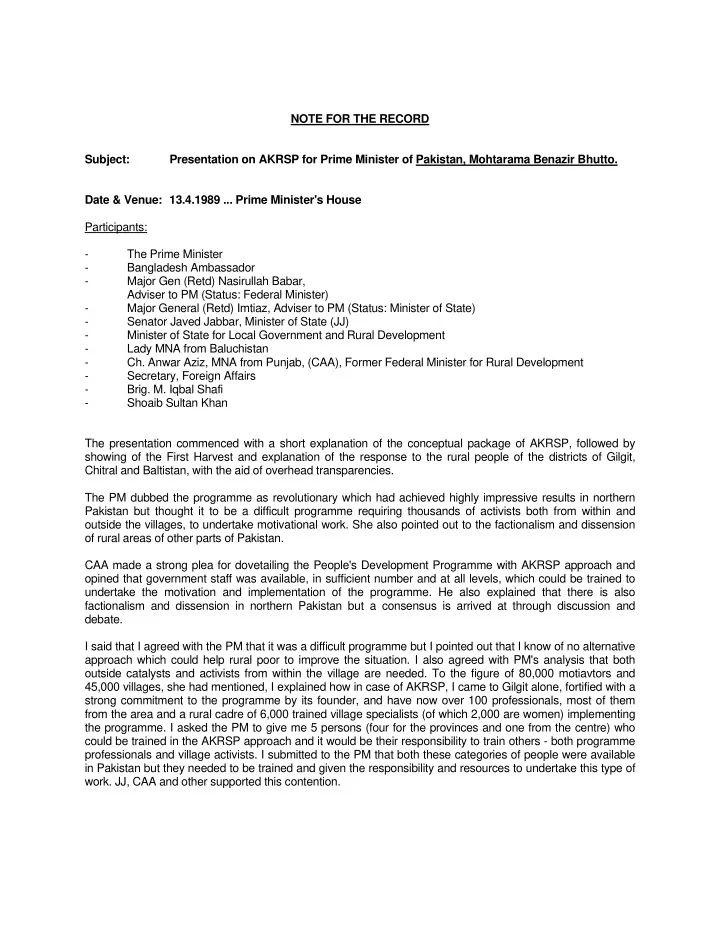
SLIDE 1 NOTE FOR THE RECORD Subject: Presentation on AKRSP for Prime Minister of Pakistan, Mohtarama Benazir Bhutto. Date & Venue: 13.4.1989 ... Prime Minister's House Participants:
- The Prime Minister
- Bangladesh Ambassador
- Major Gen (Retd) Nasirullah Babar,
Adviser to PM (Status: Federal Minister)
- Major General (Retd) Imtiaz, Adviser to PM (Status: Minister of State)
- Senator Javed Jabbar, Minister of State (JJ)
- Minister of State for Local Government and Rural Development
- Lady MNA from Baluchistan
- Ch. Anwar Aziz, MNA from Punjab, (CAA), Former Federal Minister for Rural Development
- Secretary, Foreign Affairs
- Brig. M. Iqbal Shafi
- Shoaib Sultan Khan
The presentation commenced with a short explanation of the conceptual package of AKRSP, followed by showing of the First Harvest and explanation of the response to the rural people of the districts of Gilgit, Chitral and Baltistan, with the aid of overhead transparencies. The PM dubbed the programme as revolutionary which had achieved highly impressive results in northern Pakistan but thought it to be a difficult programme requiring thousands of activists both from within and
- utside the villages, to undertake motivational work. She also pointed out to the factionalism and dissension
- f rural areas of other parts of Pakistan.
CAA made a strong plea for dovetailing the People's Development Programme with AKRSP approach and
- pined that government staff was available, in sufficient number and at all levels, which could be trained to
undertake the motivation and implementation of the programme. He also explained that there is also factionalism and dissension in northern Pakistan but a consensus is arrived at through discussion and debate. I said that I agreed with the PM that it was a difficult programme but I pointed out that I know of no alternative approach which could help rural poor to improve the situation. I also agreed with PM's analysis that both
- utside catalysts and activists from within the village are needed. To the figure of 80,000 motiavtors and
45,000 villages, she had mentioned, I explained how in case of AKRSP, I came to Gilgit alone, fortified with a strong commitment to the programme by its founder, and have now over 100 professionals, most of them from the area and a rural cadre of 6,000 trained village specialists (of which 2,000 are women) implementing the programme. I asked the PM to give me 5 persons (four for the provinces and one from the centre) who could be trained in the AKRSP approach and it would be their responsibility to train others - both programme professionals and village activists. I submitted to the PM that both these categories of people were available in Pakistan but they needed to be trained and given the responsibility and resources to undertake this type of
- work. JJ, CAA and other supported this contention.
SLIDE 2
The PM disagreed with CAA that such a large body of people could be trained overnight to dovetail the current People's Development Programme (PDP) into this approach.l When CAA showed her the manual (HWK's compilation), she wanted to see an English version. I gave her my article on the dynamics of rural development but she desired to have a step by step manual spelling out what the outside catalysts will have to say to organize people. She turned to JJ and enquired if video and radio could be pressed into service to impart training and desired showing of videos like First Harvest on the TV. JJ supported the suggestion, although the TV coverage was only restricted to 25% of the population. (I gave a copy of the video First Harvest to JJ after the presentation). On CAA's insistence that staff could be trained in the next 2/3 months to undertake the programme, the PM remained unconvinced. She suggested training of newly appointed district administrators of PDP and showing of the video to them. She turned to me and offered 60 activists from her constituency in Larkana for training. I emphasized the need for investment in organization and explained the importance of a support mechanism to foster grassroots organizations and how a social organization unit is able to mobilize the support of 300- 500 village specialists remunerated by the village organizations. She appreciated the role of village specialists especially the work being done by livestock specialists seen by her in the video. She still failed to grasp the concept of self help and enquired as to why villagers should not be able to give free labour. I explained that some of the projects required thousand of man-days and it is not possible to destitute villagers to work free for days. In our concept of self help, although we give wages at a negotiated rate, which is normally 20-25% less than the market rate, but in return we demand organization and collective management, savings and maintenance of the work completed. CAA reinforced my argument and emphasized the importance of the first grant to help organization. He quoted the problem of maintenance of projects to be completed under PDP which Punjab Government is refusing to take over for maintenance. In this context, I pointed out to PM the importance of productive sector projects as entry point for organization compared to drinking water, health, literacy and education schemes and how the maintenance of productive projects is taken over by village organizations because of the divisible nature of benefits unlike the social sector schemes. The difference between mere literacy and upgrading of human skills was also mentioned and why AKRSP is addressing itself to the latter. JJ enquired about the interface of this approach with union councils. I explained that the local council structure is essential for political education, inter-village planning, coordination with development departments and taxation, if any government wishes to levy taxes, but local council is not a unit for undertaking economic development of a village and for that matter, with due reference, neither the MNAs or MPAs are. For economic development at grassroots level, a framework of broad based organizations is needed. I mentioned that even in India, where Panchayati Raj system is highly developed, it has failed to accomplish economic development at the village level. I mentioned that there could be an interface of this approach with the departments, if the government structure is reorganized and a social organization type unit is created or an the alternative the path taken by NWFP of setting up a Sarhad Rural Support Corporation may be adopted. JJ preferred the later and suggested to the PM to set up a Sind Rural Support Programme (he did not like the word Corporation because of the dismal record of SAZDA). The PM quipped why not call it Sind Peoples Support Programme. I suggested to JJ to find one person from Sind, who we could train in Gilgit, to initiate the programme. Before taking leave, I said to the PM that I have a stake in her success because my daughter (Roohi) was her class-fellow way back in 1962. She brightened up and thanked for the presentation. CAA felt a little crestfallen and looked accusingly at me, as if I had withheld my support but I tried to explain to him that without full commitment and proper planning, there was little chance of success of a hard programme.
SLIDE 3 Major General Babar greeted me very warmly and appeared visibly pleased that NWFP had stolen a march
- ver other provinces, in adopting AKRSP. I requested him to encourage Chief Minister NWFP to expedite
SRSC. The lady MNA from Balochistan appeared very keen to do something like AKRSP in Balochistan and took my card to make contact later. The Pakistan Times Saturday, April 15, 1989 A Strategy for Rural Development THE AGA KHAN Rural Support Programme in Gilgit has already produced impressive results. The allowing description of its performance is based on a recent interview with Mr. Shoaib Sultan Khan, General Manager
The AKRSP was designed to overcome rural poverty. The task is improving the quality of life of nearly 70 millions Pakistanis living in 45,000 villages was viewed a challenge. The key factors contributing to poverty were identified as despondency and despair amongst small holders but the future of agriculture as a means of maintenance. Bankruptcy of culture was heightened by segmentation of holdings. Before adopting a workable strategy of development, the models tried elsewhere in the world were examined. The North American model derives small farmers out of the agriculture sector but provides alternative means
- f livelihood and creates large land holdings. In America today, only 2.7% of the population is engaged in
- agriculture. This model is not relevant to Pakistan where a large population is engaged in agriculture and
average holding per family is less than two hectares. The majority of persons who leave agriculture end up in the slums of Karachi or other cities while a tiny minority is absorbed in the service or the business sector. The socialist model does not permit private ownership; and is, therefore not in consonance with private
- policy. Its effectiveness is a way of life and as a means for achieving higher productivity in agriculture, is a
moot point. Its two major variants, the Soviet and the Chinese Models, have different plans to tell both as a way of life and in terms of agricultural productivity. The Raiffesson Model, which had its origin in the 19th Century Europe, admits of private ownership and makes small farmers highly productive and helps them to rise above the level of subsistence. This model was found to have the greatest relevance to Pakistan., Accordingly the method adopted was to offer development partnership; to villagers, making government assistance and collaboration dependent on villagers fulfilling their obligations of (i) organization and collective management, (ii)( generation of their own capital through savings and (iii) upgrading of human skills by participation in human resource development programmes. On acceptance of these terms of partnership, a process of diagnostic survey comprising a series of dialogues with village organisations, is initiated to identify the villagers' needs and aspirations. This results in the evolution of a developmental package e.g. the case of Aga Khan Rural Support Programme (AKRSP). This package consists of organization and collective management, land development, increased productivity, credit and banking, marketing, reduction in workload of women, coordination for provision of social sector services. The villagers' response to the AKRSP has confirmed the soundness of the approach. In terms of
- rganization, 90% of rural households got organized in Gilgit in five years. The village organisations
accumulated nearly Rs. 51 million as their savings in the programme area.
SLIDE 4 SUMMARY FOR THE PRIME MINISTER Subject: THE DYNAMICS OF RURAL DEVELOPMENT 1. The paper under consideration, "The Dynamics of Rural Development", suggests a strategy improving the quality of life of nearly 70 million people living in more than 45,000 villages in Pakistan. The majority of this population comprise small holders, subsistence farmers, tenants and landless
- labourers. There is despondency and despair amongst small holders because of bankruptcy of
agriculture as a means of subsistence. 2. The paper under consideration examines strategy options to tackle the situation of the small farmers and rejects both the North American and Socialist Models of agricultural and rural development because the former drives out small farmers from the agricultural sector and forces them to find alternative means of livelihood, whereas the latter does not admit of private ownership, which is not in consonance with state policy in Pakistan. The paper commends the Raiffeissen Model, which has its origin in 19th century Europe, admits of private ownership and makes small farmers highly productive, as evident from examples of Europe, Japan, Taiwan, South Korea etc. 3. The methodology of Raiffeissen Model depends on a development partnership making government assistance and collaboration, dependent on villagers first fulfilling their obligations, namely (i)
- rganization and collective management, (ii) generation of their own capital through savings and (iii)
upgrading of human skills by participation in human resource development programmes. 4. On acceptance of these terms of partnership, the process of diagnostic survey, comprising a series
- f a dialogues with village organizations (VOs), is initiated to identify the villagers' needs and
- aspirations. Thus the participatory approach being advocated, in which villagers establish their own
institutions, identify their priorities, organise their resources, manage their development agenda and forge the necessary links for on-going technical and financial assistance by outside agencies, is different from the managerial approach, in which programmes are designed and managed by technical experts, often according to pre-determined blue prints, or the representative approach often mistaken for community participation - in this approach elected or nominated representatives determine the development agenda, interact with the development agencies and otherwise represent their community or areas of interest, as best as they can. 5. The participatory approach, based on Raiffeissen Model, has been under implementation in 3 districts of Northern Pakistan, over the last six years in Gilgit district and 3 years in the districts of Baltistan and Chitral. The response of the villagers to forging a development partnership, has been very encouraging as evident from the statistical profile of the Aga Khan Rural Support Programme (AKRSP). In terms of organization, 90% of rural households got organized in Gilgit district in less than five years. The VOs of the entire programme area have accumulated Rs.55.92 million as their savings, end March 1989. 6. The programme was evaluated by the World Bank for mid-term assessment and was considered highly successful. The Bank dealt with the question of replicability of this development approach in
- ther parts of Pakistan or in other countries and came to the conclusion that any attempt to
reproduce the AKRSP experience, would need to take into account a number of a management factors, relating to programme planning. According to the Bank, in this respect, AKRSP might not
- nly provide a model of replication of rural development programmes, but may have an important
future role as a training ground for the management and staff of other projects. 7. In conclusion the paper under consideration, recommends that the conceptual package of AKRSP is replicable in other parts of Pakistan but the programme package will have to be determined by the villagers of the area concerned, through the process approach, based on diagnostic surveys. As the fostering of an institutional framework, comprising VOs, is a sine quo non for rural development and
SLIDE 5 for improvement of the situation of the rural poor, it is important to set up a support mechanism for fostering VOs. The pattern of this support mechanism is available in the district programme offices and field structure developed by AKRSP. As reorganization of the existing government structure is time consuming and a difficult task, the alternative is to set up a non-profit organization on lines of AKRSP, as permissible under the existing laws of Pakistan, for the different areas, where the programme of this nature is envisaged, to be extended. An example of this type of initiative, is available in the setting up of the proposed Sarhad Rural Support Corporation (SRSC) by the Government of NWFP. Any province wishing to implement a rural development programme, on the lines of AKRSP, may like to follow the lead given by NWFP or if the Prime Minister desires, a directive may be issued to the provinces to consider setting up of SRSC type organizations in other provinces. Subject: Presentation to PM on AKRSP As a sequel to the presentation on AKRSP to the Prime Minister of Pakistan on April 13 last, the Additional Secretary to the PM's Secretariat (Mr. Salman Farooqui) had a meeting with SSK on April 23 at 1030 hours at the PM's Secretariat at Rawalpindi. Mr. Farooqui had earlier requested on phone for a three page summary of the "Dynamics of Rural Development" paper given by SSK to the PM. A copy of the summary given to Mr. Farooqui is attached. At the meeting Mr. Farooqui stated that the PM desires to have AKRSP: type programme started in the Province of Sind especially villages which had been adversely affected during the events of the past few
- years. She wanted a detailed plan for such an initiative.
SSK explained the structure of the district support organization needed to foster village organizations and the training required by such personnel to initiate the programme and the support AKRSP can provide in training the staff, on the pattern of the staff of the proposed SRSC, provided a request is made by the government for such assistance.
- Mr. Farooqui felt that it might be desirable for the PM to address
His Highness on the subject for getting his approval to the involvement of AKRSP in the Sind initiative. He also undertook to send a directive to Government of NWFP to expedite setting up of SRSC.