Norma I. Cruz, MD Division of Plastic Surgery University of Puerto - - PowerPoint PPT Presentation

norma i cruz md
SMART_READER_LITE
LIVE PREVIEW

Norma I. Cruz, MD Division of Plastic Surgery University of Puerto - - PowerPoint PPT Presentation

Norma I. Cruz, MD Division of Plastic Surgery University of Puerto Rico Nothing to Disclose Is the high frequency of breast asymmetry restricted to augmentation patients? Clinical Study Breast measurements of 244 consecutive women, who had


slide-1
SLIDE 1

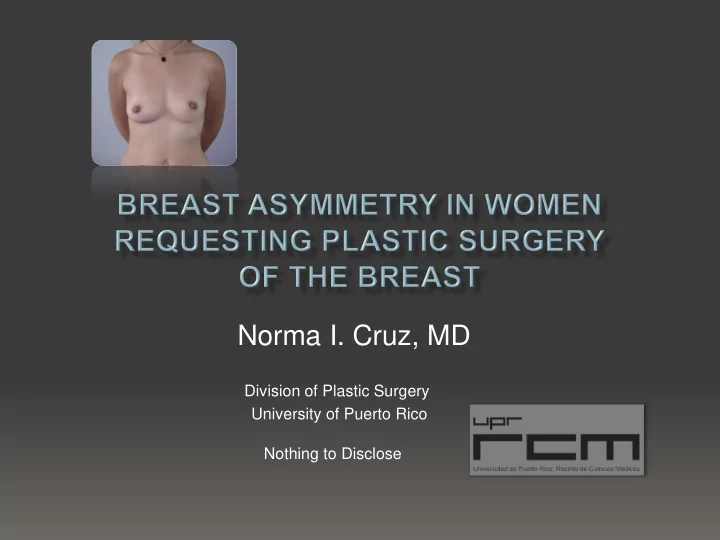
Norma I. Cruz, MD

Division of Plastic Surgery University of Puerto Rico Nothing to Disclose
slide-2
SLIDE 2

Is the high frequency of breast asymmetry restricted to augmentation patients?

slide-3
SLIDE 3

Breast measurements of 244 consecutive women, who had no prior breast surgery, were prospectively recorded in a database. Comparisons were made between the right and left breast regarding symmetry of the nipple areola complex, breast mound and chest wall.

Clinical Study

22.5 cm 20.0 cm

slide-4
SLIDE 4

The patients were classified into three groups according to the presenting breast problem.

Hypoplastic Breasts

(Augmentation)

Macromastia

(Breast Reduction)

Ptotic Breasts

(Mastopexy & Implants)

slide-5
SLIDE 5

Nipple-areola complex

  • Position
  • Size

22.5 cm 20.0 cm

slide-6
SLIDE 6

Breast Mound

  • Volume
  • Base
  • Inframammary

fold (IMF)

14.5 cm 16.0 cm

slide-7
SLIDE 7

Chest wall

  • Pectus

excavatum/ carinatum

  • Rib flaring
slide-8
SLIDE 8

Mean Age ±SD Hypoplastic breasts 31±10 Macromastia 33±13 Ptotic breasts 37±11 The mean age of the group as a whole was 34±11 years.

slide-9
SLIDE 9

Asymmetries Hypoplastic (n=106) Macromastia (n=80) Ptotic (n=58) P Nipple-areola 54% 59% 51% >0.05 Breast Mound 45% 46% 43% >0.05 Chest wall 12% 11% 10% >0.05

Overall 91% of the women had at least one type of preoperative breast asymmetry.

slide-10
SLIDE 10

Breast asymmetries occur in the majority of women and these findings are similar among the different groups. Since they are often unaware of the problem, they should be informed of the presence of the asymmetry and how this may affect the surgical outcome