Non-regular Languages 1.4 Which languages cannot be recognized by - - PDF document

non regular languages 1 4
SMART_READER_LITE
LIVE PREVIEW

Non-regular Languages 1.4 Which languages cannot be recognized by - - PDF document

CSE 2001: Introduction to Theory of Computation Summer 2013 Week 5: The Pumping Lemma and Non- Regular Languages Yves Lesperance Course page: http://www.cse.yorku.ca/course/2001 Slides are mostly taken from Suprakash Dattas for Winter 2013


slide-1
SLIDE 1

1

13-06-04 CSE 2001, Summer 2013 1

CSE 2001: Introduction to Theory of Computation

Summer 2013

Week 5: The Pumping Lemma and Non- Regular Languages

Yves Lesperance Course page: http://www.cse.yorku.ca/course/2001

Slides are mostly taken from Suprakash Datta’s for Winter 2013

13-06-04 CSE 2001, Summer 2013 2

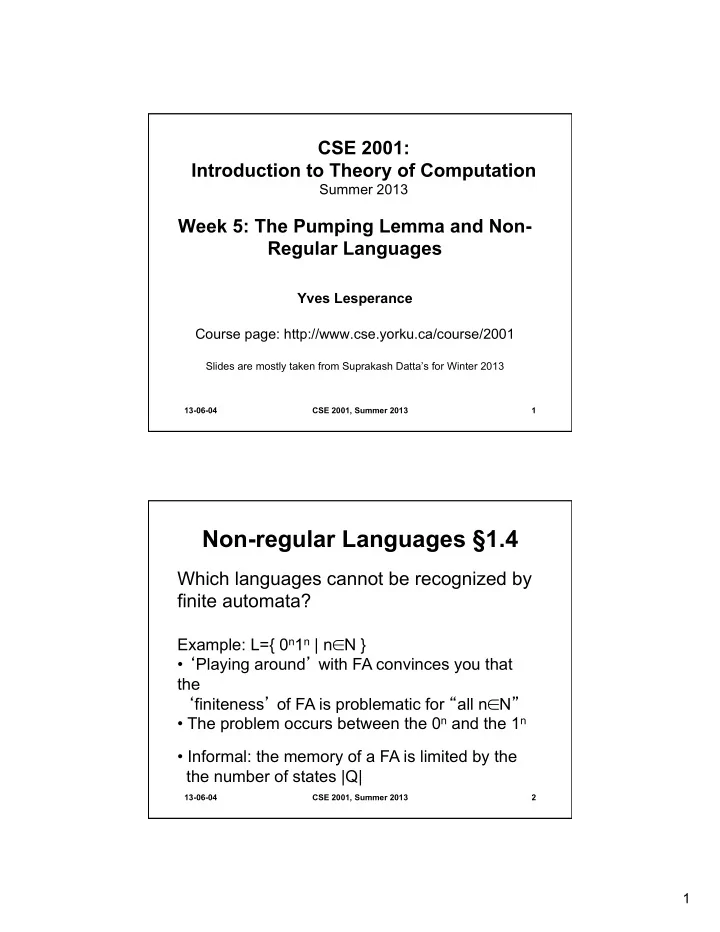
Non-regular Languages §1.4

Which languages cannot be recognized by finite automata?

Example: L={ 0n1n | n∈N }

  • ‘Playing around’ with FA convinces you that

the ‘finiteness’ of FA is problematic for “all n∈N”

  • The problem occurs between the 0n and the 1n
  • Informal: the memory of a FA is limited by the

the number of states |Q|

slide-2
SLIDE 2

2

13-06-04 CSE 2001, Summer 2013 3

Proving non-regularity

  • Prove a general statement -- NO DFA

exists for a given problem.

  • Cannot assume an automaton structure
  • r a specific strategy
  • Need an argument that holds for ALL

DFA’s

13-06-04 CSE 2001, Summer 2013 4

Repeating DFA Paths

q1 qk qj Consider an accepting DFA M with size |Q| On a string of length p, p+1 states get visited For p≥|Q|, there must be a j such that the computational path looks like: q1,…,qj,…,qj,…,qk

slide-3
SLIDE 3

3

13-06-04 CSE 2001, Summer 2013 5

Repeating DFA Paths

q1 qk qj The action of the DFA in qj is always the same. If we repeat (or ignore) the qj,…,qj part, the new path will again be an accepting path

13-06-04 CSE 2001, Summer 2013 6

Proving Non-Regularity: Line

  • f Reasoning

Proof by contradiction:

  • Assume that L is regular
  • Hence, there is a DFA M that recognizes L
  • For strings of length ≥ |Q| the DFA M has

to ‘repeat itself’

  • Show that M will accept strings outside L
  • Conclude that the assumption was wrong

Note that we use the simple DFA, not the more elaborate (but equivalent) NFA or GNFA

slide-4
SLIDE 4

4

13-06-04 CSE 2001, Summer 2013 7

Pumping Lemma (Thm 1.37)

For every regular language L, there is a pumping length p, such that for any string s∈L and |s|≥p, we can write s=xyz with 1) x yi z ∈ L for every i∈{0,1,2,…} 2) |y| ≥ 1 3) |xy| ≤ p Note that 1) implies that xz ∈ L 2) says that y cannot be the empty string ε Condition 3) is not always used

13-06-04 CSE 2001, Summer 2013 8

Formal Proof of Pumping Lemma

Let M = (Q,Σ,δ,q1,F) with Q = {q1,…,qp} Let s = s1…sn∈L(M) with |s| = n ≥ p Computational path of M on s is the sequence r1,…,rn+1 ∈ Qn+1 with r1 = q1, rn+1∈F and rt+1= δ(rt,st) for 1≤t≤n Because n+1 ≥ p+1, there are two states such that rj = rk (with j<k and k ≤ p+1) Let x = s1…sj–1, y = sj…sk–1, and z = sk…sn+1 x takes M from q1=r1 to rj, y takes M from rj to rj, and z takes M from rj to rn+1∈F As a result: xyiz takes M from q1 to rn+1∈F (i ≥ 0)

slide-5
SLIDE 5

5

13-06-04 CSE 2001, Summer 2013 9

Formal Proof of Pumping Lemma

Let M = (Q,Σ,δ,q1,F) with Q = {q1,…,qp} Let s = s1…sn∈L(M) with |s| = n ≥ p Computational path of M on s is the sequence r1,…,rn+1 ∈ Qn+1 with r1 = q1, rn+1∈F and rt+1= δ(rt,st) for 1≤t≤n Because n+1 ≥ p+1, there are two terms such that rj = rk (with j<k and k ≤ p+1) Let x = s1…sj–1, y = sj…sk–1, and z = sk…sn+1 x takes M from q1=r1 to rj, y takes M from rj to rj, and z takes M from rj to rn+1∈F As a result: xyiz takes M from q1 to rn+1∈F (i ≥ 0) |y| ≥ 1 and |xy| ≤ p x yi z ∈ L(M) for every i∈{0,1,2,…}

13-06-04 CSE 2001, Summer 2013 10

Pumping 0n1n (Ex. 1.38)

Assume that B = {0n1n | n≥0} is regular Let p be the pumping length, and s = 0p1p ∈ B By P.L.: s = xyz = 0p1p, with xyiz ∈ B for all i≥0 Three options for y: 1) y=0k, hence xyyz = 0p+k1p ∉ B 2) y=1k, hence xyyz = 0p1k+p ∉ B 3) y=0k1l, hence xyyz = 0p-k0k1l0k1l1p-l ∉ B Contradiction! So the language B is not regular.

slide-6
SLIDE 6

6

13-06-04 CSE 2001, Summer 2013 11

Another example F = { ww | w∈{0,1}* } (Ex. 1.40)

Let p be the pumping length, and take s = 0p10p1 Let s = xyz = 0p10p1 with condition 3) |xy|≤p Only one option: y=0k, with xyyz = 0p+k10p1 ∉ F Without 3) this would have been a pain.

13-06-04 CSE 2001, Summer 2013 12

Another Strategy: Intersecting Regular Languages

Let C = { w | # of 0s in w equals # of 1s in w} Problem: If xyz∈C with y∈C, then xyiz∈C Idea: If C is regular and F is regular, then the intersection C∩F has to be regular as well Solution: Assume that C is regular Take the regular F = { 0n1m | n,m∈N}, then for the intersection: C∩F = { 0n1n | n∈N } But we know that C∩F is not regular Conclusion: C is not regular

slide-7
SLIDE 7

7

13-06-04 CSE 2001, Summer 2013 13

Pumping Down E = { 0i1j | i≥j }

Problem: ‘pumping up’ s=0p1p with y=0k gives xyyz = 0p+k1p, xy3z = 0p+2k1p, which are all in E (hence do not give contradictions) Solution: pump down to xz = 0p–k1p. Overall for s = xyz = 0p1p (with |xy|≤p): y=0k, hence xz = 0p–k1p ∉ E Contradiction! So E is not regular

13-06-04 CSE 2001, Summer 2013 14

Pumping lemma usage - steps

  • You are given a pumping number
  • You choose a string
  • You are told x,y,z (satisfying some

criteria)

  • You choose i in xyiz, and show it

violates criterion of set for that i.

slide-8
SLIDE 8

8

13-06-04 CSE 2001, Summer 2013 15

Alternatives for proving non-regularity

  • Simpler technique (not in the text)

– Based on the Myhill-Nerode Theorem – less general