Non Profit M&A: Benefits and Pitfalls Analyzing Tax, Accounting - - PowerPoint PPT Presentation

non profit m a benefits and pitfalls
SMART_READER_LITE
LIVE PREVIEW

Non Profit M&A: Benefits and Pitfalls Analyzing Tax, Accounting - - PowerPoint PPT Presentation

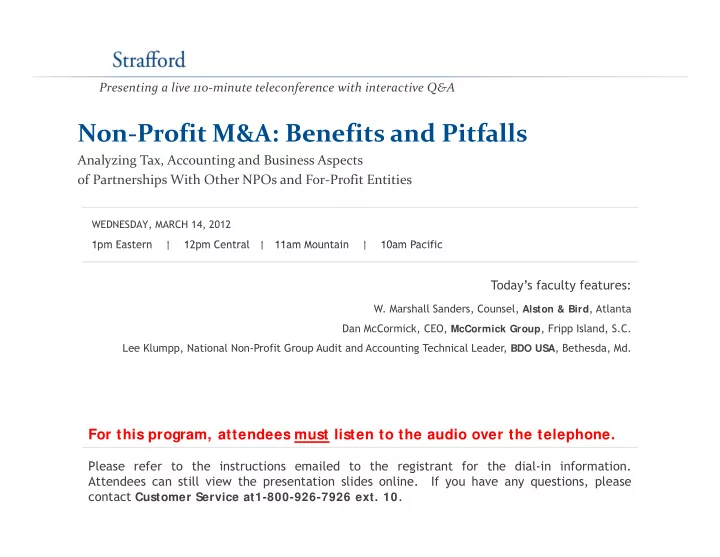
Presenting a live 110 minute teleconference with interactive Q&A Non Profit M&A: Benefits and Pitfalls Analyzing Tax, Accounting and Business Aspects of Partnerships With Other NPOs and For Profit Entities WEDNESDAY, MARCH 14,


slide-1
SLIDE 1

Presenting a live 110‐minute teleconference with interactive Q&A

Non‐Profit M&A: Benefits and Pitfalls

Analyzing Tax, Accounting and Business Aspects

  • f Partnerships With Other NPOs and For‐Profit Entities

1pm Eastern | 12pm Central | 11am Mountain | 10am Pacific WEDNESDAY, MARCH 14, 2012

Today’s faculty features:

1pm Eastern | 12pm Central | 11am Mountain | 10am Pacific

  • W. Marshall Sanders, Counsel, Alston & Bird, Atlanta

, , , Dan McCormick, CEO, McCormick Group, Fripp Island, S.C. Lee Klumpp, National Non-Profit Group Audit and Accounting Technical Leader, BDO USA, Bethesda, Md.

For this program, attendees must listen to the audio over the telephone.

Please refer to the instructions emailed to the registrant for the dial-in information. Attendees can still view the presentation slides online. If you have any questions, please contact Customer Service at1-800-926-7926 ext. 10.

slide-2
SLIDE 2

Conference Materials

If you have not printed the conference materials for this program, please complete the following steps:

  • Click on the + sign next to “Conference Materials” in the middle of the left-

hand column on your screen hand column on your screen.

  • Click on the tab labeled “Handouts” that appears, and there you will see a

PDF of the slides for today's program.

  • Double click on the PDF and a separate page will open.

Double click on the PDF and a separate page will open.

  • Print the slides by clicking on the printer icon.
slide-3
SLIDE 3

Continuing Education Credits

FOR LIVE EVENT ONLY

Attendees must listen to the audio over the telephone. Attendees can still view

the presentation slides online but there is no online audio for this program.

Attendees must stay on the line for at least 100 minutes in order to qualify for

a full 2 credits of CPE. Attendance is monitored as required by NASBA. Please refer to the instructions emailed to the registrant for additional

  • information. If you have any questions, please contact Customer Service

at 1-800-926-7926 ext. 10. at 1 800 926 7926 ext. 10.

slide-4
SLIDE 4

Tips for Optimal Quality

S d Q lit S

  • und Qualit y

For this program, you must listen via the telephone by dialing 1-866-873-1442 and entering your PIN when prompted. There will be no sound over the web connection. co ect o . If you dialed in and have any difficulties during the call, press *0 for assistance. You may also send us a chat or e-mail sound@straffordpub.com immediately so we can address the problem.

Viewing Qualit y

To maximize your screen, press the F11 key on your keyboard. To exit full screen, press the F11 key again press the F11 key again.

slide-5
SLIDE 5

N P fit M&A B fit d Pitf ll Non‐Profit M&A: Benefits and Pitfalls Seminar

March 14, 2011 Lee Klumpp, BDO USA

lklumpp@bdo.com

  • W. Marshall Sanders, Alston & Bird

marshall.sanders@astc.com

Dan McCormick, McCormick Group

danh@mcc-group.com

slide-6
SLIDE 6

Today’s Program

Related Legal Issues Slide 7 – Slide 12

[W. Marshall S anders]

Types Of Business Relationships To Consider

[Dan McCormick and Lee Klumpp]

Slide 13 – Slide 17 Reasons To Pursue Or Avoid Such A Relationship

[Lee Klumpp and Dan McCormick]

A li bl R l St d d A d G id Slide 18 – Slide 25 Slid 26 Slid 51 Applicable Rules, Standards And Guidance

[Lee Klumpp]

Potential Risks To A Non-Profit’s Tax Exemption

[Lee Klumpp]

Slide 26 – Slide 51 Slide 52 – Slide 53

[Lee Klumpp]

Leading An Organization Into Merger Consideration

[Dan McCormick]

Slide 54 – Slide 59 Commentary On Employee Benefits, HR Issues

[All speakers]

Slide 60

slide-7
SLIDE 7

RELATED LEGAL ISSUES

  • W. Marshall Sanders, Alston & Bird

RELATED LEGAL ISSUES

slide-8
SLIDE 8

Forms Of Corporate Reorganization Forms Of Corporate Reorganization

A Contractual arrangements A. Contractual arrangements B. Dissolution C. Consolidation D. Merger

8

slide-9
SLIDE 9

Merger: Basic Legal Attributes

A. Automatic assumption of liabilities by survivor B. Automatic assignment of assets to survivor C. Surviving corporation “stands in shoes” of non-surviving C. Su v v g co po a o s a ds s oes o

  • su v v g

corporation

9

slide-10
SLIDE 10

Pre Merger Steps Pre-Merger Steps

A M d f d di / h A. Memorandum of understanding/term sheet B. Due diligence

10

slide-11
SLIDE 11

Merger Plan And Articles

I. Plan Of merger A S i A. Statutory requirements B. Board of Directors approval C. Membership approval II. Articles (or certificate) of merger

11

slide-12
SLIDE 12

State And Federal Oversight Of Mergers State And Federal Oversight Of Mergers

A Attorney general A. Attorney general 1.

  • Sect. 501(c)(3) mergers

2. Non-charitable or for-profit mergers B. Internal Revenue Service 1 Final tax information return 1. Final tax information return 2. Public charity status of surviving corporation 3. Private foundations

12

slide-13
SLIDE 13

D M C i k M C i k G

TYPES OF BUSINESS

Dan McCormick, McCormick Group Lee Klumpp, BDO USA

TYPES OF BUSINESS RELATIONSHIPS TO CONSIDER

slide-14
SLIDE 14

Th C ll b i C i The Collaboration Continuum

THE COLLABORATIVE CONTINUUM THE COLLABORATIVE CONTINUUM

INITIATIVES

Service Joint Shared

POTENTIAL BENEFITS

Communicate Service Sharing Joint Ventures Shared Governance Merger

COMPLEXITY

MOU/LOA* Contracts Legal Filings INSTRUMENTS Filings

* Memo of understanding/letter of agreement

14

slide-15
SLIDE 15

Formal Collaborations Short Of Merger

I.Joint venture A. Two or more parties form an alliance to create or operate a new venture

  • together. Each entity bring specialized skills and resources to the table.

II.Shared services A. Two or more parties agree to meld specific activities or programs into a single delivery or service system (e.g., accounts receivables and payables are handled by a centralized center) payables are handled by a centralized center). III.Shared governance A. Two or more parties agree to establish an enterprise by melding resources and more importantly equally sharing governance and resources and, more importantly, equally sharing governance and strategic decisions.

“More than 100,000 nonprofit groups nationwide will fail within the next two years, including a few "big brand-name nonprofits”

  • Paul C. Light, professor of public service at New York University

15

slide-16
SLIDE 16

C ll b i C i (C ) Collaboration Continuum (Cont.)

As the opportunity for potential gain increases, so does the complexity of the relationship. A collaboration does not have to progress; it can start at any point collabo at o does ot ave to p og ess; t ca sta t at a y po t across the continuum. A contract for outsourcing, or melding specific budget line items under a single management system is a less complex option under a single management system, is a less complex option. Sharing cost, oversight, operations management and governance produces the best long-term relationships and builds trust.

16

slide-17
SLIDE 17

Alternate Forms For Merger And Acquisition

  • Merger (A>B=B) or consolidation (A+B=C)
  • Merger (A>B=B) or consolidation (A+B=C)
  • Consolidation favored; neither has advantage; but exemption

consequences

  • Acquisition of assets/dissolution
  • Acquisition of assets/dissolution
  • “Alliance,” contract, joint venture, LLC, etc.
  • Umbrella entity with subsidiaries

17

slide-18
SLIDE 18

Lee Klumpp, BDO USA

REASONS TO PURSUE OR

Lee Klumpp, BDO USA Dan McCormick, McCormick Group

AVOID SUCH A RELATIONSHIP

slide-19
SLIDE 19

Wh C id M O A i i i ? Why Consider Merger Or Acquisition?

  • Build lobbying and advocacy clout

Build lobbying and advocacy clout

  • Complementary, not competing
  • Re-positioning for new demographics
  • Increase audience/market share
  • Cutting costs, dues, fees
  • Increase awareness and raise importance in industry/field
  • Eliminate competition and build synergies
  • Reduce members’ multiple dues
  • Increase efficiency avoid duplication cut down on back office support and costs
  • Increase efficiency, avoid duplication, cut down on back office support and costs

A merger or consolidation only makes sense if there is consensus among both g i ti ’ l d hi th t b l th i t t f h g i ti d th

  • rganizations’ leaderships that balances the interest of each organization, and those

interests over the long term favor combining.

19

slide-20
SLIDE 20

Factors That Might Prohibit A M O A i i i Merger Or Acquisition

  • Mission-focused vs profit-focused personalities
  • Mission-focused vs. profit-focused personalities
  • Culture
  • History

History

  • Mistrust
  • Inability to secure balance of interests
  • Leases
  • Employee obligations

20

slide-21
SLIDE 21

Wh C id C ll b i ? Why Consider Collaboration?

  • Can you make these statements?

― We are financially stable and have the ability to plan and grow and affect our mission better than any other grow and affect our mission better than any other

  • rganization in our field.

― Our income trends are rising, and we have the capacity to invest in growth. ― Our numbers of donors and volunteers are stable and/or growing, and we have all the resources we need to affect growing, and we have all the resources we need to affect

  • ur mission and take advantage of coming trends in social

giving and constituency support.

21

slide-22
SLIDE 22

h d ll b ( ) Why Consider Collaboration (Cont.)

  • Our organization is trending downward:

― Financially ― In terms of constituent loyalty In terms of constituent loyalty ― In terms of number of donors/volunteers

  • Trends in our mission sector are going down.
  • Our capacity, both human and financial, to affect the mission is

slipping or stagnant

  • We are being negatively affected by other external factors (local
  • We are being negatively affected by other external factors (local,

national and global).

  • The culture of our organization is to react slowly to trend changes,

and we have been experiencing negative conditions for more than 12 and we have been experiencing negative conditions for more than 12 months.

22

slide-23
SLIDE 23

M C ll b i I di More Collaboration Indicators

  • Are we big enough to live up to our vision and brand?
  • Do we have some specialized capacity that would be

attractive to others in our field? attractive to others in our field?

  • Are we spending too much time and money to make our
  • rganization look different from our competitors?

"Individually, we are one drop. Together, we are an ocean." - Ryunosuke Satoro

23

slide-24
SLIDE 24

P i l I di Practical Indicators

  • We need more capacity fast to do something we really want to

do.

  • Our donor base is telling us to find a way to work more closely

Our donor base is telling us to find a way to work more closely with others in the field.

  • We know that our “sister” organization are in the same boat;

the tide is sinking all of us.

  • We can no longer afford some our essential basic needs in

personnel, equipment, space and services to our primary personnel, equipment, space and services to our primary constituents.

24

slide-25
SLIDE 25

Biggest Reasons NPOs Avoid Inter‐ Organizational Relationships

  • NPO organizational culture
  • We tend to be competitive:

― With other charities and within federations

  • We have learned to separate ourselves in order to “show up.”
  • We try to display uniqueness in mission and mission approach to attract

donors and volunteers.

  • We believe that we must be different in some way to distinguish our
  • rganization as more worthy of support.
  • We tend to return to tried-and-true methods when times get tough.

We tend to return to tried and true methods when times get tough.

  • We are traditionally optimistic.
  • Our senior staff leadership does not want to work with former competitors.

S "The secret is to gang up on the problem, rather than each other." - Thomas Stallkamp

25

slide-26
SLIDE 26

APPLICABLE RULES,

Lee Klumpp, BDO USA

, STANDARDS AND GUIDANCE

slide-27
SLIDE 27

Accounting For Combinations Of Not‐For‐Profit Organizations

Statement of Financial Accounting Standard (SFAS) No. 164 (ASC 958-805), Not -for-Profit

Ent it ies: Mergers and Acquisit ions: This standard distinguishes the difference between a

merger or an acquisition. Key concepts:

  • Mergers are accounted for on “carryover basis," similar to pooling accounting under

Accounting Principles Board (APB) Opinion 16 Business Combinations, (ASC 958-805) (APB 16).

  • Acquisitions are accounted for on an “acquisition basis “ similar to SFAS 141(R)
  • Acquisitions are accounted for on an acquisition basis,

similar to SFAS 141(R).

  • Determining factor of a merger: Ceding of control by the governing bodies of two (or

more) organizations to a new organization. The governing board of the new entity must be newly formed, but establishing a new legal entity is not a requirement.

  • Other factors such as relative size, relative dominance of the process and of the

combined entity, and relative financial health can be considered in judging whether control has been ceded, but are not themselves determinants of a merger vs. an acquisition acquisition .

  • All other combinations are acquisitions.

27

slide-28
SLIDE 28

Accounting For A Merger Accounting For A Merger

  • For mergers, we now use the carryover basis of accounting, which

g , y g, adds the historical financial data of the merging entities as of the merger date (not, as under APB 16, as of the beginning of the fiscal year in which the merger occurs). fiscal year in which the merger occurs).

  • Financial statements of the period of the merger include data

p g

  • nly since the date of the merger (except that for a public

company (FASB Staff Position (FSP) No. 126-1, (ASC 825), Applicability

  • f

Certain Disclosure and Interim Reporting Applicability

  • f

Certain Disclosure and Interim Reporting Requirements for Obligors for Conduit Debt Securities), pro forma disclosure is required as if the merger had occurred at the beginning of the fiscal year) beginning of the fiscal year).

28

slide-29
SLIDE 29

A ti F A M (C t ) Accounting For A Merger (Cont.)

  • Conform accounting policies except, because this is not a “fresh-start,“ a merger

is not an event that permits the election of accounting options that are restricted to the entity’s initial acquisition or recognition of an item (or the reversal of a previous election). Thus, for example, one merging entity’s election of the fair value option (Statement of Financial Accounting Standards No 159 (ASC 825) The value option (Statement of Financial Accounting Standards No. 159, (ASC 825) The Fair Value Option for Financial Assets and Financial Liabilities—Including an amendment of FASB Statement No. 115), for a particular financial asset or liability permits neither the new entity’s election of the fair value option for other financial assets or liabilities nor reversal of a previous election of this option.

  • Eliminate effects of any intra-entity transactions
  • All reclassifications, adjustments and other changes needed to effect a merger

are rolled into opening balances.

  • Since the successor organization after a merger is a new entity, there is no prior

period statement of activity or cash flows (an “opening“ balance sheet may be t d if d i d) presented if desired).

29

slide-30
SLIDE 30

A ti F A A i iti Accounting For An Acquisition

Identifiable assets and liabilities (and any non-controlling interest) of h d b h h f l d f the acquired entity are brought in at their fair values at date of acquisition.

  • Exceptions specific to non-profits: Collections are accounted

for in accordance with the policy of the acquirer; conditional pledges are not recorded; no value is attributed to donor relationships. p

  • Exception for leases: Leases are classified (operating vs.

capital) according to their terms at lease inception, unless they have been modified. If the value of the acquired assets exceeds the sum of the acquired liabilities plus any consideration, then the difference is recorded as an inherent contribution and reported as a separate credit in the an inherent contribution and reported as a separate credit in the statement of activities

30

slide-31
SLIDE 31

A ti F A A i iti (C t ) Accounting For An Acquisition (Cont.)

  • If the sum of the liabilities plus consideration exceeds the assets,

h d ff d d d ll the difference is recorded as goodwill, except:

  • If the entity is predominantly supported by contributions

and/or investment return, then the goodwill is written off immediately as a separate charge in the statement

  • f

immediately as a separate charge in the statement

  • f

activities (“predominantly supported by“ means that contributions and investment return are expected to be significantly more than the total of all other revenues).

  • Any non-controlling interests are accounted for in accordance

with Statement of Financial Accounting Standards No. 160, Noncontrolling Interest in Consolidated Financial Statements, (ASC 810), (SFAS 160). (ASC 810), (SFAS 160).

31

slide-32
SLIDE 32

Accounting for An Acquisition (Cont.) Accounting for An Acquisition (Cont.)

  • Acquisition-related costs are period expenses except for debt issuance costs

Acquisition related costs are period expenses, except for debt issuance costs.

  • Statement of Financial Accounting Standards No. 142, Goodwill

and Ot her Int angible Asset s (ASC 350) (SFAS 142) is made fully effective for not-for-profit

entities (goodwill is no longer amortized; rather it is tested for impairment) entities (goodwill is no longer amortized; rather, it is tested for impairment). Exception: SFAS 142 does not apply to: a. The formation of a joint venture b Th i i i f h d i i h b i b. The acquisition of assets that do not constitute either a business or a non- profit activity c. A combination between entities under common control d A t i hi h t f fit tit bt i t l f th tit d. An event in which a not-for-profit entity obtains control of another entity but does not consolidate that entity, as permitted or required by AICPA SOP

  • No. 94-3
  • Various descriptive

quantitative and qualitative (why the merger/acquisition Various descriptive, quantitative and qualitative (why the merger/acquisition

  • ccurred) disclosures are required.

32

slide-33
SLIDE 33

Fair Value Usage Fair Value Usage

The consideration transferred in an acquisition by a not-for-profit entity shall be

Level 1: Observable inputs that reflect quoted prices for identical assets or liabilities in active markets and assumes

q y p y measured at fair value, which shall be calculated as the sum of the acquisition-date fair values of the assets transferred by the acquirer and the liabilities incurred by the acquirer. The acquirer shall measure the identifiable assets acquired, the liabilities assumed, d ll h h d f l

markets and assumes the reporting entity can access the markets at the measurement date Level 2: Inputs other

and any non-controlling interest in the acquiree at their acquisition-date fair values.

Fair value is the price that would be received to sell an asset or paid to transfer a

liability in an orderly transaction between market participants at the measurement date (paragraph 5 of FASB Statement No. 157 (ASC 820), Fair Value Measurement s).

p than quoted market prices included within level 1 that are

  • bservable either

directly or indirectly Market part icipant s are buyers and sellers in the principal (or most advantageous)

market for the asset or liability that are: a. Independent of the reporting entity; that is, they are not related parties b. Knowledgeable, having a reasonable understanding about the asset or

Level 3: Unobservable inputs reflect the reporting entity's own assumptions about market participant assumptions used in

liability and the transaction based on all available information, including information that might be obtained through due diligence efforts that are usual and customary c. Able to transact for the asset or liability

assumptions used in pricing an asset or liability

d. Willing to transact for the asset or liability; that is, they are motivated but not forced or otherwise compelled to do so

33

slide-34
SLIDE 34

F i V l Of C id ti Fair Value Of Consideration

  • Acquisition date is the date that effective control is achieved.

q

  • If the initial accounting for an acquisition is incomplete by the end
  • f the reporting period, the acquirer reports provisional amounts.

The acquirer will retrospectively adjust amounts until the acquirer The acquirer will retrospectively adjust amounts until the acquirer receives information it was seeking about facts and circumstances that existed as of the acquisition date or learns the information is unobtainable, but in no cases shall this exceed one year. This is the measurement period. p

  • Contingent consideration is recognized at fair value as part of

acquisition consideration.

  • Acquisition-related costs are expensed.

34

slide-35
SLIDE 35

F i V l Of C id ti (C t ) Fair Value Of Consideration (Cont.)

  • Pre-existing relationship between the acquirer and the acquiree that effectively

g p q q y settled; it is measured at: a. For a pre-existing noncontractual relationship (such as a lawsuit), fair value b. For a pre-existing contractual relationship, the lesser of: 1) The amount by which the contract is favorable or unfavorable from the perspective of the acquirer when compared with pricing for current market transactions for the same or similar items (an unfavorable

cont ract is a cont ract t hat is unfavorable in t erms of current market t erms It is not necessarily a loss contract in which the unavoidable costs t erms. It is not necessarily a loss contract in which the unavoidable costs

  • f meeting the obligations under the contract exceed the economic

benefits expected to be received under it.) 2) (2) The amount of any stated settlement provisions in the contract available to the counterparty to whom the contract is unfavorable available to the counterparty to whom the contract is unfavorable. If (2) is less than (1), the difference is included as part of the acquisition accounting.

35

slide-36
SLIDE 36

What Is Goodwill? What Is Goodwill?

An asset representing the future economic benefits arising from

  • ther assets acquired in a business combination or an acquisition by

a not-for-profit entity that are not individually identified and t l i d [P h 3(j) f St t t 141(R)] separately recognized [Paragraph 3(j) of Statement 141(R)]

36

slide-37
SLIDE 37

Identifying Intangible Assets And Goodwill

The acquirer shall recognize separately from goodwill the identifiable intangible assets The acquirer shall recognize separately from goodwill the identifiable intangible assets

  • acquired. The asset is identifiable if:
  • It is separable. That is, it is capable of being separated or divided from the

entity and sold, transferred, licensed, rented

  • r

exchanged, either y , , , g , individually or together with a related contract, identifiable asset, or liability, regardless of whether the entity intends to do so; or

  • Arises from contractual or other legal rights, regardless of whether those

rights are transferable or separable from the entity or from other rights and

  • bligations (paragraph 3(k) of SFAS 141(R))

Exceptions

  • Donor relationships
  • Collections
  • Conditional promises to give

p g

  • Assembled and trained workforce

37

slide-38
SLIDE 38

Identifying Intangible Assets And Goodwill (Cont.)

Goodwill is measured as the excess of (a) over (b) below: Goodwill is measured as the excess of (a) over (b) below:

  • a. The aggregate of:
  • 1. The consideration transferred measured at its acquisition-
  • 1. The consideration transferred measured at its acquisition

date fair value

  • 2. The fair value of any non-controlling interest in the

i acquiree

  • 3. In an acquisition achieved in stages, the acquisition-date

fair value of the acquirer’s previously held equity interest q p y q y in the acquiree

  • b. The net of the acquisition-date amounts of the identifiable

t i d d th li biliti d d i assets acquired and the liabilities assumed measured in accordance with this statement

38

slide-39
SLIDE 39

Identifiable Intangible Assets Identifiable Intangible Assets

  • Marketing-related
  • Trademarks, trade names, service
  • Artistic-related
  • Plays, operas, ballets

marks, collective marks, certification marks

  • Trade dress (unique color, shape,

package design)

  • Books, magazines, newspapers,
  • ther literary works
  • Musical works such as compositions,

song lyrics advertising jingles package design)

  • Newspaper mastheads
  • Internet domain names
  • Non-competition agreements

song lyrics, advertising jingles

  • Pictures, photographs
  • Video and audiovisual material

including motion pictures or films Non competition agreements including motion pictures or films, music videos, television programs

39

slide-40
SLIDE 40

Identifiable Intangible Assets (Cont.) Identifiable Intangible Assets (Cont.)

  • Contract-based
  • Licensing, royalty, stand-still

agreements

  • Customer- and donor-related
  • Donor lists
  • Order or production backlog

agreements

  • Advertising, construction,

management, service or supply contracts

  • Order or production backlog
  • Customer contract and related

customer relationships

  • Non-contractual customer
  • Lease agreements (whether the

acquiree is the lessee or the lessor) C t ti it Non contractual customer relationships

  • Technology based
  • Patented technology
  • Construction permits
  • Franchise agreements
  • Operating and broadcast rights

Employment contracts

  • Computer software and mask

works

  • Unpatented technology
  • Employment contracts
  • Use rights such as drilling, water,

air, timber cutting and route authorities

  • Databases, including title plants
  • Trade secrets such as secret

formulas, processes, recipes

40

slide-41
SLIDE 41

I T S I F i V l D i i Items To Support In Fair Value Determination

  • Controls over the process used to determine fair value measurements including, for example, controls over data and the

segregation of duties between those committing the entity to the underlying transactions and those responsible for segregation of duties between those committing the entity to the underlying transactions and those responsible for undertaking the valuations

  • The expertise and experience of those persons determining the fair value measurements
  • The role that information technology has in the process
  • Th

f i i i f i l di l (f l h h h

  • The types of accounts or transactions requiring fair value measurements or disclosures (for example, whether the accounts

arise from the recording of routine and recurring transactions or from non-routine or unusual transactions)

  • The extent to which the entity’s process relies on a service organization to provide fair value measurements or the data that

supports the measurement. When an entity uses a service organization, the auditor considers the requirements of SAS No. 70,

S ervice Organizat ions (AICPA, Professional S t andards, vol. 1, AU sec. 324), as amended. S ervice Organizat ions (AICPA, Professional S t andards, vol. 1, AU sec. 324), as amended.

  • The extent to which the entity engages or employs specialists in determining fair value measurements and disclosures
  • The significant management assumptions used in determining fair value
  • The documentation supporting management’s assumptions
  • The process used to develop and apply management assumptions, including whether management used available market

information to develop the assumptions

  • The process used to monitor changes in management’s assumptions
  • The integrity of change controls and security procedures for valuation models and relevant information systems, including

g y g y p y , g approval processes

  • The controls over the consistency, timeliness and reliability of the data used in valuation models

41

slide-42
SLIDE 42

Valuation Process

iligence

Gather Relevant Company Data Interview Key Management

Analysis

Analyze Financial Performance and Forecasts Determine

e Report

Summarize Facts Describe Assumptions and Analysis O tline Methodolog

Due D

Management Research Industry and Economic Factors Search Databases for

A

Determine Appropriate Valuation Method(s) Prepare Models and Supporting Schedules

Prepare

Outline Methodology Selection and Application Describe Conclusion Market Data Supporting Schedules

42

slide-43
SLIDE 43

Goodwill Acquired Goodwill Acquired

Recognized as goodwill as of the acquisition date if the combined entity is supported Recognized as goodwill as of the acquisition date if the combined entity is supported by resources other than contributions and returns on investments Measured as the excess of (a) over (b): (a) The aggregate of: ( ) gg g (1) The consideration transferred measured at its acquisition-date fair value, (2) The fair value of any non-controlling interest in the acquiree; and (3) In an acquisition achieved in stages the acquisition date fair value of the (3) In an acquisition achieved in stages, the acquisition-date fair value of the acquirer’s previously held equity interest in the acquiree (b) The net of the acquisition-date amounts of the identifiable assets acquired and the liabilities assumed and the liabilities assumed However, if the combined entity is predominately supported by contributions and return on investments, then the excess of (a) over (b) is recognized as a separate charge in the statement of activities as of the acquisition date rather than as goodwill.

43

slide-44
SLIDE 44

G d ill A i d (C t ) Goodwill Acquired (Cont.)

  • Consider

all relevant qualitative and quantitative factors in d h d f h d f determining the expected nature of the predominant source of support

  • If no consideration is transferred, then the goodwill or the separate

charge would be the excess of liabilities assumed over assets acquired.

44

slide-45
SLIDE 45

Transition For Previously Recognized Goodwill Transition For Previously Recognized Goodwill

  • For combined entities predominately supported by contributions

d ff l d and returns on investments, write off previously recognized goodwill by a separate charge in the statement of activities at the acquisition date

  • For

combined entities not predominately supported by contributions and returns

  • n

investments: 1) establish the reporting units [Paragraph 54 of Statement 142] and 2) perform a p g [ g p ] ) p transitional goodwill impairment evaluation [Paragraphs 55-58 of Statement 142]

45

slide-46
SLIDE 46

G d ill A d Oth I t ibl A t Goodwill And Other Intangible Assets

SFAS No.142 has been amended to apply to not-for-profit entities for goodwill and other intangible assets acquired in an acquisition by a t f fit tit not-for-profit entity.

46

slide-47
SLIDE 47

Wh I M b “P d i l S d”? What Is Meant by “Predominately Supported”?

SFAS 164 defines “predominately supported” to mean that contributions and returns

  • n

investments are expected to be i ifi tl th th t t l f ll th f significantly more than the total of all other sources of revenue.

47

slide-48
SLIDE 48

What is a Contribution? What is a Contribution?

Statement of Financial Accounting Standards No. 116, (ASC 605) S AS 6 A f C b R d d C b (SFAS 116) Accounting for Contributions Received and Contributions Made defines a contribution as an unconditional transfer of cash or

  • ther assets to an entity or a settlement or cancellation of its

liabilities in a voluntary non-reciprocal transfer by another entity y p y y acting other than as an owner. An inherent contribution is made if an entity voluntarily transfers y y assets (or net assets) or performs services for another entity in exchange either for no assets or for assets of substantially lower value, and unstated rights or privileges of a commensurate value are not involved. are not involved.

48

slide-49
SLIDE 49

C t ib ti R i d Contribution Received

Recognize as a separate credit in the statement of activities as of the Recognize as a separate credit in the statement of activities as of the acquisition date Measured as the excess of (b) over (a) (a) The aggregate of: (a) The aggregate of: (1) The consideration transferred measured at its acquisition-date fair value, (2) The fair value of any non-controlling interest in the acquiree, and (2) The fair value of any non controlling interest in the acquiree, and (3) In an acquisition achieved in stages, the acquisition-date fair value of the acquirer’s previously held equity interest in the acquiree (b) The net of the acquisition-date amounts of the identifiable assets (b) The net of the acquisition date amounts of the identifiable assets acquired and the liabilities assumed. If no consideration is transferred, then the excess amount would be the excess of assets acquired over liabilities assumed.

49

slide-50
SLIDE 50

C id ti T f d Consideration Transferred

In acquisitions by not-for-profit entities

  • Measured at the acquisition-date fair value
  • The sum of the assets transferred and the liabilities incurred

Forms:

  • Cash

Oth t

  • Other assets
  • A business or a non-profit activity of the acquirer
  • Contingent consideration

50

slide-51
SLIDE 51

R l G id Relevant Guidance

SFAS 164 (ASC 958-805): Statement of Financial Accounting Standards No. 164, Not-for-Profit SFAS 164 (ASC 958 805): Statement of Financial Accounting Standards No. 164, Not for Profit Entities: Mergers and Acquisitions FASB Staff Position (FSP) No. SFAS 126-1 (ASC 825): Applicability of Certain Disclosure and Interim Reporting Requirements for Obligors for Conduit Debt Securities SFAS 141(R) (ASC 805): Statement of Financial Accounting Standards No. 141(R), Business Combinations SFAS 142 (ASC 350): Statement of Financial Accounting Standards No. 142, Goodwill and Other Intangible Assets ta g ble ssets SFAS 116 (ASC 958-605): Statement of Financial Accounting Standards No. 116, Accounting for Contributions Received and Contributions Made SFAS 160 (ASC 810): Statement of Financial Accounting Standards No. 160, Noncontrolling Interest in Consolidated Financial Statements SOP 94-3 (ASC 958-810): AICPA Statement of Position 94-3, Reporting of Related Entities by Not- for-Profit Organizations APB Opinion 16 (ASC 958 805): Accounting Principles Board Opinion No 16 Business Combinations APB Opinion 16 (ASC 958-805): Accounting Principles Board Opinion No. 16, Business Combinations

51

slide-52
SLIDE 52

POTENTIAL RISKS TO A NON‐

Lee Klumpp, BDO USA

PROFIT’S TAX EXEMPTION

slide-53
SLIDE 53

Issues To Look For In A Not‐For‐Profit Combination

  • Issues related to monetary contributions to any political

campaign

  • Non-profit corporation can only engage in political lobbying in

No p o t co po at o ca o ly e gage pol t cal lobby g limited amounts.

  • Non-profit cannot distribute its profits to directors, officers or

members members.

  • Unpaid income taxes on profits unrelated to its state purpose or

activities

  • Amount of “substantial” profits from unrelated activities
  • Do not revoke any of the organization’s tax-exempt status or EIN

numbers until you’re absolute sure that the not for profit numbers until you re absolute sure that the not-for-profit business combination is complete.

53

slide-54
SLIDE 54

LEADING AN ORGANIZATION

Dan McCormick, McCormick Group

INTO MERGER CONSIDERATION CONSIDERATION

slide-55
SLIDE 55

S i Th E l i Starting The Exploration

I. Assemble an exploration team II. Set reasonable expectations A Outcome – timing – ultimate relationship

  • A. Outcome timing ultimate relationship
  • III. Get the parties in a room
  • A. CEO to CEO – volunteer to volunteer – third-party consultant to

help B. Informal exploration with no expectation other than determining real interests

  • IV. Think about how you are “showing up”
  • A. Be aware of the dominance of the large and the tyranny of the

small small

“It’s not the strongest of the species that survives, nor the most intelligent but the one most responsive to change.” - Charles Darwin

55

slide-56
SLIDE 56

R bl E i Reasonable Expectations

I. It’s all about your mission and how to advance your impact on what you are trying to achieve.

  • II. Formal engagements are entered into for three primary

reasons:

  • A. To acquire new skills, abilities and capacities
  • B. To develop, with a partner, new skills and abilities that are

impossible or difficult to achieve on your own impossible or difficult to achieve on your own

  • C. Preserve resources in a way that allows for impact on your

mission to continue and thrive

56

slide-57
SLIDE 57

A bl A E l i T Assemble An Exploration Team

I. CEO and two volunteer leaders is an optimal make-up of an initial p p team. II. Set up a meeting with potential partners and ask them to bring the same type of team. same type of team.

  • A. Sometimes, volunteer-to-volunteer is a better way to start.
  • III. Keep the discussion at a very high level.
  • A. Talk about the vision of what might come from a discussion about

a deep formal collaboration of merger. B. Remember, you are seeking agreement to continue to meet and B. Remember, you are seeking agreement to continue to meet and explore, not to get closure on any concept, principal or negotiation point. IV Don’t expect rip-roaring acceptance of the idea concept or notion

  • IV. Don t expect rip-roaring acceptance of the idea, concept or notion.
  • A. NPOs are fiercely independent.

57

slide-58
SLIDE 58

H T S Th Di i How To Start The Discussion

I. It’s not your neighbors collaboration/merger. A. Our frame of reference is for-profit mergers that we know about or have experienced. B. NPO mergers are very different and can be formed to address “your” critical needs. 1. Legacy concerns can be met. 2. Protection of people and programs can easily be accomplished. II. Be open to lots of options A. Think of it as the design of something new, not negotiating to protect A. Think of it as the design of something new, not negotiating to protect the old. B. It doesn’t have to be competitive or contentious.

“Change is the process by which the future invades our lives.” – Alvin Toffler

58

slide-59
SLIDE 59

Why Some Strategic Relationships Fail

I. Leadership changes II. Conditions change

  • III. Rarely equal involvement (somebody gives or gets more)
  • IV. No real lock on long-term commitment

V. It’s more like dating than a true partnership

“The twenty‐first century will be the age of alliances. In these complex times, no organization can succeed on its own.”

Harvard Business Professor and Author James Austin, The Collaboration Challenge: g 59

slide-60
SLIDE 60

Lee Klumpp, BDO USA Dan McCormick, McCormick Group

COMMENTARY ON EMPLOYEE

p

  • W. Marshall Sanders, Alston & Bird

BENEFITS, HR ISSUES