Noise and Hearing Loss among Farmers: results from a point source - - PDF document

noise and hearing loss among farmers results from a point
SMART_READER_LITE
LIVE PREVIEW

Noise and Hearing Loss among Farmers: results from a point source - - PDF document

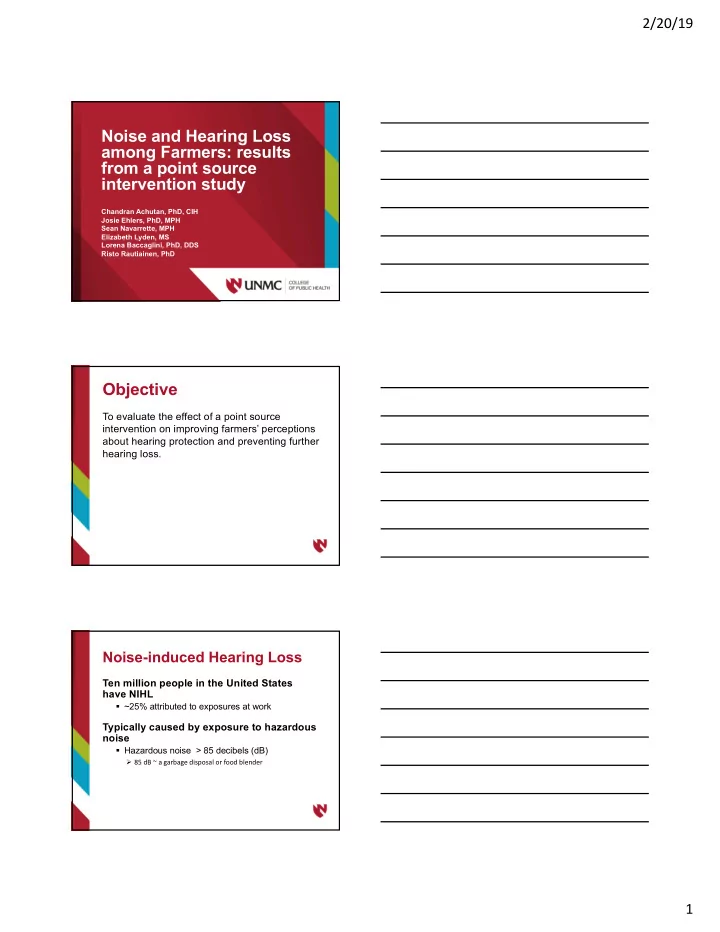
2/20/19 Noise and Hearing Loss among Farmers: results from a point source intervention study Chandran Achutan, PhD, CIH Josie Ehlers, PhD, MPH Sean Navarrette, MPH Elizabeth Lyden, MS Lorena Baccaglini, PhD, DDS Risto Rautiainen, PhD


slide-1
SLIDE 1

2/20/19 1

Noise and Hearing Loss among Farmers: results from a point source intervention study

Chandran Achutan, PhD, CIH Josie Ehlers, PhD, MPH Sean Navarrette, MPH Elizabeth Lyden, MS Lorena Baccaglini, PhD, DDS Risto Rautiainen, PhD

Objective

To evaluate the effect of a point source intervention on improving farmers’ perceptions about hearing protection and preventing further hearing loss.

Noise-induced Hearing Loss

Ten million people in the United States have NIHL

§ ~25% attributed to exposures at work

Typically caused by exposure to hazardous noise

§ Hazardous noise > 85 decibels (dB)

Ø 85 dB ~ a garbage disposal or food blender

slide-2
SLIDE 2

2/20/19 2

Hearing Loss and Farmers

11% of agricultural workers in the US have NIHL Farmers have third highest prevalence of NIHL Exposures to hazardous noise:

§ Tractors and combines2,4-5 § ATV2,5 § Equipment (sprayers, chainsaws, carts, dryers)2,4 § Livestock7 § Recreational Activities (firearms, concerts, vehicles)6,9-10

Prevention is Key

NIHL is permanent, but preventable Hazard recognized, but PPE use low

§ <50% use hearing protection

Challenges for farmers § Little oversight § Limited resources § Logistic barriers

Point Source Intervention

Weather proof box containing

§ Ear muffs § 30-pairs of earplugs

slide-3
SLIDE 3

2/20/19 3

Methodology

Study Design

§ Cluster randomized controlled trial

Ø Intervention arm (25 farms; 53 farmers)

  • Point source intervention and education

Ø Control arm (26 farms; 36 farmers)

  • Education only

§ Data collected annually

Ø BHPHL Questionnaire16-17

  • Beliefs about Hearing Protection and Hearing Loss

Ø Audiometric test data

  • Conducted onsite at each farm
  • Ambient noise

Study Population

At a glance…

§ N=89 (79 men and 10 women) § Mean Age 49.8-years (SD 16.5 years; Range 17-90 years) Ø Control farmers about 12 years older § Most soybean and corn farmers § 46% involved in animal husbandry (cattle) § N=2 farmers with profound hearing loss Ø Excluded from hearing analyses

slide-4
SLIDE 4

2/20/19 4

Statistical Analysis

Pure-tone Audiometry on Farms: Mobile Testing Without a Sound-Treated Environment

§ Descriptive statistics

Effect of a Point Source Intervention of Farmers’ Hearing

§ Generalized Linear Mixed Model (GLMM)

Significance Level Two-Sided α=0.05

Onsite Audiometric Testing

278 audiometric tests administered

§ Basement, dining room, kitchen, shed,

  • ffice, utility room, workshop, office at

university

Ambient noise minimized

§ Turning off lights § Unplugging appliances § Restarting tests

Ambient Noise Thresholds

American National Standard Institute

§ Maximum Permissible Ambient Noise Levels for Audiometric Test Rooms (ANSI MPANL)

Occupational Safety and Health Administration

§ Maximum Allowable Octave-Band Sound Pressure Level (OSHA MAOSPL)

slide-5
SLIDE 5

2/20/19 5

Results

Most exceedances at 500 and 1000 Hz

§ ANSI MPANL exceeded more than OSHA MAOSPL Ø Most exceedances < 5 dB

Hearing loss identified in unsuitable environments

§ 4000 Hz (3% exceeded) Ø 1/89 left and 2/89 right ears with hearing loss

Results

Baseline Hearing Acuity

Bolded line indicates threshold for normal hearing (≤ 25 dB)

Results

Notches identified at 3, 4, and 6 kHz

§ Most identified at 4 kHz § Mean notch depth ~20 dB § Left ears had more evidence of NIHL

ØMore notches and deeper notches

slide-6
SLIDE 6

2/20/19 6

High-Frequency PTA

High-frequency Pure-Tone Average (PTA) § Average hearing thresholds at 3, 4, and 6 kHz As farmers aged, their high-frequency PTA hearing thresholds increased (p<0.01) Left ears had greater high-frequency PTA than right ears (p<0.01) ØLeft ears = 30.35 dB* and right ears = 26.38 dB*

*Model adjusted means

Conclusion

The educational component of the study was highly effective at changing farmers’ perceptions about hearing protection. The intervention may have been successful at preventing hearing loss, but more time was needed to appreciate those changes fully.

Acknowledgement

This study was supported by a grant from the National Institute for Occupational Safety and Health (U54 OH010162)