
SLIDE 1
- We mean ….Network File System
Introduction: Remote File-systems
When networking became widely available users wanting to share files had to log in across the net to a central machine This central machine quickly become far more loaded then the user’s local machine So there was a demand for a convenient way to share files on several machines The most easily understood sharing model is one that allow a server machine to export its file systems to one
- r more clients. The clients can then import these file
systems and present them as local file systems
First Attempts
UNIX United
Implemented near the top of the kernel No caching slow performance Nearly identical semantics to a local system
Sun Microsystems network disk
Implemented near the bottom of the kernel Excellent performance Bad UNIX semantic
System V RFS
Excellent UNIX semantic Slow performance
AFS
NFS (Network File System)
The most commercially successful and widely available remote file system protocol Designed and implemented by Sun Microsystems (Walash et al, 1985; Sandberg et al, 1985) Reasons for success
The NFS protocol is public domain Sun sells that implementation to all people for less than the cost
- f implementing it themselves
Evolved from version 2 to version 3 (which is the common implementation today).
NFS Overview
Views a set of interconnected workstations as a set of independent machines with independent file systems The goal is to allow some degree of sharing among these file systems (on explicit request) Sharing is based on client server relationships A machine may be both client and server The protocol is stateless Designed to support UNIX file system semantics The protocol design is transport independent
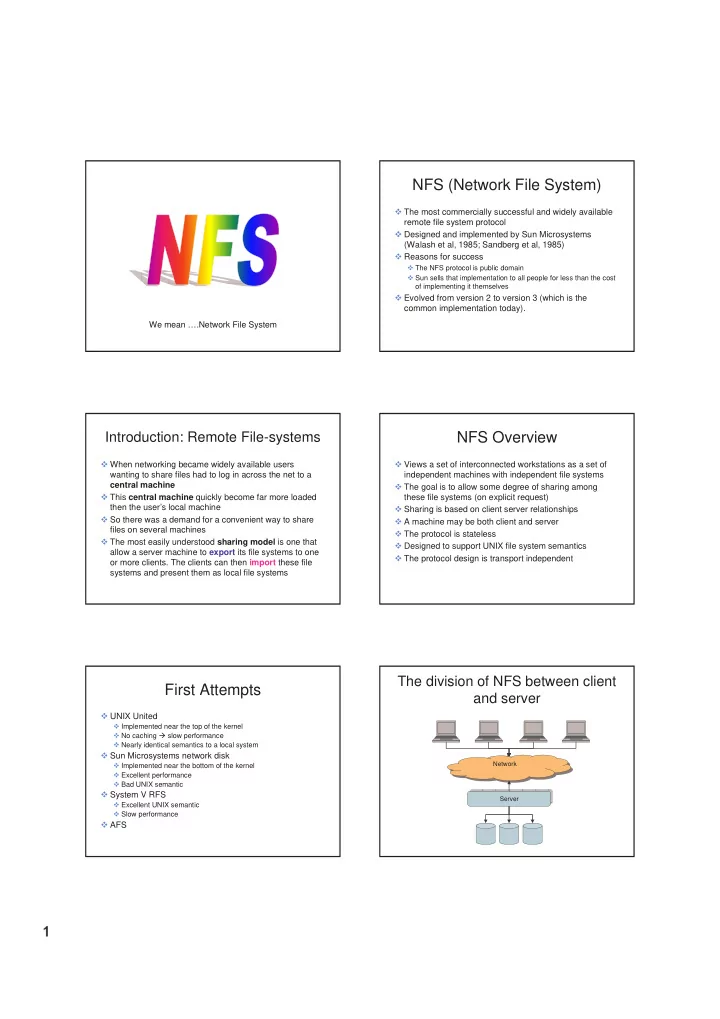
The division of NFS between client and server
Server Server Network Network