
SLIDE 1
NEXTLEAP
NeXt generation Technosocial and Legal Encryption Access and Privacy
Co-ordinator: PROSECCO
INRIA-Rocquefort Beginning: 1 Jan 2016
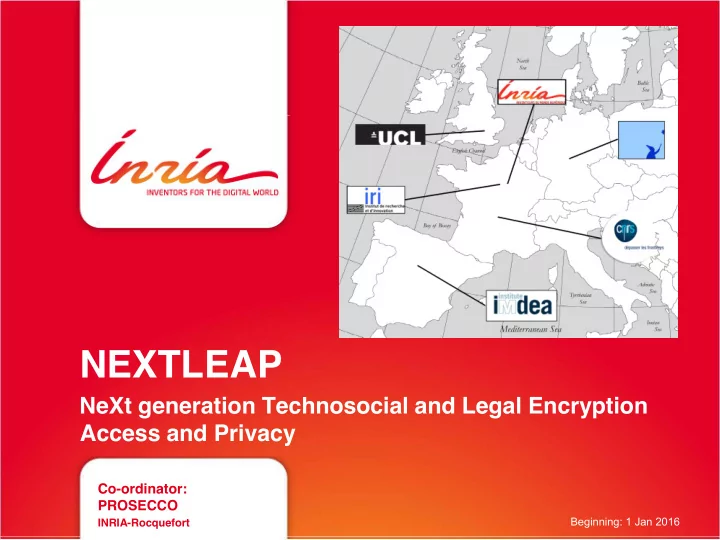
NEXTLEAP NeXt generation Technosocial and Legal Encryption Access - - PowerPoint PPT Presentation
NEXTLEAP NeXt generation Technosocial and Legal Encryption Access and Privacy Co-ordinator: PROSECCO Beginning: 1 Jan 2016 INRIA-Rocquefort NEXTLEAP Introduction The NEXTLEAP project will lay the interdisciplinary internet science
Co-ordinator: PROSECCO
INRIA-Rocquefort Beginning: 1 Jan 2016
The NEXTLEAP project will lay the interdisciplinary internet science foundations to build distributed and decentralised systems that can harness ‘bottom up’ participatory innovation. Problem: The research community does not yet know how to socially, legally, and technically build protocols that have provable security, preserve privacy, and extending fundamental rights. Despite the increased interest from the public, almost all commons-based project present privacy, security, and anonymity risks. Solution: NEXTLEAP will produce a “next generation” of decentralised and privacy- preserving protocols and open source implementations that tackle core functions monopolised by centralised proprietary cloud providers: federated identity that includes a privacy-respecting addresbook, asynchronous secure messaging for e- mail, synchronous secure messaging for chat, and privacy-preserving analytics for extracting “the wisdom of the crowd.” These protocols will be based on detailed sociological studies and a fundamental re-thinking of the philosophical foundations
NEXTLEAP
NEXTLEAP