
SLIDE 1
News from the Sudbury Neutrino Observatory (SNO) Christine Kraus - - PowerPoint PPT Presentation
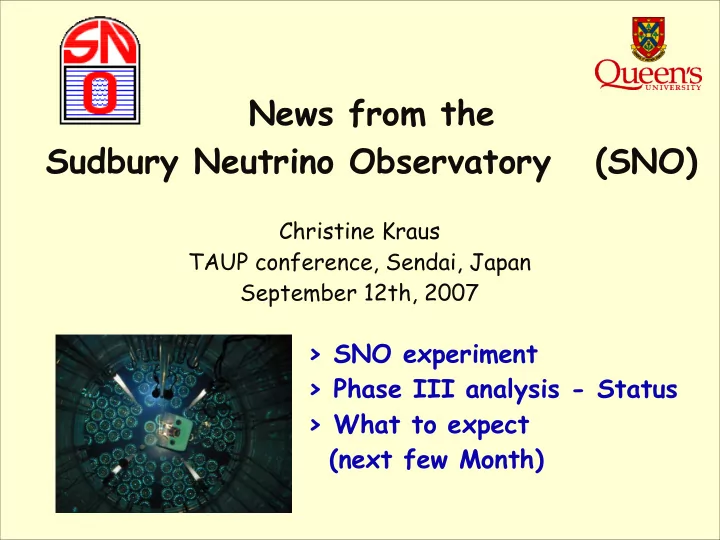
News from the Sudbury Neutrino Observatory (SNO) Christine Kraus TAUP conference, Sendai, Japan September 12th, 2007 > SNO experiment > Phase III analysis - Status > What to expect (next few Month) The SNO detector located: INCO
1000 tonnes D2O 12 m acrylic vessel 1700 t H2O (inner) 18 m PSUP 5300 t H2O (outer) ~9500 PMTs 54% coverage 2039 m underground (6000 mwe) DCR = Deck Clean Room
located: INCO Creighton mine, Sudbury, Ontario, Canada
some directional info (1-1/3cosθsun)
good Eν sensitivity equally sensitive to all active flavours detect neutron capture directional sensitivity mostly νe (factor 6.5) smaller cross section
phase II
3 phases with different ways to detect neutrons
Commissioning Pure D2O Add 2t salt Remove salt Install counter array Production data
D2O back
n captures on deuterium σ = 0.0005b 6.25 MeV γ
γ
2H 3H*
n
3H
γ γ γ
35Cl 36Cl 36Cl*
n n captures on chlorine σ = 44b 8.6 MeV multiple γs n captures on 3He
σ = 5330b 0.764 MeV n + 3He → p + 3H p
3H
5 cm
n
3He
phase I: 306 d phase II: 391 d phase III: ~396 d
PMT NCD
40 strings – 1m grid 440 m total active length
2H + νx → p + n + νx - 2.22 MeV (NC)
NCD: 3He + n → p + 3H + 0.76 MeV
NCD Specifications:
Cu anode wire
(50 µm)
3He-CF4 gas mix
Fused silica insulator CVD nickel counter body (0.36 mm thick) Delay line termination (80 ns) Vectran braid Acrylic ROV ball Acrylic anchor ball
Length of NCD Strings: 9−11 m 5 cm
Energy (ADC Channel)
50 100 150 200 500 400 300 200 100
Counts Energy spectrum using a AmBe neutron source End view of an NCD with representative ionization tracks
764-keV peak
anode wire NCD Wall
3He
neutron
191-keV shoulder (triton into wall) 573-keV shoulder (proton into wall)
1.5 1.0 0.5 0.0
8 6 4 2
De-logged current Time (microseconds)
14 12 10 8 6 4 2
8 6 4 2
De-logged current Time (microseconds)
20 15 10 5
5 4 3 2 1
De-logged current Time (microseconds)
neutron with p-t track || wire α track ⊥ wire neutron with p-t track ⊥ wire
Alpha Background Neutrons Fit Tail due to space charge and geometrical effects
final analysis to include: pulse shape information geometrical event distribution
Collaboration has developed 4 pulse shape discrimination methods Determination of systematic uncertainties well under way MC efforts for NCD pulse shapes well under way Fit of final spectral form will determine number of neutrons detected in the NCD array, after all corrections (measured with help of calibration data) have been applied.
Each physics process has typical signature in energy, radial profile and angle towards the sun This allows statistical separation of events in third phase the NC events in D2O are largely suppressed by 3He neutron capture. That allows charged current measurement with lower uncertainty (goal 3.3% instead
phase II)
0.025 0.05 0.075 0.1 5 10 15 0.05 0.1 0.15 5 10 15 0.05 0.1 0.15 0.2 5 10 15 0.025 0.05 0.075 0.1 0.5 1 1.5 0.02 0.04 0.06 0.5 1 1.5 0.05 0.1 0.15 0.5 1 1.5 0.02 0.04
1 0.2 0.4
1
CC ES NC T/MeV Probability per bin R3 coso .
0.01 0.02 0.03 0.04
1
complete data set processed (close), systematic studies well under way
systematic studies: determine radioactivity (NCDs, AV), ...