New Service Development Shin Ming Guo NKFUST Service Innovation - - PDF document

new service development
SMART_READER_LITE
LIVE PREVIEW

New Service Development Shin Ming Guo NKFUST Service Innovation - - PDF document

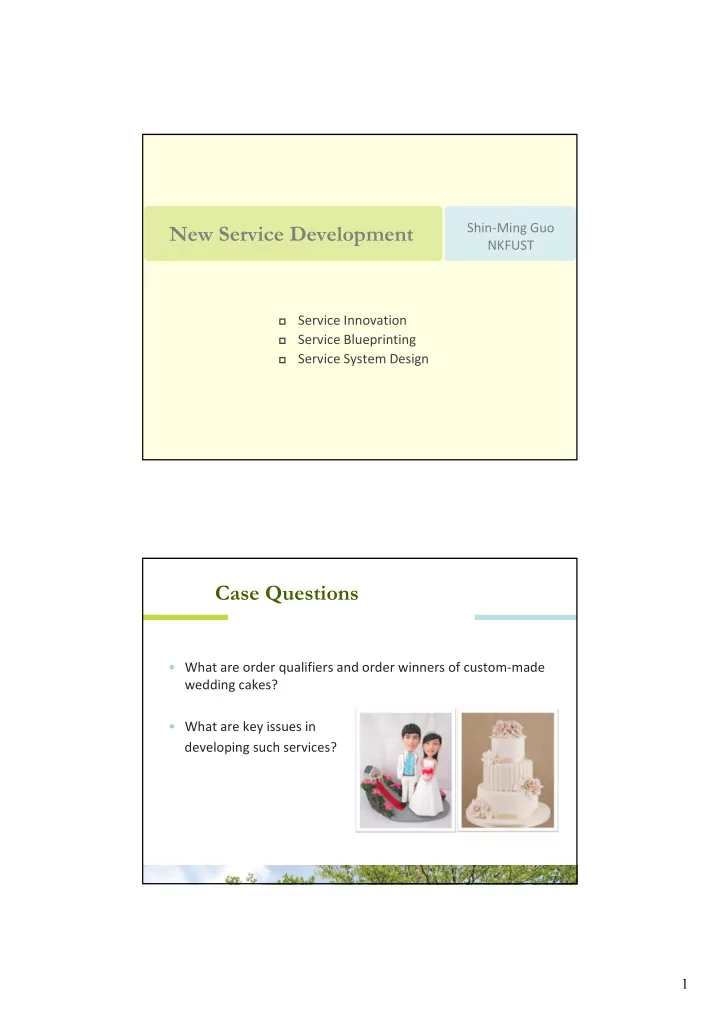
New Service Development Shin Ming Guo NKFUST Service Innovation Service Blueprinting Service System Design Case Questions What are order qualifiers and order winners of custom made wedding cakes? What are key issues


slide-1
SLIDE 1

1

New Service Development

Service Innovation

Service Blueprinting

Service System Design Shin‐Ming Guo NKFUST

Case Questions

  • What are order qualifiers and order winners of custom‐made

wedding cakes?

  • What are key issues in

developing such services?

slide-2
SLIDE 2

2

  • I. Innovation in Services

3

Idea Generation: Customers, Employees, Competitors, Technology Basic Research: Pursue a planned search for new knowledge regardless of possible application. (number theory) Applied Research: Apply existing knowledge to problems in creation of new service. (security coding) Development: Apply knowledge to problems to improve a current service. (on‐line shopping)

Technology-Driven Service Innovations

4

Source of Technology Service Example Service Industry Impact Power/energy

Jet aircraft International flight is feasible

Facility design

Hotel atrium Enclosed stadium Feeling of grandeur/spaciousness Year‐around use

Materials

Photochromic glass Synthetic engine oil Energy conservation Fewer oil changes

Methods

Just‐in‐time (JIT) Six Sigma Reduce supply‐chain inventories Institutionalize quality effort

Information

e‐commerce Internet Increase market to world‐wide Video on demand

slide-3
SLIDE 3

3

Process Innovation

5

Change where the process occurs relative to where the customer is. Electronic commerce:

 Holds inventory in a warehouse far from customers and

ship the inventory to customers upon order

 Long tail effect: allows more variety – items with little

demand for a local store can be profitably carried in an

  • rder fulfillment center

 Customers order from home but have to wait and

shipping costs must be incurred.

Case Study: Car Sharing

Best suited to urban locations where there was a dense base

  • f potential users, parking was

expensive, and the need to drive was limited. Big hole in the rental market: short‐term, on‐demand private car access.

https://www.youtube.com/watch?v=cX 2xJOo5LIs

slide-4
SLIDE 4

4

Building Service Platform

  • Mobile technology enables

vehicle reservation and usage.

  • Wireless transmission authorizes

users, read odometer, mileages, and time stamps.

Challenges for Service Innovation

8  Limited ability to protect

intellectual properties.

 Definition of the intangibles.  Incremental nature of

innovations.

 Limited ability to build

prototypes or conduct tests

slide-5
SLIDE 5

5

  • II. Service Design

 Customer

Participation

 Simultaneity  Perishability  Intangibility  Heterogeneity  Supporting Facility  Facilitating Goods  Information  Explicit Services  Implicit Services

location, interior design capacity planning, waiting line management service encounter revenue management service blueprint, service recovery

Service Design Elements

10

Design Elements Topics Structural Delivery system Process structure, service blueprint, strategic positioning Facility design Servicescapes, architecture, process flows, layout Location Geographic demand, site selection, location strategy Capacity planning Strategic role, queuing models, planning criteria Managerial Information Technology, scalability, use of Internet Quality Measurement, design quality, recovery, tools, six‐sigma Service encounter Encounter triad, culture, supply relationships,

  • utsourcing

Managing capacity & demand Strategies, yield management, queue management

slide-6
SLIDE 6

6

Customer Value Equation

Process quality Results produced Cost of acquiring the service Price to the customer Qualit Cost

Shouldice Hospital: Hernia Repair

slide-7
SLIDE 7

7

Strategic Positioning via Process Structure

13  Degree of Complexity: Measured by the number of steps

in the service blueprint, e.g., a clinic is less complex than a general hospital

 Degree of Divergence: Amount of discretion permitted

the server to customize the service, e.g., the activities of an attorney contrasted with those of a paralegal

Structural Alternatives for a Restaurant

14

slide-8
SLIDE 8

8

Structural Alternatives for a Restaurant

15

Service Process Matrix: Divergence

16

slide-9
SLIDE 9

9

Service Blueprinting: Complexity

17

Failsafing (pokayokes)

18

Service Encounter = moments of truth Every customer contact is an opportunity to satisfy the customer. To improve customers’ perception of service quality. Service failures are often caused by interruptions or negligence.

 Task to be done  Treatment accorded to the customer  Tangible features of the service

slide-10
SLIDE 10

10

Generic Approaches to Service Design

19

Production‐line

  • Low Divergence
  • Service Flow
  • Cost and Consistent Quality

Customer as Co‐Producer

  • Low Complexity, High Divergence
  • Substitute Technology for People
  • Cost and Convenience

Customer Contact

  • High Complexity, High Divergence
  • Service Encounter, Service Guarantee
  • High Performance Quality, Dependability

Service Design Example 1

20

Production Line  Treat the service as a manufacturing process

 Focus on tangibles, not people  Standardization  uniform

quality

 Low contact  high efficiency  Technology  fool‐proofing

equipment and process

slide-11
SLIDE 11

11

Service Design Example 2

21

Customer as Co‐Producer  having customers taking a greater role enhances the service

 Self service  cost, speed,

convenience, customization

 247 service  availability  Appointments and reservations  Customers generated content

 Wiki, e‐markets

Service Design Example 3

22

Customer Contact  how to achieve efficiency with customer participation

 Separation of high and low contact

  • perations

 Employee empowerment + Keep track

  • f customers’ preferences

 total customization of service

 Sales opportunities via personal

relationship

slide-12
SLIDE 12

12

Guidelines for Successful Service Design

23

1. Define the service package in detail 2. Focus on customer’s perspective (expectation and perception) 3. Recognize that designer’s perspective is different from the customer’s perspective 4. Define quality for tangible and intangibles elements 5. Make sure that recruitment, training, and rewards are consistent with service expectations 6. Establish procedures to handle exceptions 7. Establish systems to monitor service

Conclusion

  • The process is the product.
  • Service‐system matrix ≈ product‐process matrix
  • Service blueprint ≈ process flow chart
  • Inventory and scheduling are often not available to service
  • perations.
  • Expect and manage variability of service encounter
  • Parts of the service packages are defined by the training

and treatment the workers receive.

24

slide-13
SLIDE 13

13

Homework 1

  • Study the operation of zipcar. Describe its strategic service

vision and service package.

  • https://www.youtube.com/watch?v=cX2xJOo5LIs
  • Due 12:00 noon, 3/20
  • smguo@nkfust.edu.tw