SLIDE 1 Page | 1
September 2010
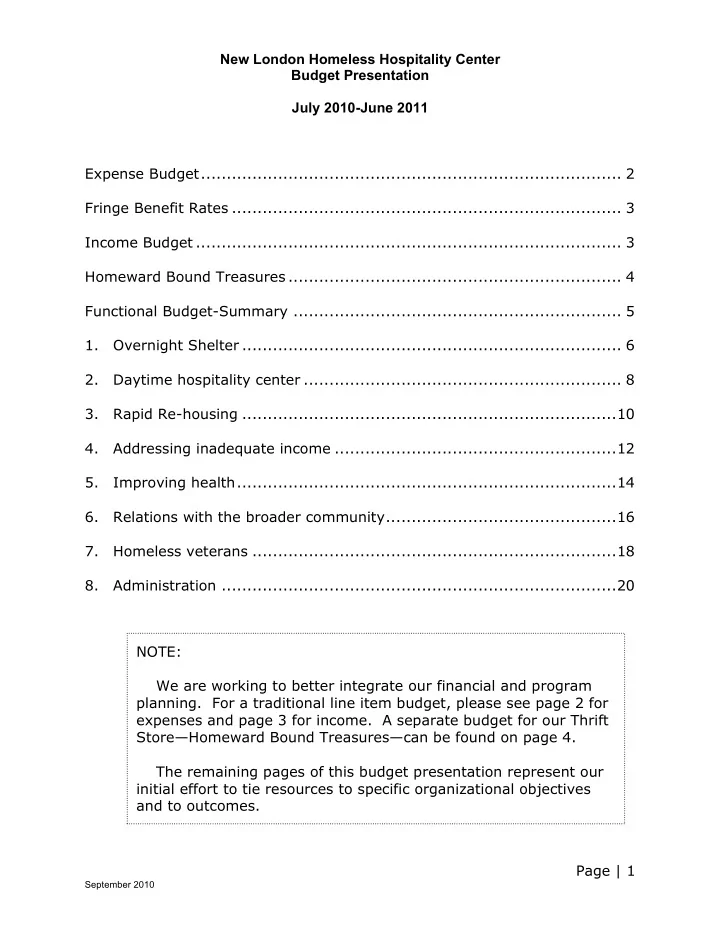
New London Homeless Hospitality Center Budget Presentation July 2010-June 2011 Expense Budget.................................................................................. 2 ¡ Fringe Benefit Rates ............................................................................ 3 ¡ Income Budget ................................................................................... 3 ¡ Homeward Bound Treasures ................................................................. 4 ¡ Functional Budget-Summary ................................................................ 5 ¡
- 1. ¡ Overnight Shelter .......................................................................... 6 ¡
- 2. ¡ Daytime hospitality center .............................................................. 8 ¡
- 3. ¡ Rapid Re-housing .........................................................................10 ¡
- 4. ¡ Addressing inadequate income .......................................................12 ¡
- 5. ¡ Improving health..........................................................................14 ¡
- 6. ¡ Relations with the broader community.............................................16 ¡
- 7. ¡ Homeless veterans .......................................................................18 ¡
- 8. ¡ Administration .............................................................................20 ¡
NOTE: We are working to better integrate our financial and program
- planning. For a traditional line item budget, please see page 2 for
expenses and page 3 for income. A separate budget for our Thrift Store—Homeward Bound Treasures—can be found on page 4. The remaining pages of this budget presentation represent our initial effort to tie resources to specific organizational objectives and to outcomes.
SLIDE 2 Page | 2
September 2010
New ¡London ¡Homeless ¡Hospitality ¡Center ¡ Expense Budget
(Excluding Homeward Bound Treasures)
¡
2010-‑2011 ¡
¡ ¡ ¡ Proposed ¡ 2010-‑2011 ¡ Approved ¡ 2009-‑2010 ¡ Executive ¡Director ¡(Cathy) ¡(25 ¡hours/week) ¡ 19,000 ¡
Operations ¡Manager(Charles) ¡ 35,088 ¡ 34,228 ¡ Shelter ¡Manager ¡
5,000 ¡ Program ¡Manager ¡(Dana) ¡ 31,579 ¡ 27,382 ¡ Service ¡Coordinator ¡(Greg) ¡ 27,864 ¡ 27,004 ¡ Service ¡Coordinator ¡(Marilyn) ¡ 24,381 ¡ 27,004 ¡ Housing ¡Advocate ¡(Jessica) ¡ 33,798 ¡ 24,768 ¡ Community ¡Outreach ¡(John ¡R.) ¡ 4,386 ¡
- ‑-‑ ¡
- Admin. ¡Support ¡
4,715 ¡ 5,000 ¡ Shelter ¡Staff ¡(hourly) ¡ 88,419 ¡ 72,842 ¡ Hospitality ¡Center ¡Staff ¡(hourly) ¡ 22,091 ¡ 27,950 ¡ Community ¡Service ¡Supervision ¡ 2,438 ¡ 12,427 ¡ Accounting ¡hourly ¡ 2,860 ¡ 3,870 ¡ Staff ¡Training ¡ 6,000 ¡ 4,900 ¡ VA ¡House ¡Coverage ¡ 9,507 ¡
Fringe ¡Benefits ¡(see ¡below-‑next ¡page) ¡ 57,130 ¡ 52,534 ¡ ¡Insurance ¡(liability ¡and ¡D&O) ¡ 3,700 ¡ 3,700 ¡ Insurance ¡(auto) ¡ 1,050 ¡ 1,050 ¡ Audit ¡Fees ¡ 7,500 ¡ 7,000 ¡ Shelter ¡space ¡donation ¡ 18,000 ¡ 18,000 ¡ Hospitality ¡Center ¡space ¡ 12,804 ¡ 1,2804 ¡ Other ¡Space ¡Costs ¡ 3,650 ¡
Trash ¡Removal ¡ 1,800 ¡ 1,800 ¡ Mountain ¡Ave. ¡mortgage ¡ 3,000 ¡ 3,600 ¡ Mountain ¡Ave. ¡operations ¡ 17,000 ¡
Supplies-‑-‑shelter ¡and ¡center ¡ 9,600 ¡ 10,800 ¡
4,100 ¡ 3,000 ¡ Staff ¡travel ¡ ¡ 3,600 ¡ 2,800 ¡ Repairs ¡& ¡Maintenance ¡ 4,100 ¡ 4,100 ¡ Service ¡Incentives ¡ 4,940 ¡ 3,000 ¡ ¡Other ¡Payments ¡for ¡Guests ¡ 19,000 ¡ 9,000 ¡ Other ¡payments ¡veterans ¡ 9,600 ¡
Telephone ¡ ¡ 4,800 ¡ 6,000 ¡ Copier ¡ 1,500 ¡ 1,500 ¡ ¡ ¡ ¡
Total ¡Expenses ¡ 499,000 ¡ 413,063 ¡
SLIDE 3 Page | 3
September 2010
Fringe Benefit Rates
Salaried ¡ ¡ ¡ Hourly ¡ ¡ Employer ¡Tax ¡ 7.65% ¡ ¡ Employer ¡Tax ¡ 7.65% ¡ Unemployment ¡ 1.90% ¡ ¡ Unemployment ¡ 1.90% ¡ Workers ¡Comp. ¡ 3.20% ¡ ¡ Workers ¡Comp. ¡ 3.20% ¡ Health ¡Fund ¡ 2.00% ¡ ¡ Health ¡Fund ¡ 2% ¡ ¡ ¡ ¡ Vacation ¡ 9% ¡ Total ¡ 14.75% ¡ ¡ Total ¡ 23.75% ¡
Income Budget
Income ¡ 2010-‑2011 ¡Proposed ¡ 2009-‑2010 ¡ Approved ¡ Projected ¡Actual ¡ 2009-‑2010 ¡ Faith ¡community ¡Gifts ¡ 24,000 ¡ 19,000 ¡ 16,000 ¡ Foundations ¡ 179,600 ¡ 167,600 ¡ 140,000 ¡ Individual ¡and ¡Business ¡ 51,000 ¡ 48,000 ¡ 45,000 ¡ Surrounding ¡Towns ¡ 9,000 ¡ 6,000 ¡ 18,000 ¡ Special ¡Events ¡ 30,000 ¡ 28,000 ¡ 23,000 ¡ Thrift ¡Store ¡ 40,000 ¡ 29,000 ¡ 30,000 ¡ Federal ¡Funds ¡ ¡ ¡ ¡ CDBG ¡ 4,000 ¡ 5,000 ¡ 4,000 ¡ Emergency ¡Food ¡ and ¡Shelter ¡ 26,000 ¡ 52,500 ¡ 60,000 ¡ VA ¡ ¡ 68,000 ¡ 15,000 ¡
HUD ¡(HPRP) ¡ 10,500 ¡ 15,000 ¡ 7,500 ¡ Housing ¡for ¡Health ¡ 4,500 ¡
Workforce ¡ Development ¡ 3,220 ¡
3,500 ¡ State ¡Funds ¡ ¡ ¡ ¡ State ¡DSS ¡ 44,500 ¡ 26,000 ¡ 35,000 ¡ SMHA ¡ 4,000 ¡ 1,500 ¡ 4,000 ¡ Guest ¡Contributions ¡ 1,000 ¡ 1,000 ¡ 1,000 ¡ Total ¡Income ¡ 499,320 ¡ 413,600 ¡ 387,000 ¡ ¡ ¡ ¡ ¡
SLIDE 4
Page | 4
September 2010
Homeward Bound Treasures
Operating Budget
Income ¡ ¡ Store ¡Sales-‑Regular ¡(net ¡of ¡sales ¡tax) ¡ ¡184,000 ¡ ¡ Moving ¡Fees ¡ ¡6,000 ¡ ¡ Delivery ¡Charges ¡ ¡3,000 ¡ ¡ Net ¡Income ¡ ¡193,000 ¡ ¡ ¡ ¡ Expenses ¡ ¡ Store ¡Manager ¡ ¡ ¡40,950 ¡ ¡ Store ¡administration ¡ ¡3,466 ¡ ¡ Trucking ¡Staff ¡(40 ¡hours/week) ¡ ¡25,466 ¡ ¡ Other ¡store ¡coverage ¡ ¡8,509 ¡ ¡ Other ¡Labor ¡(in ¡store) ¡ ¡13,319 ¡ ¡ Moving ¡Hours ¡(@15/hour) ¡ ¡4,500 ¡ ¡ Accounting ¡ ¡2,400 ¡ ¡ Rent ¡ ¡36,000 ¡ ¡ Utilities ¡ ¡3,600 ¡ ¡ Minor ¡Repairs ¡ ¡2,200 ¡ ¡ Telephone ¡ ¡ ¡1,800 ¡ ¡ Supplies ¡ ¡2,400 ¡ ¡ Insurance-‑space ¡ ¡1,000 ¡ ¡ Insurance-‑truck ¡ ¡1,000 ¡ ¡ Gas ¡ ¡4,800 ¡ ¡ Parking ¡ ¡900 ¡ ¡ ¡ ¡ Total ¡Expenses ¡ ¡152,309 ¡ ¡ ¡ ¡ Net ¡Surplus ¡Used ¡for ¡HHC ¡Operations ¡ 40,691 ¡
SLIDE 5 Page | 5
September 2010
Functional Budget-Summary (Detailed discussion of each objective follows)
The New London Homeless Hospitality Center (HHC) embraces a two-fold mission. First, our mission is to provide a place of safety and welcome to our adult homeless neighbors. We address this goal by providing overnight shelter and day time access to a hospitality center. Second, our mission is to assist our homeless guests move from homelessness to permanent housing. What every homeless person most needs is a permanent
- home. Through a staff located at our daytime hospitality center and by partnering
with others, we seek to assist our guests to chart a path back to housing. We organize our work toward this mission around eight key objectives. Key Objective Details Page # Estimated Budget
1) Provide an overnight shelter where single adults experiencing homelessness can find a place of safety and hospitality. 6-7 186,700 2) Offer homeless individuals access to supports needed to make day-to-day life manageable including: a place to sit during the day, get mail, use phones, access showers, get financial help with transportation/ laundry and get assistance in solving day-to-day problems with identification, scheduling appointments and finding resources. 8-9 95,700 3) Provide guests who have income, or the ability to access supportive/subsidized housing, with intensive support in moving quickly to permanent housing. 10-11 26,200 4) Assist guests without income to increase income so they can afford housing or help people find no-cost housing
12-13 26,150 5) Improve health status by assisting guests in accessing and effectively utilizing available community services to address health, mental health and substance abuse challenges. 14-15 34,100 6) Reduce the impact of homelessness on downtown
- businesses. Implement a community service program to
improve New London environment. 16-17 20,400 7) Provide transitional housing and support services to eligible veterans. 18-19 69,300 8) Provide overall management of HHC administrative and fiscal functions. 20 40,450 Total 499,000
SLIDE 6 Page | 6
September 2010
Single adults experiencing homelessness need a place of safety where they can spend the night.
What do we hope to achieve?
- All single homeless adults with ties to SE CT in need of emergency shelter—and able to
follow basic HHC rules--will have year round access to overnight shelter within three days of application. (Individuals from outside our region would be provided up to three nights of shelter plus assistance in returning to their town of origin.)
- Individuals utilizing the shelter will experience a safe, clean, hospitable and comfortable
environment.
- The emergency shelter will be organized in a way that supports transition to permanent
housing and the shortest possible shelter stay without imposing arbitrary time limits.
- During severe weather, any adult in need (but not a danger to themselves or others) will
be provided access to shelter on the first day needed.
- Emergency shelter will operate in a way that minimizes impact on the surrounding
community. What are the key assumptions that inform our approach?
- Controlling the number of people using the shelter needs to be a very high priority
because we cannot effectively provide hospitality when our nightly census exceeds about 50. Equally important, however, our mission is to provide shelter access for all in
- need. We are not a “program” offering a fifty bed shelter. We are a non-denominational
“ministry” committed to assuring that all our adult homeless neighbors have a place of safety when they need it.
- Not everyone seeking access to the shelter is truly homeless. An effective “front end”
process is needed to divert individuals who have other housing alternatives.
- Shelter requirements must be structured in a way that encourages transition to
permanent housing. Effective strategies toward this focus include: required savings toward housing, participation in shelter operation (chores), and a continual encouragement/mandate to seek out housing when feasible.
- Effective staffing is the key to achieving the hospitality we seek to offer. Staffing levels
must be sufficient to assure effective operation of the shelter. Staff must also be thoroughly trained, adequately compensated, carefully supervised and continually encouraged to assure that guests experience a deep sense of hospitality even in the difficult environment of the shelter. How will we measure progress?
- Provide up to 18,250 nights of shelter during the fiscal year.
SLIDE 7 Page | 7
September 2010
- Provide shelter to all single adults in need during the winter months (mid-November to
mid-March). During this period, loosen some shelter rules and expand capacity as needed to bring in individuals who would otherwise remain outdoors.
- Implement a quarterly survey of guests to assess satisfaction with shelter services.
- Implement a monthly analysis of new guests to better identify sources/causes of
homelessness. What resources do we plan to devote to this objective? Activity Resources Estimated Cost Provide shelter space
- St. James space, supplies,
maintenance/repairs, materials, insurance, trash removal
30,000 Shelter staffing
1 staff supervisor plus 1 volunteer, salaried employee or hourly worker 6:30-10:00 1 staff 10:00 pm-7:45 am,
No-freeze shelter extra staffing
1 extra staff person 6:00pm to 7:00 am for winter season
110,700 Staff supervision
Charles 12 hours/week, Cathy 3 hours/week
14,800 Initial screening of potential guests and initial efforts at diversion
16 staff hours/week (Greg)
12,800 Small, one-time expenditures to divert people from shelter
Funding to help people avoid the need for shelter
2,400 Management of housing savings accounts, chores and assigned beds
20 staff hours/week (Marilyn)
16,000 Total 186,700
SLIDE 8 Page | 8
September 2010
- 2. Daytime hospitality center
Single adults experiencing homelessness face many day-to-day challenges in daily living in addition to the need for shelter.
What do we hope to achieve?
- Homeless individuals will have access to a daytime hospitality center from 8:30-4:30 on
week days. (During the winter, Saturday access will also be provided).
- The hospitality center will provide supports usually provided by a home: showers, mail
delivery, phones, computers (without internet), sitting area and coffee.
- Guests with no income will have access to laundry and bus vouchers as funding permits.
- Guests who are sick, have worked overnight or have other special needs will be
provided a place to sleep during the day.
- Guests will be provided with practical assistance in securing new identification
documents, in connecting with relatives, in storing important papers, in interacting with the court system and with other short term problems they identify. This help will be provided primarily in response to direct requests from guests. What are the key assumptions that inform our approach?
- Very few public locations are welcoming to homeless individuals. People need a place
that is welcoming and safe where they can spend daytime hours. Having a place to be during the day improves our guest’s quality of life and provides us the opportunity to get to know people on a personal basis.
- Access to mail, phone and computers helps homeless individuals stay connected to their
broader social network. Staying connected to social networks improves the likelihood of finding housing.
- The needs of homeless individuals vary widely—we serve these needs best by being
available and responsive to needs as identified by guests. In this phase of our work, our priority is being responsive to the problems guests ask us to help them solve.
- Relatively small investments—in laundry, transportation, replacing lost identifications
and other practical challenges can provide a significant increase in our guest’s quality of life. How will we measure progress?
- Record 20,000 visits to the daytime hospitality center.
SLIDE 9 Page | 9
September 2010
What resources do we plan to devote to this objective? Activity Resources Estimated Cost Provide hospitality center location Allocation of All Souls space, supplies, insurance, maintenance, HHC van, phone 25,000 Manage site access from front desk 30 hours/week (40 hours winter) staff time for front desk. (hourly employees) 28,200 Site and staff supervision, intervention with guests as needed 12 hours/week (Charles) 15,000 Responding to guest requests for assistance 28 hours of staff time/week (Greg/Marilyn) 25,000 Other payments on behalf of guests Various direct expenditures based
- n guest requests for assistance
2,500 Total 95,700
SLIDE 10 Page | 10
September 2010
Housing is the answer to homelessness. Guests with the ability to access permanent housing should do so quickly.
What do we hope to achieve?
- Some of our guests arrive at HHC with income sufficient to pay for market rate housing.
These individuals will transition to permanent housing within sixty days of entry into the shelter.
- Some of our guests are eligible for very low cost housing due to their disability or age.
These individuals will complete necessary applications within thirty days of entry into the
- shelter. Ongoing advocacy will seek to expedite access to these specialized housing
placements.
- Newly housed guests will retain the housing they secure.
What are the key assumptions that inform our approach?
- People with income can afford permanent housing. The shelter cannot become a
vehicle for avoiding the need to pay housing costs. Our policies must require individuals to devote their income to housing.
- Guests are often unaware of specialized housing options (supportive housing,
subsidized housing, senior housing, other shelters and residential programs). We need to provide intensive one-on-one support to help guests access these opportunities. Advocacy also helps people move though the approval and/or waiting list process more quickly.
- Even people with income and a desire for permanent housing often need assistance in
locating, renting and moving into new apartments. Advocacy with landlords and one-on-
- ne support for guests in the housing search significantly increases the speed at which
people find housing.
- Most guests do not have sufficient savings to handle security deposits and costs in the
first few months of a rental. Targeted short term financial assistance is needed to help guests overcome this barrier and get people into housing as quickly as possible.
- For some individuals money management is the key barrier which keeps them from
permanent housing. These individuals may need the assistance of a representative payee.
- Individuals with limited income will benefit significantly from linkages with so called
mainstream services (food stamps, tax credits, medical benefits). Getting these supports in place along with permanent housing will increase housing stability.
- Most homeless individuals will transition successfully to permanent housing without the
need for long-term social service support. These individuals often, however, benefit from appropriately scaled and short-term support in the time right after they move into permanent housing. To achieve our goal of housing stability we need to provide these limited supports in an appropriate and cost effective manner.
SLIDE 11 Page | 11
September 2010
How will we measure progress?
- Provide housing location support to at least 60 different individuals.
- Assist at least 35 guests to move from homelessness to permanent housing.
- Provide sufficient support to maintain at least 80% of guests for whom we provide
housing location and/or financial assistance in housing for at least six months.
- Link at least 70% of all housed guests with food stamps and other programs for which
they are eligible. What resources do we plan to devote to this objective? Activity Resources Estimated Cost Housing location support 15 hours/week of staff time (Jessica) 14,900 Rental subsidies for situations not covered by HPRP or State Security Deposit Guarantee Program. Direct payment to landlords on behalf of guests. (Additional funds from other sources including HPRP are not reflected in this budget. Budget also does not reflect the impact of the guest’s own savings from the Housing Savings Account.) 7,600 Complete monthly budgets with anyone for whom we serve as a payee. Contracted out with costs covered by small fee charged to payee
1,200 Space, phone, copier allocation 2,500 Total 26,200
SLIDE 12 Page | 12
September 2010
- 4. Addressing inadequate income
Inadequate income is the single greatest barrier to permanent housing. We will implement a variety of supports to assist guests to increase income and/or find access to no cost housing.
What do we hope to achieve?
- Individuals who cannot work will be assisted to apply for SSI/SSDI.
- Individuals with very limited income will be assisted to explore creative approaches to
securing housing including finding roommates and returning to family. Emergency shelter should not become a person’s permanent home.
- HHC will provide practical and financial support to help guests seek employment
including replacing ID’s, providing transportation to interviews, accessing appropriate clothing and providing financial support for needed licenses.
- Individuals will be assisted in accessing job search, training, education and other job
readiness programs.
- After two months of shelter usage, every guest will have individualized support in
preparing and implementing a housing plan. What are the key assumptions that inform our approach?
- For disabled guests, SSI/SSDI is the only avenue that will provide access to financial
- independence. Success in applying for SSI/SSDI will be greatly increased with
assistance from staff trained in proven approaches such as SOAR.
- Each situation is different and assisting guests to move toward higher income and/or
creative housing alternatives requires time and ongoing follow-up. Volunteers are a key resource in efforts to find enough time to work one-on-one with individuals whose lack of income places market rate housing out of reach. How will we measure progress?
- At least eight individuals will be assisted to apply for SSI/SSDI and at least four will be
approved.
- At least 25 individuals will be assisted to return to family or shared housing they can
afford on very limited income.
- HHC will sponsor/facilitate at least four employment related outreach activities each
month in an effort to increase engagement with educational, job training, job search and
- ther employment related activities.
- By the spring of 2011 at least 20 longer term guests will be working on housing plans
and meeting weekly with staff of volunteers available to assist them.
SLIDE 13 Page | 13
September 2010
What resources do we plan to devote to this objective? Activity Resources Estimated Cost Project management and linkage with
4 staff hours/week (Cathy) 2,750 Assist guests with SSI and other income related activities 6 staff hours/week (Dana) 7,250 Recruit, train, assign and supervise volunteers working one-on-one with guests 2 VISTA staff Staff supervision (10 hours/week Jessica) 9,000 Weekly visits to DSS in Norwich and assistance in securing public benefits. 4 staff hours/week (Greg) 3,200 Transport guests Gas for trips to Norwich and to appointments 350 Provide direct financial assistance as needed to advance guest plans related to income. Various payments 1,200 Space, phone, copier allocation 2,400 Total 26,150
SLIDE 14 Page | 14
September 2010
Our guests face a variety of serious health issues: physical health, mental health and substance abuse. Health issues impact our guest’s overall quality of life and often become a barrier to securing permanent housing.
What do we hope to achieve?
- All guests will be assisted to secure SAGA health insurance if they are not currently
insured to provide the financial foundation for access to needed health care.
- Any guest interested in entering substance abuse treatment will be linked to the
appropriate program and ongoing support.
- Guests with identified physical health issues will be referred to VNA on-site staff and/or
to the community health center.
- For guests with significant health concerns, we will provide coordinated support to help
the individual find and utilize necessary services.
- Reduce inappropriate use of the emergency room by helping people connect to more
appropriate treatment alternatives.
- Increase treatment compliance by helping maintain access to necessary prescriptions,
by providing support in making/keeping appointments and by implementing individualized health education. What are the key assumptions that inform our approach?
- We need to make special efforts to engage individuals facing the most serious mental
health and substance abuse challenges. These individuals are often reluctant to connect to existing services. To maintain contact we must keep HHC “requirements” to a minimum, offer access to supports people want and be engaged in continual outreach in the community.
- Getting insurance is a critical first step in addressing health concerns.
- Individuals with serious health concerns will often require assistance from a variety of
- sources. These resources are often difficult to access and not effectively coordinated
with each other. The community care team continues to be an invaluable forum for increasing this coordination and improving access to services.
- There are people we cannot safely serve. We need to have procedures and staffing in
place to assist these individuals to find the services they need in other settings.
- Readiness for substance abuse treatment can come at any time—we need to be ready
to move quickly to help guests enter treatment quickly once they express an interest. We also need to use access to the shelter as an incentive to encourage treatment.
- Recovery is the hope for every person and should be central in our thinking. We also,
however, seek to utilize a harm reduction model until individuals are ready to move toward recovery.
SLIDE 15 Page | 15
September 2010
- A very small number of individuals—many with chronic substance abuse challenges—
are making inappropriate use of the emergency room. With creative, intensive and persistent engagement and follow-up many of these individuals could be redirected into more appropriate service alternatives.
- Improving health outcomes can take time and patience. We need to adopt a strategy of
- ngoing engagement and careful planning even with individuals not yet ready to take the
steps necessary to address health issues. How will we measure progress?
- At least 50 individuals will be assisted in securing health insurance coverage.
- At least 50 different individuals will receive attention from the community care team in an
effort to identify needed resources and achieve improved health outcomes.
- At least six individuals currently making inappropriate use of emergency room services
will be identified for intensive engagement in the hope of assisting them to more effective treatment resources.
- At least 10 individuals will be linked to intensive case management services provided by
the Southeastern Mental Health Authority (SMHA), local mental health providers or the Eastern Region Service Council (ERSC) What resources do we plan to devote to this objective? Activity Resources Estimated Cost Facilitate Community Care Team meetings and provide one-on-one intensive service management to high need individuals. 14 hours/week of staff time (Dana) 14,200 Maintain relationships with the broad network of service providers who interact with homeless individuals: SMHA, housing, TVCCA, Sound, hospitals, police, ERSC, senior services. 4 hours/week of staff time (Dana) 4,000 Assistance with entry into substance abuse treatment. 4 hours/week of staff time (Marilyn) 3,200 Assistance with securing health insurance 6 hours/week of staff time (Greg) 5,200 Project management and building linkages with
3 hours/week (Cathy) 2,700 Travel and minor payments Direct payments for gas, guest travel and mis. expenses 2,300 Space, phone, copier allocation 2,500 Total 34,100
SLIDE 16 Page | 16
September 2010
- 6. Relations with the broader community
Part of our mission is to reduce the impacts of homelessness on the New London community while also advocating for the interests of our homeless guests.
What do we hope to achieve?
- Downtown business owners and other community members will know how to contact
HHC if they are experiencing an issue with one or more homeless individuals.
- HHC staff will be a regular presence at public locations including the train station and
public library working to improve relationships between homeless individuals and other parts of the community.
- At least twice a week during the warmer months community service crews from HHC will
be visible in the community improving the overall New London environment. What are the key assumptions that inform our approach?
- We need to be known in the community and develop one-on-one relationships with key
New London business owners and staff at public facilities. While our first priority is to advocate for our homeless guests, we must also seek to respond to inappropriate behavior when it occurs. We want business owners and the general public to let us know if they have a problem so we can work toward solutions.
- We know from experience that tensions between the community and homeless
individuals are particularly intense in certain locations: public library, train station, parade and pier. We need to be proactive in working to improve relationships in these locations by having a continuing presence.
- The vast majority of our homeless guests have no negative interactions with the
surrounding community. A very small number of individuals, however, do create friction by panhandling, littering, drinking in public, abusing public facilities and trespassing. Patient and consistent engagement with this small number of individuals can lead to noticeable reductions in inappropriate behavior.
- The New London Police Department is a key partner in our efforts to improve
relationships with the broader community. We need to be responsive to issues brought to our attention by the police.
- Our guests are willing to “give back” and be of service to the community. A well
structured community service component can improve the New London community, demonstrate the contribution made by homeless individuals, provide meaningful service
- pportunities and improve community relations.
How will we measure progress?
- Provide at least 60 two hour community service opportunities over the year.
- Achieve broad based awareness of available HHC supports in downtown business
community.
SLIDE 17 Page | 17
September 2010
What resources do we plan to devote to this objective? Activity Resources Estimated Cost Project management 3 hours/week of staff time (Cathy) 2,750 Intensive service management for individuals selected for active
- engagement. Routine visits to library,
train station, pier. 12 hours/week of staff time (Dana and Charles) 11,300 Community Service Supervision 6 hours per week part of the year (hourly staff) 2,600 Transport guests Staff travel 750 Minor expenses related to outreach and modest incentives for individuals completing community service. Payments on behalf of guests including community service incentives 3,000 Total 20,400
SLIDE 18 Page | 18
September 2010
Provide transitional housing and support services to homeless veterans.
What do we hope to achieve?
- Open a four unit, 8 bed transitional housing site on Mountain Avenue to provide
transitional housing for eligible homeless veterans.
- Identify qualified veterans and achieve at least 85% occupancy rate.
- Provide outstanding support services to enrolled veterans and meet all VA contract
performance goals. What are the key assumptions that inform our approach?
- Our responsibilities under this grant are spelled out in great detail in our agreement with
the VA. We will need to implement a high quality program and a careful record keeping system to achieve all stated goals.
- Intensive engagement with each veteran and a focus on increasing income are central
features of our design.
- VA regulations require that this property provide a “sober environment”. We will need to
experiment and learn from best practices elsewhere as we work to achieve this goal while also providing a broad range of homeless veterans with the chance to take part in this program. How will we measure progress? Our grant proposal includes detailed outcomes. All outcome measures apply to veterans who successfully complete a one month “probationary” period in transitional housing.
- 80% of veterans in transitional housing will demonstrate effective money management
skills by contributing the greater of 30% of their income, the full amount of any direct rental subsidy or $25/week toward a housing savings account as measured by weekly collection reports.
- 80% of veterans in transitional housing will achieve a rating of at least “good” as
measured by the weekly house manager’s assessment of tenant compliance with
- ccupancy standards related to noise, appropriate visitation, apartment maintenance
and avoidance of behaviors that disrupt other tenants.
- 50% of veterans accessing transitional housing will secure permanent housing within
nine months and 75% will secure permanent housing within one year as measured by review of case records.
- 100% of veterans accessing transitional housing will be carefully screened for potential
eligibility for public benefits including VA, SSI/SSDI, unemployment, public assistance in their first one month of housing as documented in the individual’s case file.
- 100% of veterans in transitional housing and deemed potentially eligible for one or more
public benefits who wish to pursue applications will have an initial application filed for
SLIDE 19 Page | 19
September 2010
such benefits within 60 days of the initial assessment date as documented in the individual’s case file.
- 80% of veterans utilizing transitional housing will have at least twenty hours of
documented work (paid or unpaid) each month.
- 80% of veterans utilizing transitional housing and working less than 20 hours/week will
have at least three employment related activities each month (e.g. meeting with DOL VA representative, resume workshops, skills training, meeting with mentors) as documented by a month end review of the client’s case file.
- 50% of veterans utilizing transitional housing will have income from paid employment
when they leave transitional housing.
- 90% of veterans in transitional housing will have a “change plan” on file that they have
developed or updated within the last month which includes concrete specific goals and action plans as evidenced in their case files.
- 80% of veterans in transitional housing will report a greater confidence in their ability to
work toward and achieve positive goals as measured by a quarterly survey administered by an independent evaluator. What resources do we plan to devote to this objective? Activity Resources Estimated Cost Project management 6 staff hours/week (Cathy) 8,300 One-on-one service management 12 staff hours/week (Charles) 10 staff hours/week (Jessica) 20,000 Assistance in accessing specialized services when needed. 3 hours/week (Dana) 3,600 Assist with services and maintain housing and service records 5 staff hours/week (Marilyn) 4,300 Provide housing Mountain avenue operations— utilities, maintenance, cleaning, etc. 20,000 Provide financial support to vets for program related activities Voucher, direct payment to vendors 9,600 Space, phone, copier Office space, intake support, administrative support provided at hospitality center 3,500 Total 69,300
SLIDE 20 Page | 20
September 2010
HHC has multiple diverse funding sources which must be managed with the highest level of effectiveness and accountability.
What do we hope to achieve?
- HHC will operate a comprehensive year round fundraising effort guided by an annual
fundraising plan.
- HHC will maintain an accounting system which meets all applicable standards.
- HHC will be in compliance with all contract requirements.
- Volunteers and donors will receive regular updates on HHC activities.
What are the key assumptions that inform our approach?
- We will continue to need to rely on multiple funding sources—many of them small.
Cultivating relationships with donors of all kinds will be key.
- We must devote the resources needed to assure that all accounting and record keeping
meets the highest standards. How will we measure progress?
- Meet fundraising goals established in the annual plan.
- Secure an unqualified audit.
What resources do we plan to devote to this objective? Activity Resources Estimated Cost Overall management 15 staff hours/week (Cathy) 15,000 Support of financial, contract management and fundraising activities 10,000 Audit and D&O Insurance 8,250 Staff training 6,000 Administrative supplies 1,200 Total 40,450