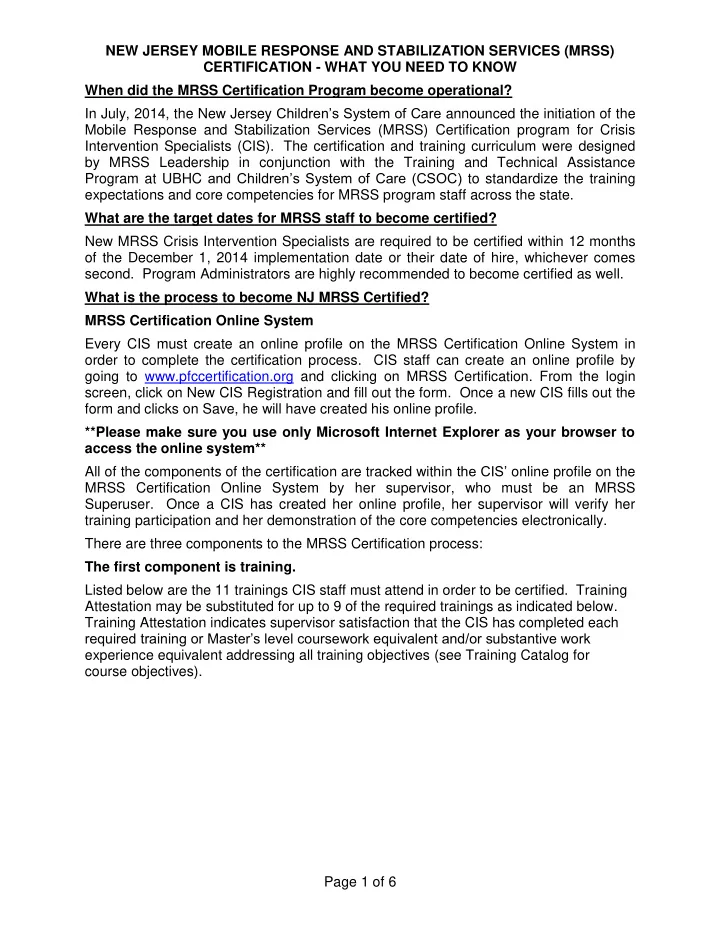
SLIDE 1 NEW JERSEY MOBILE RESPONSE AND STABILIZATION SERVICES (MRSS) CERTIFICATION - WHAT YOU NEED TO KNOW Page 1 of 6 When did the MRSS Certification Program become operational? In July, 2014, the New Jersey Children’s System of Care announced the initiation of the Mobile Response and Stabilization Services (MRSS) Certification program for Crisis Intervention Specialists (CIS). The certification and training curriculum were designed by MRSS Leadership in conjunction with the Training and Technical Assistance Program at UBHC and Children’s System of Care (CSOC) to standardize the training expectations and core competencies for MRSS program staff across the state. What are the target dates for MRSS staff to become certified? New MRSS Crisis Intervention Specialists are required to be certified within 12 months
- f the December 1, 2014 implementation date or their date of hire, whichever comes
- second. Program Administrators are highly recommended to become certified as well.
What is the process to become NJ MRSS Certified? MRSS Certification Online System Every CIS must create an online profile on the MRSS Certification Online System in
- rder to complete the certification process. CIS staff can create an online profile by
going to www.pfccertification.org and clicking on MRSS Certification. From the login screen, click on New CIS Registration and fill out the form. Once a new CIS fills out the form and clicks on Save, he will have created his online profile. **Please make sure you use only Microsoft Internet Explorer as your browser to access the online system** All of the components of the certification are tracked within the CIS’ online profile on the MRSS Certification Online System by her supervisor, who must be an MRSS
- Superuser. Once a CIS has created her online profile, her supervisor will verify her
training participation and her demonstration of the core competencies electronically. There are three components to the MRSS Certification process: The first component is training. Listed below are the 11 trainings CIS staff must attend in order to be certified. Training Attestation may be substituted for up to 9 of the required trainings as indicated below. Training Attestation indicates supervisor satisfaction that the CIS has completed each required training or Master’s level coursework equivalent and/or substantive work experience equivalent addressing all training objectives (see Training Catalog for course objectives).
SLIDE 2
NEW JERSEY MOBILE RESPONSE AND STABILIZATION SERVICES (MRSS) CERTIFICATION - WHAT YOU NEED TO KNOW Page 2 of 6 Training Title Length Source Modality Time Frame
1
Crisis Response Protocol 2 days UBHC Live Training 6 mos
2
Setting Yourself Up for Safety 1 day UBHC Live Training 6 mos
3
DSM* 1 day UBHC Live Training 1 year
4
PBS* – 1 of 5 1 day UBHC Live Training 1 year
5
Cultural Competence* 1 day UBHC Live Training 1 year
6
Developmental Tasks of Childhood and Adolescence * 1 day UBHC Live Training 1 year
7
Engagement & Motivation Skills* 1 day UBHC Live Training 1 year
8
Family Dynamics* 1 day UBHC Live Training 1 year
9
Child Traumatic Stress* 1 day UBHC Live Training 1 year
10 Risk Assessment and Mental
Health* 1 day UBHC Live Training 1 year
11 Understanding Child Abuse and
Reporting Laws* 1 day UBHC Live Training 1 year
Subject Matter Required, Course Titles May Change *MA level Coursework or work experience Equivalent Consideration
CIS staff should begin attending trainings as soon as they are hired in order to meet the certification time frame. If a CIS has attended one of the required trainings prior to his hire date and can provide verification of attendance (Certificate of Attendance or transcript), that training can count toward MRSS Certification. Once a CIS participates in one of the required trainings, she may present her attendance certificate to her supervisor so that the supervisor may verify the CIS’ attendance in her online profile on the MRSS Certification Online System. The second component is core competency. CIS staff must meet all 23 core competencies as verified by their supervisors. Core Competency attestation indicates that a supervisor has consistently observed the defined Core Competency set in practice. See attached sheet for the complete list of core competencies. Note that certification on the use of the CAT IMDS tool is one of the competencies. Each individual core competency is verified, entered and tracked electronically in the CIS online profile by the supervisor. The third component is an online, thirty-six (36) question multiple-choice review. If a CIS’ score on the online review is 70% or higher, he will then be considered “NJ MRSS Certified.” If a CIS’ score is between 60% and 69%, he will be advised to review his training materials and retake the review. If after a second attempt, his score remains between 60% and 69% OR if after a first attempt his score is below 60%, the CIS and his supervisor will be advised to contact Antoinette Gurden at antoinette.gurden@rutgers.edu to discuss his scores on individual content areas. The CIS and his supervisor will be asked to develop a plan to ensure that he receives further training on content areas missed on the online review. The plan may include the CIS attending specific live trainings again AND/OR the CIS reviewing training content with
SLIDE 3
NEW JERSEY MOBILE RESPONSE AND STABILIZATION SERVICES (MRSS) CERTIFICATION - WHAT YOU NEED TO KNOW Page 3 of 6 his supervisor. If a CIS fails a section on the review that was waived by his supervisor, he will be required to attend the corresponding live training. Once the plan has been carried out, the CIS and his supervisor will be advised to contact Antoinette Gurden at antoinette.gurden@rutgers.edu in order to attempt the online review again. What is the process to become a NJ MRSS Superuser? If you supervise MRSS staff and you want them to become NJ MRSS Certified, you will need to be able to establish an online MRSS Superuser file, assign your CIS staff to your staff list, and electronically verify your CIS’ completion of trainings and demonstration of core competencies. CIS staff cannot be NJ MRSS Certified without being assigned to a supervisor and having their supervisors verify training completion and core competencies. Agencies may designate one or more persons to be MRSS Superusers. MRSS supervisors are highly recommended to attend the Crisis Response Protocol training if they have not done so recently. They MUST attend the MRSS Superuser Technical Assistance, which will be provided to them locally, in order to receive the MRSS Superuser login and password that will allow them to access the MRSS Certification Online System and certify their CIS staff. Are MRSS staff required to be re-certified? Yes, all CIS staff are required to be re-certified annually.
Year 1 Recertification
There are two (2) components to the first year recertification process. The first component is live training. Listed below are the 9 trainings CIS staff must attend in order to be re-certified. Training Attestation may be substituted for up to 5 of the required trainings as indicated below. Training Attestation indicates supervisor satisfaction that a CIS has completed each required training or Master’s level coursework equivalent and/or substantive work experience equivalent addressing all training objectives (see Training Catalog for course objectives). Training Title Length Source Modality
1
NJ Wraparound 1 day UBHC Live Training
2
Crisis Intervention with Traumatized Youth 1 day UBHC Live Training
3
Crisis Intervention with Youth with IDD 1 day UBHC Live Training
4
The Nurtured Heart Approach 1 day UBHC Live Training
5
Substance Disorders* - 1 of 4 1 day UBHC Live Training
6
Domestic Violence* – 1 of 2 1 day UBHC Live Training
7
PBS* – 1 of 5 1 day UBHC Live Training
8
Collaboration* 1 day UBHC Live Training
9
Foundations of IDD* 1 day UBHC Live Training
Subject Matter Required, Course Titles May Change *MA level Coursework or work experience Equivalent Consideration
Once a CIS participates in one of the required trainings, she may present her attendance certificate to her supervisor so that her supervisor may verify the CIS’ attendance in her online profile on the MRSS Certification Online System.
SLIDE 4 NEW JERSEY MOBILE RESPONSE AND STABILIZATION SERVICES (MRSS) CERTIFICATION - WHAT YOU NEED TO KNOW Page 4 of 6 The second component is core competency. The CIS’ supervisor must electronically verify in the CIS’ online profile that she continues to meet all core competencies, INCLUDING RECERTIFICATION ON THE CAT TOOL. Once the supervisor verifies all the core competencies and the training attendance, the CIS will be recertified for one year. There is no online review component for the recertification process.
Subsequent Annual Re-Certification
There are two (2) components to the recertification process. The first component is live training. In order to foster a culture of continuing education supportive of best practice, CIS staff must attend 6 trainings relevant to the MRSS role annually, which can be selected from available CSOC trainings and/or other trainings approved by his supervisor. These trainings are intended to be full day information sessions or combinations of half day sessions as opposed to shorter
- webinars. The MRSS Certification Online System will allow selection of CSOC trainings
and offer an option in which text can be entered to document other trainings attended. Once a CIS participates in one of the required trainings, he may present his attendance certificate to his supervisor so that the supervisor may verify the CIS’ attendance in his
- nline profile on the MRSS Certification Online System.
Trainings may be attended at any time between the CIS’ prior certification expiration date and his new expiration date. The second component is core competency. The CIS’ supervisor must electronically verify in the CIS’ online profile that she continues to meet all core competencies, INCLUDING RECERTIFICATION ON THE CAT TOOL. Once the supervisor verifies all the core competencies and the training attendance, the CIS will be recertified for one year. There is no online review component for the recertification process.
SLIDE 5 NEW JERSEY MOBILE RESPONSE AND STABILIZATION SERVICES (MRSS) CERTIFICATION - WHAT YOU NEED TO KNOW Page 5 of 6 The website http://www.nj.gov/dcf/providers/csc/training/ only shows trainings for the following month. Is there any way we can get the schedule further in advance for planning purposes? The schedule is posted by 5pm on the 15th of every month for the following month. Due to the logistics of securing trainers and venues, it is generally not possible to confirm training dates and locations further out than that. I attended Cultural Competence sometime last year. Do I have to take it again? Your supervisor will decide if you need to retake trainings in order to be MRSS Certified. How do I register for MRSS Certification Trainings? You register the same way you would register for any other Children’s System of Care
- training. Go to http://www.nj.gov/dcf/providers/csc/training/ and click on the blue
shaded box to the right that says “Online Training Registration.” Where are the trainings offered? Most required trainings are offered regionally throughout the state. Throughout the year, training locations rotate through the northern, central, and southern regions. The Crisis Response Protocol is generally offered in the central region. I don’t see any of the MRSS Trainings on the http://www.nj.gov/dcf/providers/csc/training/ website except for the MRSS Orientation. Other than the Crisis Response Protocol, the required trainings are open to all system partners and not specifically labeled as MRSS trainings, however, there is a search function on the registration website. Choose MRSS from the “recommended for” dropdown menu in the search field to search for trainings required for MRSS Certification and Recertification.
SLIDE 6
NEW JERSEY MOBILE RESPONSE AND STABILIZATION SERVICES (MRSS) CERTIFICATION - WHAT YOU NEED TO KNOW Page 6 of 6 CORE COMPETENCE WORKSHEET Competency MET
Communication Demonstrates and models empathic communication by using attending, listening and interactive skills to engage and build relationships with youth and families in crisis. Asks questions respectfully and skillfully to elicit relevant information. Discusses observed family dynamics and recurring patterns with family. Models functional skills including problem solving and boundary setting. Effectively synthesizes information gained through observations and conversations. Documents specific, individualized descriptions of behaviors, crisis intervention, strengths-based strategies, measurable outcomes, and progress monitoring. Crisis Intervention/De-escalation De-escalates crises and attends to safety concerns by addressing immediate environmental, personal, and interpersonal factors contributing to crisis. Shares relevant information and skills to help youth and families prevent future crises (i.e. coping skills such as self awareness, self regulation). Develops Family Crisis Plan including proactive and reactive strategies for managing identified crisis triggers and context. Assessment & Planning Applies knowledge of Positive Behavior Support to identify functions of target behaviors, antecedents, triggers, and consequences. Develops interventions addressing both immediate crisis triggers and underlying circumstances contributing to crisis, geared towards prevention of future crisis. Maintains annual certification in the use of the Crisis Assessment Tool (CAT). Facilitates individualized plan development based on youth and family vision, needs and strengths to address crisis behaviors using strengths-based strategies. Develops plans that routinely address all high level needs identified during assessment. ICP Implementation Facilitates linkages to culturally appropriate community-based resources that address identified needs, to support sustainability throughout and following MRSS involvement. Regularly and effectively communicates with family and collateral contacts providing supports to the child/family in order to monitor progress and plan implementation. Demonstrates accountability in developing, implementing, evaluating and adjusting strategies based on available resources and progress monitoring. Overall Approach Applies knowledge of contexts such as child development, family dynamics, mental and physical health symptoms and trauma to make observations, formulate hypotheses and address challenging behaviors from multiple perspectives. Demonstrates a learning approach to working with children/families from varied cultural backgrounds. Makes effective use of team members and supervision process throughout assessment, plan development, implementation and transition. Uses effective strategies for self care to maintain self awareness and a neutral perspective during intervention and service delivery. Demonstrates a hopeful, flexible, energetic, and creative approach. Family members report feeling respected, supported, and empowered by worker.