
SLIDE 1
18TH INTERNATIONAL CONFERENCE ON COMPOSITE MATERIALS 1
1 Introduction ASTRIUM Space Transportation use lightweight structures made of composite materials for space
- vehicles. Weight saving and performance increasing
have been gained by using adhesive joints. Even if a lot of attention is paid during assembling, the process of joining cannot by itself guarantee the health of the joint when complex systems are
- manufactured. Therefore the assembling is generally
controlled with non-destructive techniques. The complexity of the shape of the joint, the anisotropy
- f adherents made of composite materials and the
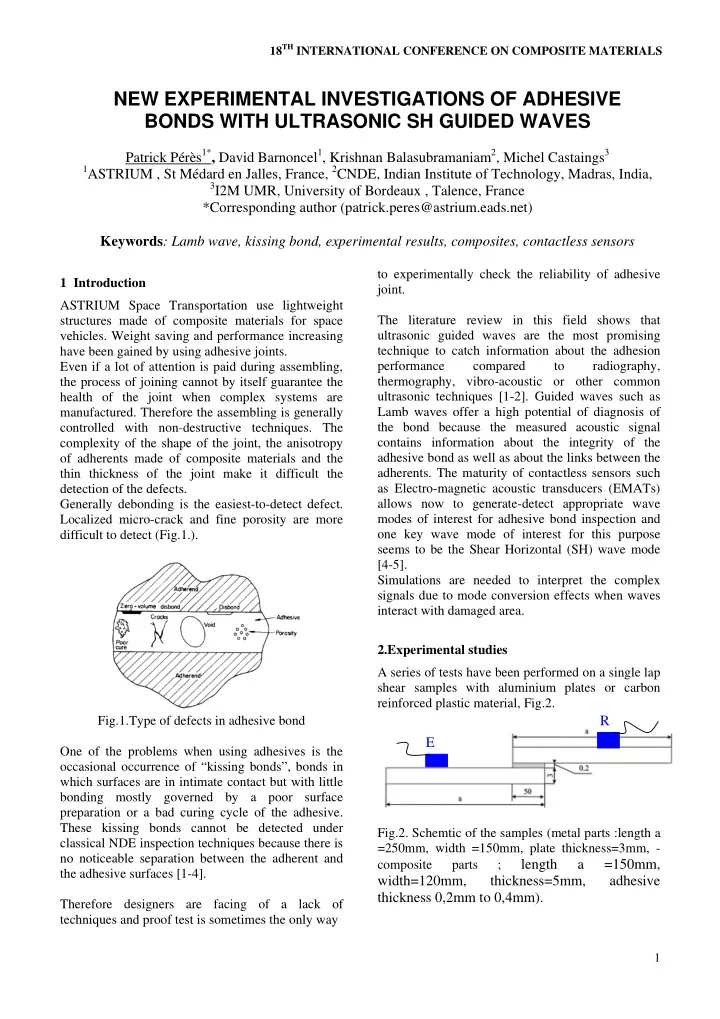
thin thickness of the joint make it difficult the detection of the defects. Generally debonding is the easiest-to-detect defect. Localized micro-crack and fine porosity are more difficult to detect (Fig.1.). Fig.1.Type of defects in adhesive bond One of the problems when using adhesives is the
- ccasional occurrence of “kissing bonds”, bonds in
which surfaces are in intimate contact but with little bonding mostly governed by a poor surface preparation or a bad curing cycle of the adhesive. These kissing bonds cannot be detected under classical NDE inspection techniques because there is no noticeable separation between the adherent and the adhesive surfaces [1-4]. Therefore designers are facing of a lack of techniques and proof test is sometimes the only way to experimentally check the reliability of adhesive joint. The literature review in this field shows that ultrasonic guided waves are the most promising technique to catch information about the adhesion performance compared to radiography, thermography, vibro-acoustic or other common ultrasonic techniques [1-2]. Guided waves such as Lamb waves offer a high potential of diagnosis of the bond because the measured acoustic signal contains information about the integrity of the adhesive bond as well as about the links between the
- adherents. The maturity of contactless sensors such
as Electro-magnetic acoustic transducers (EMATs) allows now to generate-detect appropriate wave modes of interest for adhesive bond inspection and
- ne key wave mode of interest for this purpose
seems to be the Shear Horizontal (SH) wave mode [4-5]. Simulations are needed to interpret the complex signals due to mode conversion effects when waves interact with damaged area. 2.Experimental studies A series of tests have been performed on a single lap shear samples with aluminium plates or carbon reinforced plastic material, Fig.2. Fig.2. Schemtic of the samples (metal parts :length a =250mm, width =150mm, plate thickness=3mm, - composite parts ;
length a =150mm, width=120mm, thickness=5mm, adhesive thickness 0,2mm to 0,4mm).
NEW EXPERIMENTAL INVESTIGATIONS OF ADHESIVE BONDS WITH ULTRASONIC SH GUIDED WAVES
Patrick Pérès1*, David Barnoncel1, Krishnan Balasubramaniam2, Michel Castaings3
1ASTRIUM , St Médard en Jalles, France, 2CNDE, Indian Institute of Technology, Madras, India, 3I2M UMR, University of Bordeaux , Talence, France