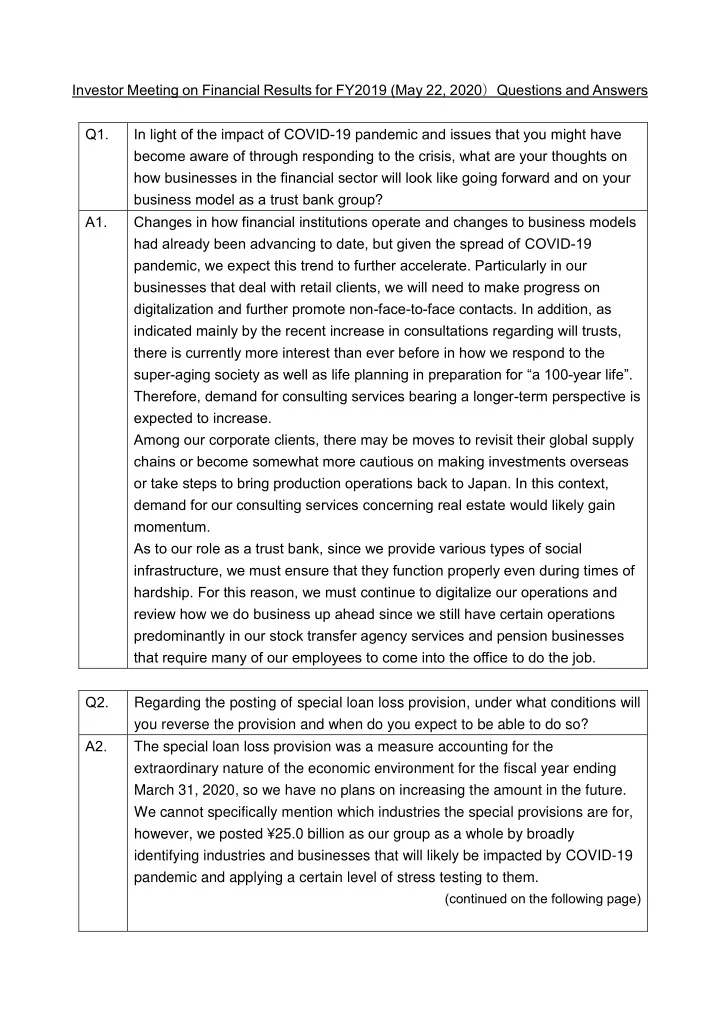
SLIDE 1 Investor Meeting on Financial Results for FY2019 (May 22, 2020) Questions and Answers Q1. In light of the impact of COVID-19 pandemic and issues that you might have become aware of through responding to the crisis, what are your thoughts on how businesses in the financial sector will look like going forward and on your business model as a trust bank group? A1. Changes in how financial institutions operate and changes to business models had already been advancing to date, but given the spread of COVID-19 pandemic, we expect this trend to further accelerate. Particularly in our businesses that deal with retail clients, we will need to make progress on digitalization and further promote non-face-to-face contacts. In addition, as indicated mainly by the recent increase in consultations regarding will trusts, there is currently more interest than ever before in how we respond to the super-aging society as well as life planning in preparation for “a 100-year life”. Therefore, demand for consulting services bearing a longer-term perspective is expected to increase. Among our corporate clients, there may be moves to revisit their global supply chains or become somewhat more cautious on making investments overseas
- r take steps to bring production operations back to Japan. In this context,
demand for our consulting services concerning real estate would likely gain momentum. As to our role as a trust bank, since we provide various types of social infrastructure, we must ensure that they function properly even during times of
- hardship. For this reason, we must continue to digitalize our operations and
review how we do business up ahead since we still have certain operations predominantly in our stock transfer agency services and pension businesses that require many of our employees to come into the office to do the job. Q2. Regarding the posting of special loan loss provision, under what conditions will you reverse the provision and when do you expect to be able to do so? A2. The special loan loss provision was a measure accounting for the extraordinary nature of the economic environment for the fiscal year ending March 31, 2020, so we have no plans on increasing the amount in the future. We cannot specifically mention which industries the special provisions are for, however, we posted ¥25.0 billion as our group as a whole by broadly identifying industries and businesses that will likely be impacted by COVID-19 pandemic and applying a certain level of stress testing to them.
(continued on the following page)
SLIDE 2 We intend to reverse what is left of the special provision once the impact of COVID-19 has subsided. Therefore, if it were to be based on our current assumption that the pandemic will recede in FY 2020, the reversal can be expected to be made around September 2021. Q3. Going forward, how do you intend to position SBI Sumishin Net Bank? A3. SBI Sumishin Net Bank has been able to efficiently capture clients with different profiles to those of SuMi TRUST Bank. As a result of recently capturing new clients of the younger generation coupled with its existing clients’ age rising, clients across a broad age group, including those older than 50 are now using SBI Sumishin Net Bank. Therefore, we expect to see continued advantages through collaboration with SuMi TRUST Bank. Q4. Under an environment of a new normal post the COVID-19 shock, will the relative advantages of SuMi Trust’s business model go up or down? Please explain the outlook by business segments. A4. Considering that needs for various types of consulting will increase, we believe
- ur group’s relative advantage will grow for sure.
Corporate clients are re-acknowledging the importance of the welfare and benefits package for their employees. We think this is where we can be of support by thinking of how the clients’ welfare and benefits can be made substantial through pension schemes such as DC. We will accommodate by
- ffering consultations on finances including catering to the clients’ lending
needs and others. Ways to expand non-face to face consulting for retail clients is a theme that needs to be worked on. And in an age of a 100-year life, there is an increasing demand for longer time horizon consulting. Therefore, the relative advantage
- f SuMi TRUST, capable of offering services across all types of assets
including real estate can only increase. We will steadily ramp up profits in various businesses during the course of this Medium-Term Management Plan. Though there may not be home-run hitters, by sincerely addressing and responding to the needs of individuals, corporations, and investments in each of the business areas and advancing
- ur crossing /merging of capabilities and businesses, we hope to boost the
quality of our client services, broaden the scope of businesses we have with the customers and respond to deeper rooted issues that they are facing.
(continued on the following page)
SLIDE 3 Q5. If ROE for the final year of the Medium-Term Management Plan is 7%, equity capital will need to be kept within 2.7 trillion yen. What are your thoughts on capital deployment such as for organic/inorganic growth, returns to shareholders and such, both from a short term as well as medium to long term perspective? A5. Starting with the shorter time horizon of one year or less, solidly responding to lending demand will be of utmost significance. On the other hand, for a medium to long time frame of 3 to 5 years, we will also consider growing the scope of our service offerings, improving quality as well as enhancing profitability through strategic inorganic investments. As for inorganic investments, we plan to consider use of capital for seeking efficiencies in areas such as system development where we had been nurturing our own talent for the job or operations we had been outsourcing
- utside of the group to date.
We have reviewed our shareholder return policy this time to place further focus
- n dividends. However, our direction to enhance shareholder return in line with
sustainable and steady profit growth will remain unchanged. On the other hand, since there is the will to make certain levels of dynamic use
- f capital including the option to invest for inorganic growth as mentioned
before, use of capital will be considered within the context of the overall balance. Q6. I believe your FY 2020 plan has priced in quite a bit of COVID-19 shock impacts. What are the types of downside risks in the assumption? A6. The FY 2020 guidance is well assuming impacts from the COVID-19 shock. As for credit cost which is presumably an area of most interest, in light of an environment that is highly uncertain, a total of 55.0 billion, equivalent to around 30bps in corporate credits has been assumed with FY 2020 also assuming a cost of 30.0 billion yen in addition to the 25.0 billion yen special loan loss provision posted in FY 2019. Impacts from the COVID-19 shock is globally spreading and when the situation will return to normal is unclear. Therefore, it cannot be asserted that impact will surely be confined within this scope. However, risk is limited and under control for both retail and corporates including overseas credits and we believe that impact will be relatively less significant even under various stress scenarios.
(continued on the following page)
SLIDE 4 Q7. Are there areas in your expense strategy where you can go further to seek even more efficiency? And please provide the breakdown for the 7.0 billion yen advance investments
A7. We are considering various possibilities for further cost reduction. Reconsidering branch location buildings could be an option. We are developing a plan to slim down branches under our branch strategy by accounting for how contacts with clients should be made. Yet there may be
- pportunities to take further steps depending on the profile of client needs or
potential of each specific geographical area. As to the 7.0 billion yen advance investment, most of this would be system investments for new businesses in various areas, investments for building alliances/collaborations with third-parties, or cost for partial equity investments and others. Q8. Please share updates if any on the collaboration with the UBS group in the wealth management business regarding the status of access to clients, assumed scale of assets under administration, and KPIs of focus. A8. With the establishment of a joint marketing company in January, we had started accessing to clients. Until the start of self-restraints on face to face marketing, access to clients were progressing on many different fronts. However, with the implementation
- f self-restraint initiatives, we had no choice but to refrain from and postpone
promotional activities including seminars and events that had been in plan from the beginning of the year. The weight of face to face marketing is quite high, however, we are working on cultivating new clients and collaborating with corporates via web marketing. We will carve out the wealth management capability out of UBS securities within 2021 to establish a new securities company and full-fledged operations will start from there. It is difficult to project the level of assets under administration from clients in the medium term, yet “the number of clients x breadth of businesses with clients” should be the KPI.
(continued on the following page)
SLIDE 5
Q9. Decline in office demand is expected due to impacts from COVID-19. Please share the impacts to property prices both in and outside of Japan as well as impact to the real estate business. A9. Hotels and commercial facilities are suffering most recently. However, impact to offices are expected to remain limited for the time being and assume it will continue to be strong in FY 2020. Yet, with remote work projected to increase in the future, office demand may not grow as it did in the past due to complete working from home situations and expansion of satellite offices located closer to residential areas. Though there are continuing needs for both selling and buying real estate, in and outside of Japan, since overseas investors cannot physically visit the sites, and as for situations in Japan where tackling COVID-19 related measures are keeping schedules busy, speed of transactions are slower and we are also closely monitoring the impacts from limitations on marketing activities. There are signs of similar to post-Lehman crisis situations developing to property prices where sellers are expecting pre-shock price levels and buyers are thinking that purchases can be made at cheaper than original prices. Thus, expected prices of sellers and buyers are starting to show discrepancies. This is where we, SuMi Trust can show our full potential as a real estate broker but property prices and market trends should start to be set as more transactions close and track-records are built. Q10. It was mentioned that profits attributable to deployment of surplus foreign currency funds are expected to drop. What are the reasons since demand for foreign currencies from corporates appear to be continuing? A10. Profits attributable to deployment of surplus foreign currency funds are a result of the gap between NCD and USPC funding costs which act as the source for foreign currency funding and investment gains. Funding costs are more recently stabilizing and foreign currency demand is expected to remain. However, comparing with FY 2019 where a relatively large net revenue of 21.2 billion yen after funding cost was posted, a decline is expected in FY 2020.
(continued on the following page)
SLIDE 6
Q11. It was noted that growth drivers for the new Medium-Term Management plan are Retail TS business, Real estate business, and Fiduciary business. However, Wholesale business was pulling the business forward during the 3 years of the previous Medium-Term Management Plan and Retail TS business was suffering. What is the backdrop to assuming that Retail TS business will grow this time? What is the background to thinking that Real estate business will grow when there is possibility that property prices will collapse due to the COVID-19 shock? Further, does the significant growth you are expecting in Fiduciary business include inorganic growth in the plan as well? A11. Generally speaking, the plan expects revenues of each business to steadily grow in the order of a few billion yen respectively. However, Global markets business is viewed conservatively since FY 2019 posted very strong results. Retail TS business struggled in investment trust sales and the struggle is continuing most recently with the ongoing voluntary restraint on face to face marketing activities. However, we are assuming growth in inheritance related and asset administration areas especially for the senior generation. Moreover, growth in Private banking business is also anticipated. Apart from the aforementioned, in Work place business for the asset formation generation, though we expect that it will require some time until profitability can be generated, we will build up revenue in the medium to long term by promoting the advancement of asset management through our consulting capabilities leveraging experience and know hows fostered in the pension area. Real estate business will be unable to avoid market impact, yet if we were to view the Medium-Term Management Plan period as a whole, needs for asset sales and consulting should grow where corporate owned assets will be subject to an overall review with the impact from COVID-19. In addition, property investment needs among investors are expected to be sustained with the continuing ultra-low interest rate environment. Even in the wealth management business under alliance with the UBS group, the number of property related consultations and concrete brokerage deals are increasing and is looking promising moving forward as well. Inorganic growth is not included in the assumption for Fiduciary business. Asset management business will take inorganic growth into account, yet both Sumitomo Mitsui Trust Asset Management and Nikko Asset Management will each ramp up revenue by leveraging their respective uniqueness. (continuing to the next page)
SLIDE 7 A11. Moreover, outsourcing services for securities management administration work made available for asset managers called JABIS(*) is steadily increasing and is expected to continue growing.
(*)Abbreviation for Japan Asset Business Information services; outsourcing services offered for securities administration work
Q12. Regarding the credit portfolio. The original policy was to increase product related credits. However, please share how that was looking at the end of March with the larger impact coming from COVID-19. Further, is there impact
- n the new medium-term plan initiatives?
A12. Aircraft financing which is heavily impacted by COVID-19 is in essence stopped most recently and new deals related to product credits are generally
- stagnated. We have always kept credits in emerging markets diversified and
they have guarantees such as ECA and others attached. Further risk management is in place with close monitoring of the developments. As to medium to long term policies from here and on, the direction to control corporate loans to a certain extent and increase more profitable and efficient product related credits will remain unchanged. However, we may be reconsidering policies individually by asset class. For example, discerning off-taker risks and taking cautious approaches to in- construction risks in project financing will be prerequisites, however, we plan to continue focusing on infrastructure related project financing. As to real estate related portfolios, in view of life-style changes to happen not just in Japan but globally, we will narrow down acceptable usages more so than to date and engage under close scrutiny of the risks involved.
Forward-Looking Statements This document contains statements about future earnings. Such forward-looking statements do not guarantee future performance and involve risks and
- uncertainties. Please note that future results may differ from stated targets as a result of various
factors, including changes in managerial circumstances. Information regarding companies and
- ther entities outside the Group has been obtained from publicly available information and other
- sources. The accuracy and appropriateness of that information has not been verified and cannot
be guaranteed. The information in this document was prepared for the purpose of information provision and does not constitute an invitation to purchase securities.