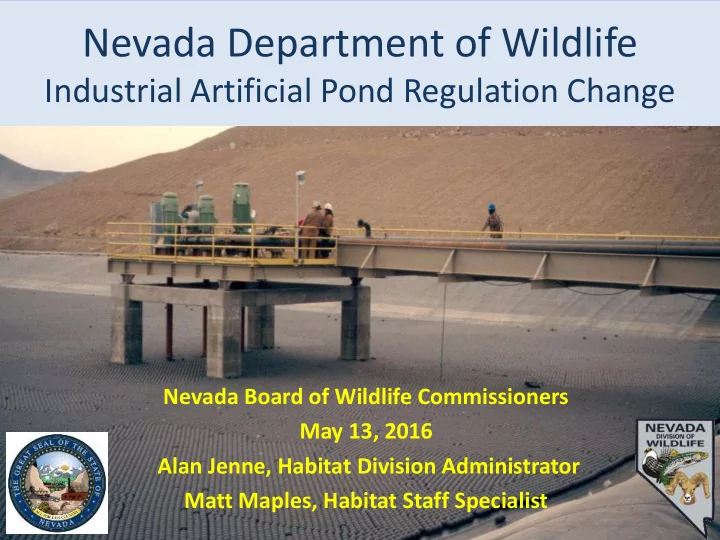
Nevada Department of Wildlife Industrial Artificial Pond Regulation - - PowerPoint PPT Presentation

nevada department of wildlife
SMART_READER_LITE
LIVE PREVIEW

Nevada Department of Wildlife Industrial Artificial Pond Regulation - - PowerPoint PPT Presentation

Nevada Department of Wildlife Industrial Artificial Pond Regulation Change Nevada Board of Wildlife Commissioners May 13, 2016 Alan Jenne, Habitat Division Administrator Matt Maples, Habitat Staff Specialist NRS 502.390 Requires a permit to


slide-1
SLIDE 1

Nevada Department of Wildlife

Industrial Artificial Pond Regulation Change

Nevada Board of Wildlife Commissioners May 13, 2016 Alan Jenne, Habitat Division Administrator Matt Maples, Habitat Staff Specialist

slide-2
SLIDE 2

Requires a permit to develop or maintain certain bodies of water; fees and assessments; penalties

1. Defines the type of ponds or operations that must have an Industrial Artificial Pond Permit (IAPP) 2. Provides guidelines as to how permits should be issued, renewed, transferred, or denied 3. Provides for the permit cost (no more than $125 per year) 4. Requires an annual assessment fee (no more than $10,000 per year) as determined by the Nevada Board of Wildlife Commissioners 5. Specifies penalties (misdemeanor or gross misdemeanor) for failure to

  • btain a permit, comply with permit conditions, or pay assessment fees

NRS 502.390

slide-3
SLIDE 3

To implement NRS, the Nevada Board of Wildlife Commissioners adopted Nevada Administrative Code (NAC) NAC 502.460 to 502.495 in 1989-1991 and it has not been changed since. This proposed regulation change modifies only NAC, not NRS.

slide-4
SLIDE 4
  • Changes to assessment fee structure

to encompass more active permittees and align assessment fees more closely with cost (cost- recovery).

  • Add/modify certain definitions to

support the revised assessment fees.

  • Clean-up and additional language to

clarify purpose of permits and process for permit issuance, renewal, and modification.

Proposed Regulation Change

slide-5
SLIDE 5
  • January 2016 – 3 Stakeholder

meetings were held across the state in Reno, Elko and Las Vegas to present a draft regulation and receive input. All permit holders were invited.

  • Coordinated with NDEP and

NDOM.

  • Met multiple times with Nevada

Mining Association.

  • Reached out to Power and

Geothermal Industry.

Outreach and Input

slide-6
SLIDE 6

NAC 502.482 Requires permittees to pay an annual assessment fee based on the tons of material processed through a mill or a heap leach pad during the previous fiscal year.

Overview of existing NAC Regulations

slide-7
SLIDE 7

– Only 55% of current permit holders pay an annual assessment. – Many projects that require significant staff time and inspections are paying $0 to $50 per year. – Program cost is approximately $578,000 but assessment fees

  • nly bring in $258,000.

– Program has a funding shortfall of $320,000 per year. – Average NDOW cost per permit ~$6,423/year

  • Costs include staff time to issue and manage permits,

conduct compliance inspections and review quarterly reports. – Average revenue per permit is ~$2,870

Assessment Fee Challenges

slide-8
SLIDE 8
  • Establish three Assessment Fee Schedules:

a) Number of tons of ore a facility is designed to process per year, b) Cumulative acres of artificial water bodies a facility is designed to include, and c) Cumulative number artificial water bodies a facility is designed to include.

  • These schedules will increase the number of facilities that are

required to pay an assessment fee.

  • Inclusion of industries beyond mining (solar, geothermal, coal

power plants).

  • Assessment fee would be required from most permitted facilities.

Increasing payees from 55% to 100%.

How will the proposed assessment fee structure work?

slide-9
SLIDE 9
  • Establish five Payment Tiers within each Fee Schedule:
  • As project size or production increases, the fee will increase.
  • Larger projects require more effort to permit and inspect (higher

costs to NDOW).

  • Payment tier for permanently closed facilities that still require an

IAP permit, and create permitting/inspection costs.

  • The highest payment tier will not exceed the existing fee cap of

$10,000 per year.

  • The proposed payment tiers start at $1,000 and increase to

$10,000 per year.

How will the proposed assessment fee structure work?

slide-10
SLIDE 10

Fee Calculation Example

(A) Ore Tons (B) Pond Acres (C) Pond Census Tier 4 $10,000 $10,000 $10,000 Tier 3 $6,000 $6,000 $6,000 Tier 2 $3,000 $3,000 $3,000 Tier 1 $1,500 $1,500 $1,500 Permanent Closure $1,000 $1,000 $1,000

  • Example of assessment fee calculation for a project that includes:

– Designed to process 250,000 tons of ore per year = Tier 3 in Schedule A (Ore Tons) – Has a total of 30 surface acres in ponds at the facility = Tier 2 in Schedule B (Pond Acres) – Has 3 individual ponds at the facility = Tier 1 in Schedule C (Pond Census) The assessment fee is based on the highest qualifying payment tier. In this example, the project’s assessment fee would be $6,000 per year.

slide-11
SLIDE 11

Questions?