Neutronization and weak reactions in SNe Ia Edward Brown Michigan - - PowerPoint PPT Presentation

neutronization and weak reactions in sne ia
SMART_READER_LITE
LIVE PREVIEW

Neutronization and weak reactions in SNe Ia Edward Brown Michigan - - PowerPoint PPT Presentation

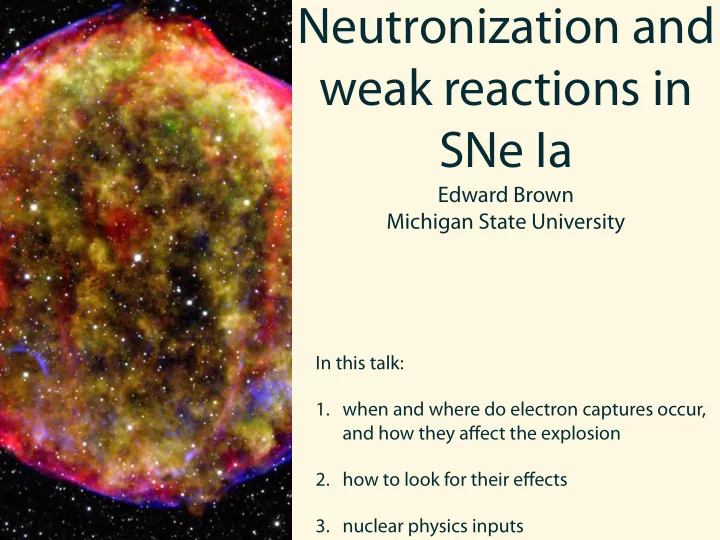
Neutronization and weak reactions in SNe Ia Edward Brown Michigan State University In this talk: 1. when and where do electron captures occur, and how they a ff ect the explosion 2. how to look for their e ff ects 3. nuclear physics inputs to


slide-1
SLIDE 1

Neutronization and weak reactions in SNe Ia

Edward Brown Michigan State University

In this talk:

  • 1. when and where do electron captures occur,

and how they affect the explosion

  • 2. how to look for their effects
  • 3. nuclear physics inputs
slide-2
SLIDE 2

to get an explosion to look (superfjcially) like a Ia…

2

…detonate ≈ 1Msun C- O WD with a central density ≈108 g cm-3 (Woosley, yesterday)

There are potentially

many ways to do this.

slide-3
SLIDE 3

3

Evidence that at least some SNe Ia come from near MCh WDs with high central densities Abundance of 55Mn (Seitenzahl ’13; next talk) late-time NIR spectroscopy of 2005df suggests ρ ≈ 109 g cm-3 (Diamond et al. ’15)

slide-4
SLIDE 4

MS CNO abundance sets starting neutron-to-proton ratio

4

➤ ➤ ➤ ➤ ➤ ➤ ➤ ➤ ➤

C (6) N (7) O (8) F (9) Ne (10) 6 7 8 9 10 11 12 10

  • 1

10 10

1

.2 .4 .6 Mass of

56Ni ejected (Msun)

Metallicity of Progenitor (Z/Zsun) Dominguez et al. Analytical result W7 models

Factor of 3 variation in the CNO + Fe abundances ~25% variation in

56Ni

() = ()

  • − .
  • Explosion dynamics insensitive

to 22Ne abundance; Townsley et

  • al. ’09

Can account for ≈10% of 56Ni variation (Howell et al. ’09)

slide-5
SLIDE 5

Testing this relation with the “twins” 2011fe, 2011by (see talk by Graham)

5

Foley & Kirshner ’13, Graham et al. ‘14

Production of stable 58Ni,

54Fe affects NUV (Lentz et

al., Sauer et al.)

slide-6
SLIDE 6

simmering

6

Nonaka et al. 2012; image courtesy M. Zingale

≈ × () ≈ ×

Woosley et al. (04)

slide-7
SLIDE 7

neutronization during simmering

7

A reaction flow out of a nuclide i is defined by

f ≡

t+T

t

dYi dt

  • reaction

dt.

➤ ➤

➤ ➤

  • n (0)

H (1) He (2) Li (3) Be (4) B (5) C (6) N (7) O (8) F (9) Ne (10) Na (11) Mg (12) 1 2 3 4 5 6 7 8 9 10 11 12 13 14 15 > . × −

Piro & Bildsten ’08, Chamulak et al ‘08

slide-8
SLIDE 8

decrease in e- abundance (equivalent to X(22Ne) from Z≈ 2/3 Zsun)

8

tH < t23

  • [Y12(t = 0)−Y12(t)]×103

[Ye(t = 0)−Ye(t)]×104

T = 0.27 GK; tH = 103 yr T = 0.35 GK; tH = 101 yr T = 0.44 GK; tH = 10−1 yr T = 0.54 GK; tH = 10−3 yr T = 0.67 GK; tH = 10−5 yr T = 0.85 GK; tH = 10−7 yr

1 2 3 4 2 4 6 8 Piro & Bildsten ’08; Chamulak et al. ‘08

slide-9
SLIDE 9

QSE products are sensitive to Ye

9

De et al. ‘14

  • =
  • +
  • +
  • +
  • +
  • ,
  • .
  • A more comprehensive study (post-

processing DDT) is in preparation (Miles, van Rossum, Townsley et al.)

slide-10
SLIDE 10
slide-11
SLIDE 11

convective Urca


11

  • T (GK)

tconv (s), tec (s) 0.2 0.3 0.4 0.5 0.6 0.7 0.8 10 102 103 104

ρinit = 1.0×10⁹ gcm−3 ρinit = 3.0×10⁹ gcm−3 ρinit = 6.0×10⁹ gcm−3

Mixing becomes faster than

23Na(e-,νe)23Ne

Chamulak et al. ‘08 Denissenkov et al. ‘15

electron captures/beta decays on 23Na,

25Mg affect the convective fmow

(Paczynski, Barkat & Wheeler, Iben, Mochkovitch, Stein & Wheeler) Energy loss via neutrinos acts as a bulk viscosity (Bisnovatyi-Kogan ’01); confjnes convective zone. This is not accounted for in MLT (Lesaffre et al. ’05; Denissenkov et

  • al. ’15)
slide-12
SLIDE 12

Nuclear physics input

12

“Despite experimental and theoretical progress, lack of knowledge of relevant or accurate weak-interaction data still constitutes a major

  • bstacle in the simulation of some astrophysical scenarios today.”

Langanke & Martinez-Pineado 2003, RMP

  • Supernovae (both core-collapse and white dwarf)
  • Accreting neutron stars
  • Nucleosynthesis (r-, s-process)
slide-13
SLIDE 13

JINA-CEE NSF Physics Frontier Center

Joint Institute for Nuclear Astrophysics—Center for the Evolution of the Elements

13

H & He Burn B1.1 Pyconuclear B1.2 Masses B1.3 Neutron Capture B1.4 Transport B2.1 X-ray Burst B3.1 Superburst B4.3 NS Mergers B3.2 X-ray LC B4.1 X-ray Spectra B4.2 NS Crust B4.4 NS Nuclear B4.4 H-Burn A1.1 Aprahamian, Wiescher Aprahamian, Wiescher Reddy, Wiescher, Timmes Wiescher, Timmes Aprahamian, Clark, Reddy, Schatz, Ott, Zegers Aprahamian, McLaughlin, Schatz, Wiescher Beers, Frebel Heger, Herwig, Timmes Herwig, Woodward Burrows, Heger, Herwig, McLaughlin, Ott, Schatz, Truran Heger, Herwig, Timmes Burrows, McLaughlin, Ott, Reddy Beers, Herwig, Frebel, O’Shea, Timmes, Truran Brown, Burrows, Ott, Reddy, Schatz, Zegers Brown, Reddy, Schatz

  • E. Brown, Galloway, Heger, Schatz

Galloway,Cackett

  • E. Brown, Galloway,

Heger, Schatz McLaughlin, Burrows, Ott, Reddy, Schatz, Zegers

  • E. Brown, Galloway,

Heger, Schatz

  • E. Brown, Reddy

Nunes, Reddy Aprahamian, Clark, Reddy, Schatz Wiescher, Reddy Aprahamian, Bardayan, Clark, Nunes, Schatz, Wiescher He-Burn A1.2 C-Burn A1.3 Screening A1.4 Weak Reactions A1.5 Neutron Production A1.6 Observations A2.1 First Stars A3.1 i-process A3.2 r- and νp-process A3.3 Early Stars A3.4 Supernovae A3.5 Chem Evol A4.1

MA2 MA1

slide-14
SLIDE 14

JINA-CEE NSF Physics Frontier Center

Charge-exchange group at NSCL (R. Zegers)

14

H & He Burn B1.1 Pyconuclear B1.2 Masses B1.3 Neutron Capture B1.4 Transport B2.1 X-ray Burst B3.1 Superburst B4.3 NS Mergers B3.2 X-ray LC B4.1 X-ray Spectra B4.2 NS Crust B4.4 NS Nuclear B4.4 H-Burn A1.1 Aprahamian, Wiescher Aprahamian, Wiescher Reddy, Wiescher, Timmes Wiescher, Timmes Aprahamian, Clark, Reddy, Schatz, Ott, Zegers Aprahamian, McLaughlin, Schatz, Wiescher Beers, Frebel Heger, Herwig, Timmes Herwig, Woodward Burrows, Heger, Herwig, McLaughlin, Ott, Schatz, Truran Heger, Herwig, Timmes Burrows, McLaughlin, Ott, Reddy Beers, Herwig, Frebel, O’Shea, Timmes, Truran Brown, Burrows, Ott, Reddy, Schatz, Zegers Brown, Reddy, Schatz

  • E. Brown, Galloway, Heger, Schatz

Galloway,Cackett

  • E. Brown, Galloway,

Heger, Schatz McLaughlin, Burrows, Ott, Reddy, Schatz, Zegers

  • E. Brown, Galloway,

Heger, Schatz

  • E. Brown, Reddy

Nunes, Reddy Aprahamian, Clark, Reddy, Schatz Wiescher, Reddy Aprahamian, Bardayan, Clark, Nunes, Schatz, Wiescher He-Burn A1.2 C-Burn A1.3 Screening A1.4 Weak Reactions A1.5 Neutron Production A1.6 Observations A2.1 First Stars A3.1 i-process A3.2 r- and νp-process A3.3 Early Stars A3.4 Supernovae A3.5 Chem Evol A4.1

MA2 MA1

1. perform charge-exchange experiments (for example,

56Ni(p,n)56Cu measures transition

rates in β- direction; 46Ti(t,3He+γ)46Sc at intermediate energies to benchmark and test theoretical rate calculations 2. work together hand-in-hand with nuclear theorists and astrophysicists to develop improved weak-rate sets and perform improved astrophysical simulations
slide-15
SLIDE 15
  • Normally, 13N decays via β+ (Q =

2.22 MeV)

  • Electron Fermi energy is 5.1 MeV,

so capture into excited state (E = 3.68 MeV) of 13C is possible

  • Increases capture rate
  • Increases heat deposition

15

13 13 13 13

B C N

O

3/2 T= 3/2 3/2 T= 3/2 3/2 T= 3/2 3/2 T= 3/2 3/2 T= 1/2 3/2 T= 1/2 1/2 T= 1/2 1/2 T= 1/2

1 2 3 4 5 6 7

β

+

β

+

β

  • 3.68 M

eV 3.51 M eV 15.1 MeV (Q=2.22 MeV) T =3/2

z

T =1/2

z

T = 1/2

z

T = 3/2

z

  • PHYSICAL REVIEW C 77, 024307 (2008)

Gamow-Teller strength for the analog transitions to the first T = 1/2, Jπ = 3/2− states in 13C and

13N and the implications for type Ia supernovae

  • R. G. T. Zegers,1,2,3,* E. F. Brown,1,2,3 H. Akimune,4 Sam M. Austin,1,3 A. M. van den Berg,5 B. A. Brown,1,2,3
  • D. A. Chamulak,2,3 Y. Fujita,6 M. Fujiwara,7,8 S. Gal`

es,9 M. N. Harakeh,5 H. Hashimoto,8 R. Hayami,10 G. W. Hitt,1,2,3

  • M. Itoh,11 T. Kawabata,12 K. Kawase,8 M. Kinoshita,4 K. Nakanishi,8 S. Nakayama,10 S. Okumura,8 Y. Shimbara,1,3
  • M. Uchida,13 H. Ueno,14 T. Yamagata,4 and M. Yosoi8

1National Superconducting Cyclotron Laboratory, Michigan State University, East Lansing, Michigan 48824-1321, USA

slide-16
SLIDE 16

JINA-CEE NSF Physics Frontier Center

Completed: Comprehensive evaluation of theoretical electron-capture rates in pf-shell near stability.

16

slide-17
SLIDE 17

JINA-CEE NSF Physics Frontier Center

Gamow-Teller transitions from 56Ni (Sasano et al., 2011, PRL)

17

1 2 3 1 2 3 4 5 6 7

Ex(56Cu) (MeV) B(GT) (MeV-1) data (sta. error)

  • syst. error

GXPF1A KB3G

56Ni 56Cu

∝cross-section

GXPF1A, KB3G are different nuclear interaction models used to calculate EC rates

slide-18
SLIDE 18

JINA-CEE NSF Physics Frontier Center

Facility for Rare Isotope Beams, MSU—1 year ago

18

slide-19
SLIDE 19

JINA-CEE NSF Physics Frontier Center

Facility for Rare Isotope Beams, MSU—yesterday

19

slide-20
SLIDE 20

NEW Computational Mathematics, Science, and Engineering at MSU

20

3D simulation of a massive star just prior to collapse and explosion as a supernova. Couch et al. (2015)

Offers both 
 graduate and undergraduate programs in computational

  • science. Astronomy faculty

Brian O’Shea and Sean Couch have joint appointments. We are looking for talented graduate students interested in computational modeling!

slide-21
SLIDE 21

Discussion

  • 1. What important physics haven’t we included in the

simmering phase? Is the convective Urca important? What could derail “ignition at only one point”?

  • 2. What is the greatest impediment to improving

determinations of metallicity?

21