Network in Network (NiN) Network in Network (NiN) In [1]: import - - PowerPoint PPT Presentation

network in network nin network in network nin
SMART_READER_LITE
LIVE PREVIEW

Network in Network (NiN) Network in Network (NiN) In [1]: import - - PowerPoint PPT Presentation

2/27/2019 nin slides Network in Network (NiN) Network in Network (NiN) In [1]: import d2l from mxnet import gluon, init, nd from mxnet.gluon import nn http://127.0.0.1:8000/nin.slides.html?print-pdf/#/ 1/4 2/27/2019 nin slides In [2]: def


slide-1
SLIDE 1

2/27/2019 nin slides http://127.0.0.1:8000/nin.slides.html?print-pdf/#/ 1/4
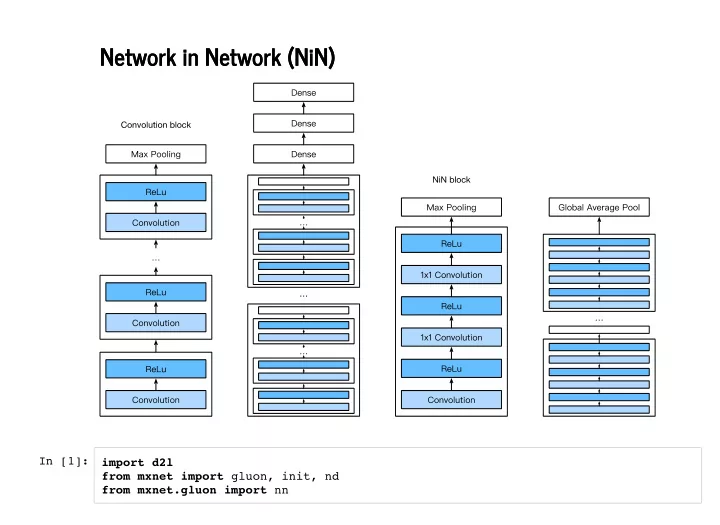
Network in Network (NiN) Network in Network (NiN)

In [1]: import d2l from mxnet import gluon, init, nd from mxnet.gluon import nn

slide-2
SLIDE 2

2/27/2019 nin slides http://127.0.0.1:8000/nin.slides.html?print-pdf/#/ 2/4

In [2]:

NiN Model

In [3]: def nin_block(num_channels, kernel_size, strides, padding): blk = nn.HybridSequential() blk.add(nn.Conv2D(num_channels, kernel_size, strides, padding, activation='rel u'), nn.Conv2D(num_channels, kernel_size=1, activation='relu'), nn.Conv2D(num_channels, kernel_size=1, activation='relu')) return blk net = nn.HybridSequential() net.add(nin_block(96, kernel_size=11, strides=4, padding=0), nn.MaxPool2D(pool_size=3, strides=2), nin_block(256, kernel_size=5, strides=1, padding=2), nn.MaxPool2D(pool_size=3, strides=2), nin_block(384, kernel_size=3, strides=1, padding=1), nn.MaxPool2D(pool_size=3, strides=2), nn.Dropout(0.5), # There are 10 label classes. nin_block(10, kernel_size=3, strides=1, padding=1), # The global average pooling layer aggregates over all entries nn.GlobalAvgPool2D(), # Transform the four-dimensional output into two-dimensional output nn.Flatten())

slide-3
SLIDE 3

2/27/2019 nin slides http://127.0.0.1:8000/nin.slides.html?print-pdf/#/ 3/4

Output shapes throughout the network

In [4]: X = nd.random.uniform(shape=(1, 1, 224, 224)) net.initialize() for layer in net: X = layer(X) print(layer.name, 'output shape:\t', X.shape) hybridsequential1 output shape: (1, 96, 54, 54) pool0 output shape: (1, 96, 26, 26) hybridsequential2 output shape: (1, 256, 26, 26) pool1 output shape: (1, 256, 12, 12) hybridsequential3 output shape: (1, 384, 12, 12) pool2 output shape: (1, 384, 5, 5) dropout0 output shape: (1, 384, 5, 5) hybridsequential4 output shape: (1, 10, 5, 5) pool3 output shape: (1, 10, 1, 1) flatten0 output shape: (1, 10)

slide-4
SLIDE 4

2/27/2019 nin slides http://127.0.0.1:8000/nin.slides.html?print-pdf/#/ 4/4

Training

In [5]: lr, num_epochs, batch_size, ctx = 0.1, 5, 128, d2l.try_gpu() net.initialize(force_reinit=True, ctx=ctx, init=init.Xavier()) net.hybridize() trainer = gluon.Trainer(net.collect_params(), 'sgd', {'learning_rate': lr}) train_iter, test_iter = d2l.load_data_fashion_mnist(batch_size, resize=224) d2l.train_ch5(net, train_iter, test_iter, batch_size, trainer, ctx, num_epochs) training on gpu(0) epoch 1, loss 2.2738, train acc 0.166, test acc 0.286, time 23.5 sec epoch 2, loss 1.5193, train acc 0.438, test acc 0.615, time 22.2 sec epoch 3, loss 0.7831, train acc 0.702, test acc 0.762, time 22.1 sec epoch 4, loss 0.6504, train acc 0.755, test acc 0.814, time 22.2 sec epoch 5, loss 0.5287, train acc 0.803, test acc 0.828, time 22.2 sec