
CS 573: Algorithms, Fall 2014
Network Flow IV - Applications II
Lecture 14
October 14, 2014
1/61
Airline Scheduling
Problem
Given information about flights that an airline needs to provide, generate a profitable schedule.
- 1. Input: detailed information about “legs” of flight.
- 2. F: set of flights by
- 3. Purpose: find minimum # airplanes needed.
2/61
Example
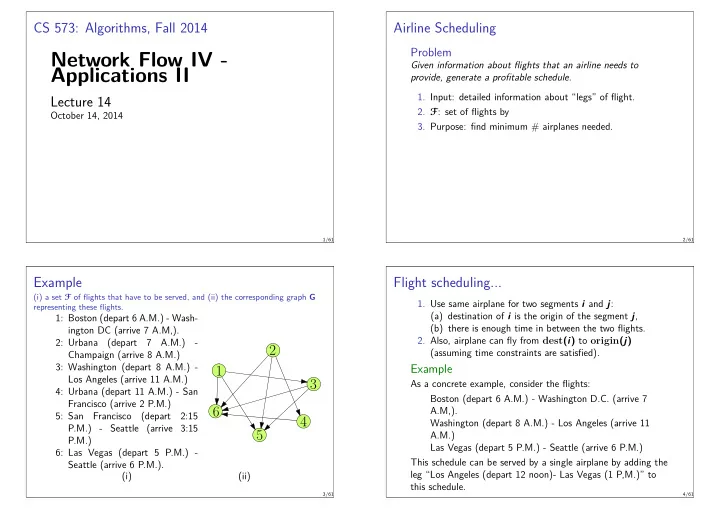
(i) a set F of flights that have to be served, and (ii) the corresponding graph G representing these flights.
1: Boston (depart 6 A.M.) - Wash- ington DC (arrive 7 A.M,). 2: Urbana (depart 7 A.M.)
- Champaign (arrive 8 A.M.)
3: Washington (depart 8 A.M.) - Los Angeles (arrive 11 A.M.) 4: Urbana (depart 11 A.M.) - San Francisco (arrive 2 P.M.) 5: San Francisco (depart 2:15 P.M.) - Seattle (arrive 3:15 P.M.) 6: Las Vegas (depart 5 P.M.) - Seattle (arrive 6 P.M.).
4 5 6 1 2 3
(i) (ii)
3/61
Flight scheduling...
- 1. Use same airplane for two segments i and j:
(a) destination of i is the origin of the segment j, (b) there is enough time in between the two flights.
- 2. Also, airplane can fly from dest(i) to origin(j)
(assuming time constraints are satisfied).
Example
As a concrete example, consider the flights: Boston (depart 6 A.M.) - Washington D.C. (arrive 7 A.M,). Washington (depart 8 A.M.) - Los Angeles (arrive 11 A.M.) Las Vegas (depart 5 P.M.) - Seattle (arrive 6 P.M.) This schedule can be served by a single airplane by adding the leg “Los Angeles (depart 12 noon)- Las Vegas (1 P,M.)” to this schedule.
4/61