Needs for Physical Models and Related Methods for Development of - - PDF document

needs for physical models and related methods for
SMART_READER_LITE
LIVE PREVIEW

Needs for Physical Models and Related Methods for Development of - - PDF document

Jubilee Symposium 2019: Future Directions of System Modeling and Simulation Needs for Physical Models and Related Methods for Development of Automated Road Vehicles Professor in Vehicle Dynamics, PhD Bengt Jacobson (Chalmers University of

slide-1
SLIDE 1

1

Professor in Vehicle Dynamics, PhD Bengt Jacobson (Chalmers University of Technology; Sweden) Industrial researcher, PhD Peter Nilsson (Volvo Global Trucks Technology; Sweden) Senior researcher, PhD Mats Jonasson (Chalmers University of Technology; Sweden)

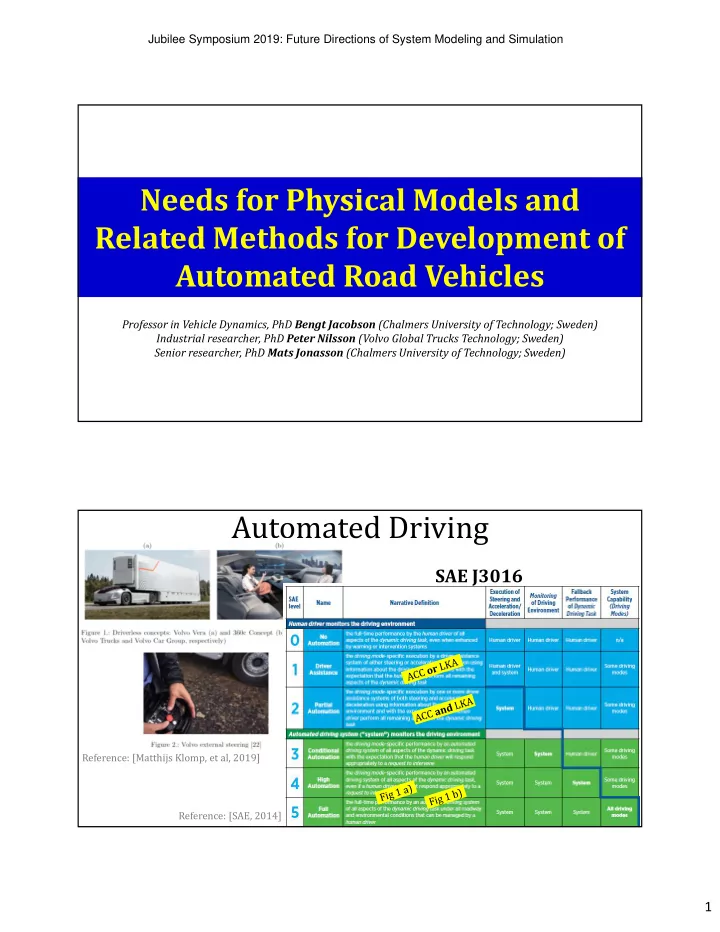
Needs for Physical Models and Related Methods for Development of Automated Road Vehicles Automated Driving

SAE J3016

Reference: [Matthijs Klomp, et al, 2019] Reference: [SAE, 2014]

Jubilee Symposium 2019: Future Directions of System Modeling and Simulation

slide-2
SLIDE 2

2

“Function Architecture” for vehicle motion & energy

Vehicle Motion Management Motion Support Device Management Vehicle Environment Traffic Situation Management Route Management Human Machine Interface Requests Estimates, Confidence Status, Capabilities

accelerations environment observations wheel torques, axle steering angles velocities from human driver devices

Reference: [Nilsson, 2017] Traffic Situation Motion Support Devices Vehicle Motion physical models

Vehicle Motion Management Motion Support Device Management Vehicle Environment Traffic Situation Management Route Management Human Machine Interface

data‐driven models

Models for vehicle motion and energy control design

  • drivers
  • micro traffic
  • estimators

sub‐system/actuator models motion relative lane & traffic motion & individual tyre forces

fuel / SOC

velocity & energy

  • macro traffic

Jubilee Symposium 2019: Future Directions of System Modeling and Simulation

slide-3
SLIDE 3

3

Vehicle Motion Management Motion Support Device Management Vehicle Environment Traffic Situation Management Route Management Human Machine Interface

Next speakers

Traffic Situation Management, Dynamically Feasible Trajectories, Peter Nilsson, Volvo Trucks

Jubilee Symposium 2019: Future Directions of System Modeling and Simulation

slide-4
SLIDE 4

4

Vehicle Longitudinal and Lateral Control Motion Planning (Trajectory planning) Behaviour planning (Tactical decision)

Transitions between driving modes Robust control Thrust and comfort Predictions of surrounding traffic and VRUs Situation assessment Consistent and predictable behaviour Sensor imperfections and occlusions Computational efficient methods

Examples of challenges for TSM

Functional safety Predictions of surrounding traffic and VRUs Collision free trajectories Comfortable and predictable trajectories Dynamically feasible trajectories

Trajectory planning

“Trajectory planning is a generalization of path planning, involved with planning the state evolution in time while satisfying given constraints on the states and actuation” Commonly used methods:

  • Numerical optimization (e.g. MPC)
  • Graph search (e.g. A*)
  • Neural network (e.g. Nvidia PilotNet)
  • ...

Trajectory planning example: left curve, tractor semi-trailer

Jubilee Symposium 2019: Future Directions of System Modeling and Simulation

slide-5
SLIDE 5

5

Heavy duty combination vehicles

Example of motion constraints:

  • Position of first unit
  • Position of trailer units (off-tracking)
  • Roll-over threshold (rearward amplification)
  • ...

Trajectory planning modelling

Example of modelling:

  • One-track models : 𝑦 𝑔 𝑦, 𝑣, 𝑥
  • Possible states for A-double
  • 1st unit (tractor) : 𝑤, 𝑤, 𝜔
  • 2nd unit (trailer) :∆𝜔, Δ𝜔
  • 3rd unit (dolly) :∆𝜔, Δ𝜔
  • 4th unit (trailer) :∆𝜔, Δ𝜔

Jubilee Symposium 2019: Future Directions of System Modeling and Simulation

slide-6
SLIDE 6

6

Vehicle variants and trajectory planning challenges

Challenge:

Trajectory planning methodology needs to scalable and robust with respect to variant combinatorics

Vehicle variant combinatorics:

  • Powertrain : 10^2 variants
  • Chassis : 10^3 variants
  • Vehicle load 7 - 120t (incl. different heights to CoG)
  • Vehicle units : 1-4

Trajectory planning example: Roundabout, tractor semi-trailer

Vehicle Motion Management, Road friction estimation, Mats Jonasson

Jubilee Symposium 2019: Future Directions of System Modeling and Simulation

slide-7
SLIDE 7

7

Challenges for VMM

Reference: [Matthijs Klomp, et al, 2019]

slip (%) force (N) low friction ~ 5% 𝑔 𝜈𝑔

  • Most driving take place here, not possible to distinguish between low or high

friction To estimate friction the tyre must at least be excited to the nonlinear region at “the bend” ABS activation, friction can be found 𝜈

  • Definitions:

0 𝜈 0.4 Low friction 0.4 𝜈 0.7 Mid friction 0.7 𝜈 High friction

high friction

Road condition – road friction

More than 10% of all accidents occur because of slippery conditions* In the US: yearly approx 500 000 accidents of which 1800 are deadly*

* Reference: [IVSS Road Friction Estimation Part II] * Reference: [ US Department of Transportation – Federal Highway Administration ** Reference: [Wallman. Tema vintermodell – olycksrisker vid olika vinterväglag]

Jubilee Symposium 2019: Future Directions of System Modeling and Simulation

slide-8
SLIDE 8

8

Confusion matrix of road friction

Reference: [Matthijs Klomp, et al, 2019]

Assumed friction True friction High (dry asphalt) Low (snow) Low (snow) High (dry asphalt)

  • False slippery warnings
  • AD Vehicle will drive

unacceptably slow (not transport efficient) Vehicle speed can be adapted to friction Vehicle speed can be adapted to friction

  • AD Vehicle will drive too

fast (not safe)

  • High frequency of

accidents

Methods for road friction estimation

Optical measurement device Model-based estimator Machine learning estimator

  • Contactless
  • Requires a map from

texture to friction

  • Use the tyre as the

sensor

  • Requires knowledge

about tyre physics

  • Use features without

knowledge of physics

  • Requires training

Jubilee Symposium 2019: Future Directions of System Modeling and Simulation

slide-9
SLIDE 9

9

State-of-the art model-based estimator

Kinetic and kinematic models

Wheel speeds, Inertial Meas. Syst. Steering angle Pre-processing Friction estimator Tyre forces Tyre slip

𝜈̂

Features and correlation to friction

Features 1...86 Temperature, GPS, vehicle speed, surface and road type are important features for friction estimation Surface & road type are not available in the sensor suite -> important to use a new sensor e.g. a camera Temperature GPS wheel speeds Surface, Road Type Correlation to true friction

* Reference[Roychowdhury, et al, 2018]

Jubilee Symposium 2019: Future Directions of System Modeling and Simulation

slide-10
SLIDE 10

10

Challenges road friction estimation

  • General:
  • Difficult to identify friction for normal driving (low friction utilization)
  • Model-based:
  • Model uncertainties for different tyres - the physics is hard to model
  • The pre-processing is not accurate enough
  • Machine learning:
  • Generalizability of machine learning algorithms to various situations
  • Generalizability would require large testing
  • Training of machine learning algorithms require ground truth – road friction is hard

to measure

Reference [Jonasson, et al] 2018

Motion Devices, Virtual Verification, Wheel Model, Bengt Jacobson

Jubilee Symposium 2019: Future Directions of System Modeling and Simulation

slide-11
SLIDE 11

11

Vehicle Motion Management Motion Support Device Management Vehicle Environment Traffic Situation Management Route Management

Human Machine Interface

Models for Virtual Verification

For Virtual Verification:

  • Higher accurate and larger

validity range than for control design.

  • But only simulate‐able, no

need for linearized, inversion, etc.

Mechatronic Sensor

Environment (other vehicles, lane edges, …)

Mecha‐ tronic Actuator

wheels absolute position relative position suspension body

Real world Theoretical world

Computation/Simulation

Explicit form modelling Mathematical modelling

Interpret results, judge model validity

Physical modelling

Final Design Formulate engineering task (problem) Initial Design Re-Design Evaluate requirement fulfilment Real-world testing

OK NOK

…one view of model based engineering

Drawing DAE (Modelica) ODE

Jubilee Symposium 2019: Future Directions of System Modeling and Simulation

slide-12
SLIDE 12

12

Wheel model as example

𝟐 𝟒 𝟓 𝟑 𝟒 ⋅ 𝟑 𝟑𝟕 wheels 104 tonnes, 33 m

𝑈

𝑈

𝜕 𝑈 𝐺

  • 𝐺
  • 𝐺
  • 𝑤

𝑤

Wheel model use cases

𝑈

𝑈

𝜕 𝑈 𝐺

  • 𝐺
  • 𝐺
  • 𝑤

𝑤 Control Longitudinal vehicle translation Control Longitudinal wheel rotation

Jubilee Symposium 2019: Future Directions of System Modeling and Simulation

slide-13
SLIDE 13

13

Wheel model, Mechanical challenges

𝐺

𝐷 ⋅ 𝑡;

𝑡 𝑆 ⋅ 𝜕 𝑤 𝑆 ⋅ 𝜕 ; 𝐺

, 𝐺 min 𝐷 ⋅ 𝑡, 𝜈 ⋅ 𝐺 ⋅ sin 𝜄 , cos 𝜄

; 𝑡 𝑆 ⋅ 𝜕 𝑤 𝑤

  • 𝑆 ⋅ 𝜕

; 𝜄 𝑏𝑠𝑑𝑢𝑏𝑜2 𝑤, 𝑆 ⋅ 𝜕 𝑤 ; 𝐾 ⋅ 𝜕 𝑈 𝐺

⋅ 𝑆 𝑈;

𝑈 sign 𝜕 ⋅ 𝑈 𝑆𝑆𝐷 ⋅ 𝑆 ⋅ 𝐺

;

If vehicle standstill and two or more wheels locked: Statically underdetermined Continuously Renewed Friction Surfaces Relative Velocity Direction Dry Friction in Brake Rolling Resistance Multiple wheels

Wheel model in its model context

Vehicle Motion Management Motion Support Device Management Vehicle Environment Traffic Situation Management Route Management Human Machine Interface

Mechatronic Sensor Environment (other vehicles, lane edges, …) Mecha‐ tronic Actuat
  • r
wheels absolute position relative position suspension body

Jubilee Symposium 2019: Future Directions of System Modeling and Simulation

slide-14
SLIDE 14

14

Conclusions

Automated driving needs modelling in many aspects:

  • TSM and VMM needs Physical

modelling for “Control/algorithm design”.

  • “Virtual verification” drives

Physical modelling, incl. exchange of models between

  • rganisation.

𝑈

𝑈

𝜕 𝑈 𝐺

  • 𝐺
  • 𝐺
  • 𝑤

𝑤

You have seen:

Jubilee Symposium 2019: Future Directions of System Modeling and Simulation

slide-15
SLIDE 15

15

References

Matthijs Klomp, et al, Trends in vehicle motion control for automated driving on public roads, 2019. https://www.tandfonline.com/doi/full/10.1080/00423114.2019.1610182 Nilsson, Peter, Traffic Situation Management for Driving Automation of Articulated Heavy Road Transports ‐ From driver behaviour towards highway autopilot, PhD thesis, Chalmers, 2017. https://research.chalmers.se/publication/251872 Weitao Chen et al, Integration and Analysis of EPAS and Chassis System in FMI‐based co‐simulation, 2019. http://www.ep.liu.se/ecp/article.asp?issue=157%26article=74 SAE, Taxonomy and Definitions for Terms Related to On‐Road Motor Vehicle Automated Driving Systems, Standard J3016, 2014. https://saemobilus.sae.org/content/j3016_201401 IVSS Road Friction Estimation Part II Report, http://www.ivss.se US Department of Transportation – Federal Highway Administration C.-G Wallman. Tema vintermodell – olycksrisker vid olika vinterväglag. Technical Report N60-2001, VTI, 2001.

  • S. Roychowdhury, M. Zhao, A. Wallin, N. Ohlsson, M. Jonasson, ‘Machine learning models for road surface and friction estimation using front-camera

images’, International Joint Conference on Neural Networks (IJCNN 2018), Rio, Brazil, 2018.

  • M. Jonasson, N. Olsson, S. R. Chowdhury, S. Muppirisetty, Z. Minming, Automated Road Friction Estimation using Car‐sensor Suite: Machine Learning

Approach, Autonomous Vehicle Software Symposium, Stuttgart, Germany, 2018

Thanks for your attention

Jubilee Symposium 2019: Future Directions of System Modeling and Simulation