
SLIDE 1
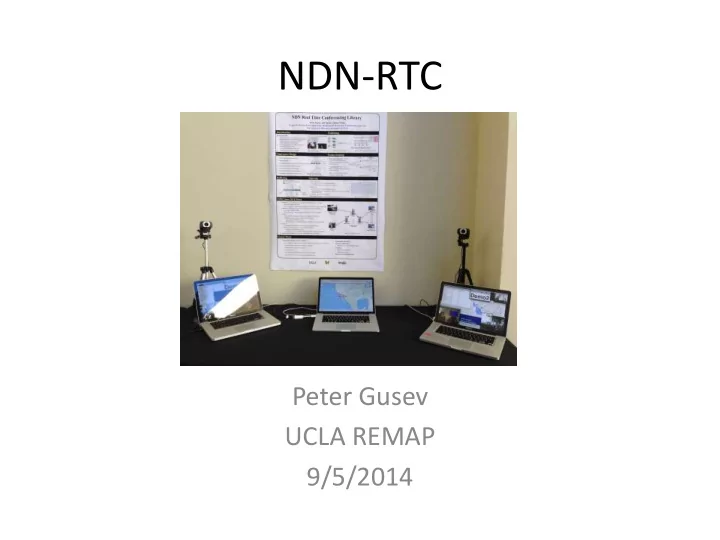
NDN-RTC Peter Gusev UCLA REMAP 9/5/2014 NDNComm 2014 Demo - - PowerPoint PPT Presentation
NDN-RTC Peter Gusev UCLA REMAP 9/5/2014 NDNComm 2014 Demo Producer 1: Live NDNComm HD streaming (1080p 30fps, 1.5Mbps) Producer 2: REMAP office webcam producer (SD, 30fps, 500Kbps) Demo 1: Demo-1 Demo-2 Consumer for 3
HD streaming (1080p 30fps, 1.5Mbps)
webcam producer (SD, 30fps, 500Kbps)
– Consumer for 3 streams: NDNComm, REMAP and Demo-2 – Producer: webcam producer (SD, 25fps, 500Kbps)
– Consumer for 3 streams: NDNComm, REMAP and Demo-1 – Producer: webcam producer (SD, 25fps, 500Kbps)
1/6/2015 2
NDN-Comm producer
REMAP-1 producer Demo-1 producer+consumer Demo-2 producer+consumer CAIDA/UCSD REMAP UA (arizona) Simulated periodic link break
Demo-1 Demo-2 – Real-time audio/video/text chat library which allows many-to- many conferencing over the NDN network and requires no direct communication between peers – Starting point for NDN traffic congestion control algorithm research – Test NDN-CPP library and NFD – Traffic generator for the testbed
– No load on a publisher (network does content distribution) – Intrinsic multicast (one-to-many and many-to-many scenarios) – On track for peer-to-peer with no STUN, TURN, etc.
1/6/2015 3
– Publish media (audio/video) streams – Fetch media (audio/video) streams from multiple producers
– Publishing audio/video stream – Fetching audio/video streams (multiple)
1/6/2015 4
1/6/2015 5
1/6/2015 6
NDN Cache
interests data
1/6/2015 7
– Key: ~30KB (20 segments) – Delta: ~1-6KB (~4 segments)
– Segment size - 1000 bytes – NDN overhead - ~330-450 bytes – Complete segment less than MTU
1/6/2015 8
– User prefix (username)
– Media streams (audio/video) – Streams meta info
– Individual encoding parameters
– Key and Delta frames in separate branches
– Individual media packets (audio samples, encoded video frames)
– Data and Parity segments in separate branches
– Actual NDN-data objects
1/6/2015 9
/<root>/ndnrtc/user/<producer-id>/ streams audio0 video0 video1 stream info thread1 thread1 thread2 thread3 frames root media streams encoding threads packet_type packet data_type segment delta key 1 ... N data parity %00 %01 ... %MM %00 %01
1/6/2015 10 Buffer Raw frame Decoder Encoded frame
%00%N1 %00%N2 %00%NN ...
Segments Renderer NDN
Interest pipeliner Interests
Playout
playhead
1/6/2015 11
gen – time interval between receiving an interest and satisfying it
with data (producer-side)
asm– time needed to fetch all frame segments (consumer side)
B1 >= RTT, B2 >= RTT Minimal buffer size >= 2*RTT milliseconds
1/6/2015 12
becomes outdated fast
network and tries to avoid playing it back
– Cache exhaustion:
rate
– Chase mode:
interval dint < Producer rate
– If darr is increasing – continue fetching – If darr is stable – switch to “Fetch“ mode 1/6/2015 13
1/6/2015 14
Chase mode Fetch mode
darr
400 200 600 800 1000 1200 1400 1600 1800 2000 10 20 30 40 50 60 70 Milliseconds Milliseconds
Future improvement (suggested by Dave Oran):
– <frame prefix>/<frame#>/parity/<segments>
1/6/2015 15
github.com/remap/ndnrtc
redmine.named- data.net/projects/ndnrtc
1/6/2015 16
– In collaboration with Panasonic R&D department (Muramoto-san, Yoneda-san) – Keep low-latency transmission & best throughput – Maintain RTT fairness (self-fairness) – Consumer-driven – NW bandwidth estimation based on RTT and timeouts – Control interest rate according to bandwidth estimation
– Adding modularity to the existing code
– Can be RTC over NDN better than IP?
1/6/2015 17
– Express just enough interests to fetch needed frames and meet the deadline, but keep low latency
– How consumer can be sure that it’s getting the latest data from the network without explicit producer-consumer signaling?
– Trust model; signing and verification; encryption approach?
– How many conference peers can there be? – What are the requirements for the forwarder? – What are the requirements for the peers?
– Best route strategy 2
1/6/2015 18
1/6/2015 19
1/6/2015 20