NCT Conference, Heidelberg, Germany, September 24, 2013 Roche - - PowerPoint PPT Presentation

nct conference heidelberg germany september 24 2013
SMART_READER_LITE
LIVE PREVIEW

NCT Conference, Heidelberg, Germany, September 24, 2013 Roche - - PowerPoint PPT Presentation

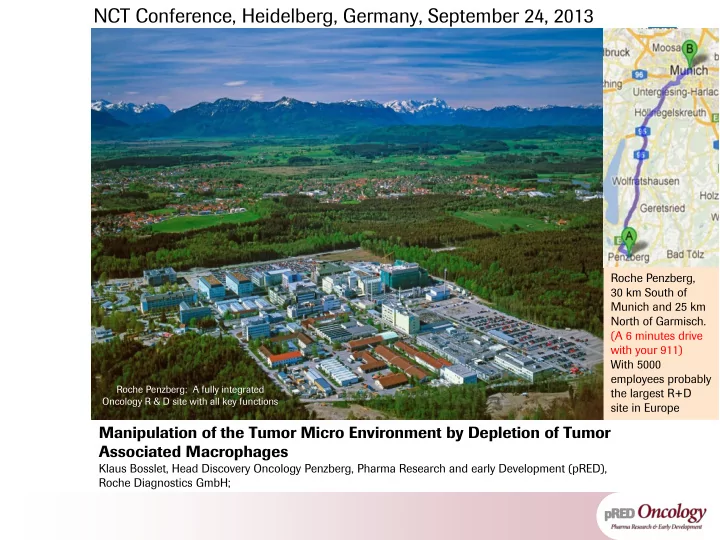
NCT Conference, Heidelberg, Germany, September 24, 2013 Roche Penzberg, 30 km South of Munich and 25 km North of Garmisch. (A 6 minutes drive with your 911) With 5000 employees probably Roche Penzberg: A fully integrated the largest R+D


slide-1
SLIDE 1

Roche Penzberg: A fully integrated Oncology R & D site with all key functions

NCT Conference, Heidelberg, Germany, September 24, 2013

Manipulation of the Tumor Micro Environment by Depletion of Tumor Associated Macrophages

Klaus Bosslet, Head Discovery Oncology Penzberg, Pharma Research and early Development (pRED), Roche Diagnostics GmbH; Roche Penzberg, 30 km South of Munich and 25 km North of Garmisch. (A 6 minutes drive with your 911) With 5000 employees probably the largest R+D site in Europe

slide-2
SLIDE 2

Vision – where the science is driving us

Understand patients and their disease to achieve CURE

Cancer cell-directed targets

  • Signalling inhibition

(e.g. ALK; HER3)

  • Apoptosis induction

(e.g. targeted IT)

  • Tumor Suppression

(e.g. MDM2)

+ +

Dysregulated cell signaling Tumor-Micro- Environment (TME) Cancer Immunotherapy Individually necessary but not sufficient. CURE requires a multi-paradigm approach. Engage host immune response via Systemic modulation of immunity Tumor targeted immune modulation

  • Glyco-enhanced Abs
  • Cytokine Ab fusions
  • T-cell bispecific Abs

Modulate immuno suppressive TME

  • Elimination and switching of

M2 macrophages (e.g. CSF1R Mab, AICs)

  • Anti-Angiogenesis

(e.g. Ang2/VEGF Mab)

2 Confidential information – do not copy or distribute

slide-3
SLIDE 3

Modulation of the Tumor Micro Environment

Treatment Barriers in Tumor Micro Environment

 Tumor heterogeneity:

Molecular and cellular heterogeneity of tumor cell population => limits efficacy of targeted signal transducing and apoptosis inducing drugs

 Cancer initiating cells:

A quiescent cell within the tumor micro environment with the potential to generate a new tumor being vastly resistant towards anti proliferative drug therapy

 Tumor supportive ECM:

Connective tissue and CAFs generate a pro-tumorigenic milieu, produce growth factors contributing to resistance towards targeted drugs

 Aberrant vascular network:

Limits accessibility for both low molecular as well as high molecular weight drugs

 Immuno suppressive phenotype:

Accumulation of anergic immune and inflammatory cells within the tumor mass (T-reg and M2 M accumulation) => T-cells activated by peripheral immunisation show limited efficacy in the established tumor micro environment

Cancer drugs with „step change potential“ have to overcome these Treatment Barriers

Mikala Egeblad,1,* Elizabeth S. Nakasone, 1,2 and Zena Werb3,*

Evolutionary Neo-Organ
slide-4
SLIDE 4

Tumors escape host immune response by inducing an immuno- suppressive Tumor Microenvironment (iTME) by recruitment of myeloid cells

4

Immune Suppression Tumor Immunity

TAM e.g. M2c-M MDSC DC Treg

IL-10, TGF-β, CCL-2 …

CTL Th B NK

IL-2, IFN-γ …

Target myeloid cells

  • First in class opportunity
  • Tumor specific
  • Low risk for autoimmunity

Strategy: Enable effective anti-tumor immune response by targeting key immunosuppressive myeloid cells

slide-5
SLIDE 5

CSF-1R as Survival and Differentiation Factor for TAMs

Tumor associated macrophages are alternatively activated M2 -Mφ

Tumor-eliminating

adapted from Pollard Nat Rev. Immunol. 2009

Survival Differentiation engaging Mabs Depletion of M2-Mφ by anti-CSF-1R therapy offers opportunity to inhibit various signaling and effector molecules at the same time to target genetically stable cells in contrast to genetically instable tumor cells

M2-Mφ can be discriminated from M1-Mφ by differential expression of scavenger receptor CD163

M1 CD68

Monocyte

Inflammatory macrophage (M1)

Tumor-promoting

huMab CSF-1R RG7155

M2 CD68 Alternatively activated macrophage (M2)

slide-6
SLIDE 6

Colony-Stimulating Factor-1 Receptor structure Binding of CSF-1 or IL-34 induce homodimerization

6

Adapted from Hamilton J Nature Rev Immunol . 2008; 8(7):533-544

CSF-1R

CSF-1/ IL-34

slide-7
SLIDE 7

RG7155, a novel humanized FIC anti-CSF-1R mAb

Highly potent, specific and purely antagonistic CSF-1R inhibitor

Data: Kaluza, Scheiblich, Lanzendörfer, Fertig/Runza and Dimoudis labs, Crystal structure: J. Benz and I. Gorr and team pRED Basel and Penzberg

Light chain ligand binding (D1-D3) dimerization interface (D4 and D5) RG7155* Fab Fragment

* Chimeric antibody variant

Isotype: IgG1 Binding to domain in CSF-1R ECD: domain D4/D5 Affinity to human CSF-1R (Biacore): <1nM Affinity to Cynomolgus CSF-1R (Biacore): <1nM Inhibition of pCSF-1R*: <2 nM Inhibition of CSF-1/CSF-1R complex formation IC50:* <1 nM Monocyte survival assay IC50: <1 nM Osteoclast differentiation assay IC50: <3 nM Activation of monocytes: none NIH3T3 CSF-1R (L301S,Y969F) viability IC50: <100nM

Summary of key data for RG7155

Heavy chain

slide-8
SLIDE 8

RG7155 targets essential Mφ pathway RG7155 induces cell death of M2-like CSF-1R+CD163+ Mφ

8

Data: Valeria Runza lab pRED Penzberg *adapted from J. Pollard Nat Rev Immunol. 2009; 9(4):259-270

M1

% of all cells p-value 0.11 p-value 0.02

*

Monocyte CSF-1R+CD163+ Mφ CSF-1R-CD80+ Mφ CSF-1 GM-CSF

M2

*

slide-9
SLIDE 9
slide-10
SLIDE 10

Anti–CSF-1R mAb in transgenic BC model Targeting mouse CSF-1R enhances efficacy of chemotherapy

10

Karin deVisser lab Netherlands Cancer Institute, Amsterdam Oral Presentation Metamia Ciampricotti, Keystone Symposium Dublin 2012

p=0.001

anti-CSF-1R + Cisplatin Control ab Control ab + Cisplatin anti-CSF-1R

10 20 30 40 50 60 70 20 40 60 80 100

Days after initiation of treatment % survival

slide-11
SLIDE 11

Acknowledgement:

Carola Ries, rPL Michael Cannarile, BML Dominik Rüttinger, TML and the many other colleagues of the CSF1R project team

11