NC House Committee on Food Desert Zones Raleigh, NC January 27, 2014 - - PowerPoint PPT Presentation
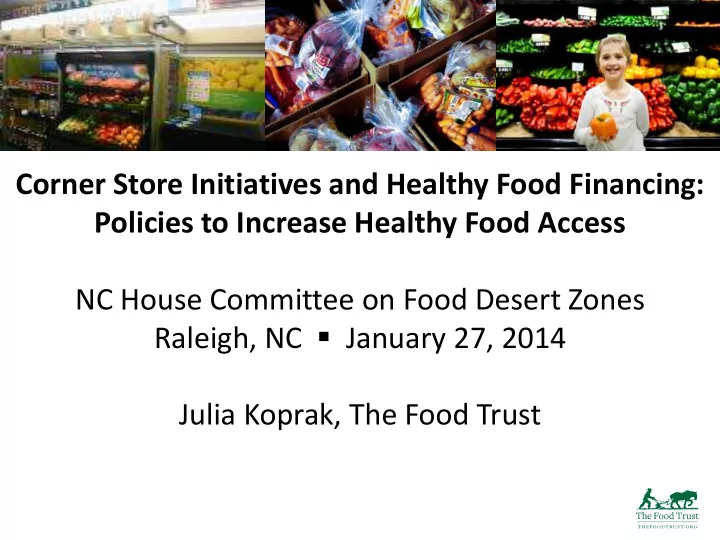
Corner Store Initiatives and Healthy Food Financing: Policies to Increase Healthy Food Access NC House Committee on Food Desert Zones Raleigh, NC January 27, 2014 Julia Koprak, The Food Trust The Food Trust Since 1992, working to ensure that
The Food Trust
Since 1992, working to ensure that everyone has access to affordable nutritious food
1/27/2014
Healthy food access is a public health issue.
1/27/2014
Obesity Trends in the US
1985 1995
No Data <10% 10%–14% 15%–19% 20%–24% 25%–29% ≥30%
Source: Behavioral Risk Factor Surveillance System, CDC
2010
1/27/2014
NC Committee on Food Desert Zones
The alternatives in many places
1/27/2014
The Grocery Gap: Key Research Findings
Available at: http://www.thefoodtrust.org
- Accessing healthy food is a challenge for
many Americans – particularly those living in low-income neighborhoods, communities
- f color, and rural areas.
- Better access corresponds with healthier
eating
- Access to healthy food is associated with
lower risk for obesity and other diet-related chronic diseases.
- New and improved healthy food retail in
underserved communities created jobs and helps to revitalize low-income neighborhoods.
Increasing healthy food access at corner stores and convenience stores
Why Corner Stores?
- Supermarket deserts and
customer dependence
- Philadelphia study:
- 42% students shop 2 times/day;
53% shop once a day
- 356 calories per purchase
- Energy dense, low-nutritive
food and beverages
- Engaging as ALLIES
Chart Source: Food Geography: How Food Access Afftects Diet and Health. Available at http://www.thefoodtrust.org/pdf/Food%20Geography%20Final.pdf
What makes a healthy corner store?
- Stocking healthier items
(whole grains, low-fat dairy, fresh produce)
- Increasing the quantity and
shelf space for healthy
- ptions
- Marketing to promote healthy
foods
- Technical Assistance to
- wners
- Equipment and conversions
In-store marketing for healthy foods
A typical corner store aisle
The same corner store post- renovation
Examples of Healthy Corner Store Initiatives
- Austin, TX
- Camden, NJ
- Kentucky (rural areas)
- North Carolina (rural areas)
- Philadelphia, PA
- Richmond, VA
- San Jose, CA
Healthy Food Financing: The Basics
- Business financing programs
that provide grants and loans for new and expanded grocery retailers in underserved communities
- Administered by a variety of
community development entities, especially CDFIs
- Funded with federal, state,
local, and philanthropic dollars
Healthy Food Financing Program Model
Fresh Food Retail Projects in Underserved Communities
Supermarkets Small grocery stores Co-ops, farmers markets, and
- ther “non-traditional” formats
Community Development Financial Institution & Food Access Organization
Raise private capital Provide financing Determine applicant eligibility Market program, advocate for community
Government or Foundation
Provide seed funding Oversee program implementation
Healthy Food Financing Initiative Implementation Process
Grocer applies for financial incentives to build or expand store in a food desert. Food access
- rganization
screens for eligibility. CDFI provides customized financing to support store.
NC Committee on Food Desert Zones
88 approved stores in PA urban/rural areas $190 million total invested 1.7 million sq. ft. of grocery retail developed/refreshed 5,000 jobs created/retained Named “Top 15 Innovation in Government” by Harvard
Success Story: PA Fresh Food Financing Initiative
Fresh Grocer opens at Progress Plaza in North Philadelphia December 2009
Circle Food Store, New Orleans, 2005
Circle Food Store, New Orleans, 2014
Federal Healthy Food Financing Initiative
- $118 Million awarded
to CDFIs and CDCs from the U.S. Treasury and Dept of Health and Human Services
- $400 Million in New
Markets Tax Credits
1/27/2014
1/27/2014
1/27/2014