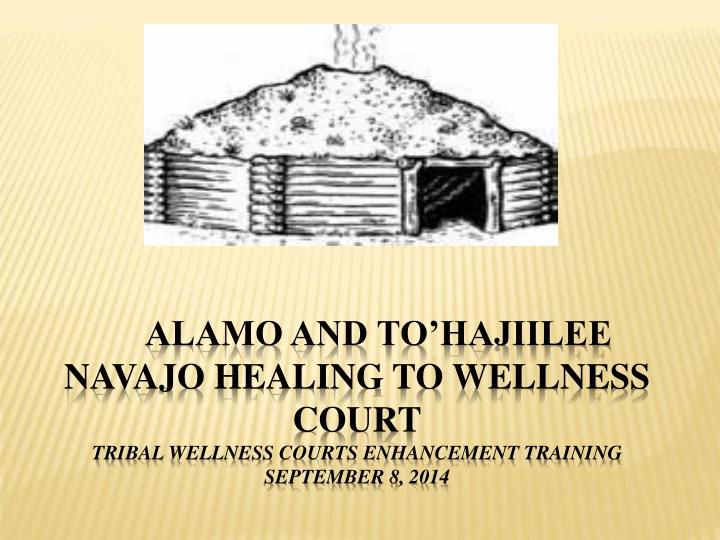
NAVAJO HEALING TO WELLNESS COURT TRIBAL WELLNESS COURTS ENHANCEMENT - - PowerPoint PPT Presentation

navajo healing to wellness
SMART_READER_LITE
LIVE PREVIEW

NAVAJO HEALING TO WELLNESS COURT TRIBAL WELLNESS COURTS ENHANCEMENT - - PowerPoint PPT Presentation

ALAMO AND TOHAJIILEE NAVAJO HEALING TO WELLNESS COURT TRIBAL WELLNESS COURTS ENHANCEMENT TRAINING SEPTEMBER 8, 2014 ALAMO-TOHAJIILEE JUDICIAL DISTRICT WWW.NAVAJOCOURTS.ORG (NO. 8 ON THE MAP) Satellite Navajo communities (Canoncito


slide-1
SLIDE 1

ALAMO AND TO’HAJIILEE NAVAJO HEALING TO WELLNESS COURT

TRIBAL WELLNESS COURTS ENHANCEMENT TRAINING SEPTEMBER 8, 2014

slide-2
SLIDE 2

NAVAJO NATION JUDICIAL DISTRICTS

WWW.NAVAJOCOURTS.ORG ALAMO-TOHAJIILEE JUDICIAL DISTRICT (NO. 8 ON THE MAP)

 Satellite Navajo communities

(Canoncito Band of Navajos and Alamo Band of Navajos)

 Bernallillo, Cibola, Socorro

and Sandoval Counties

AZ NM

slide-3
SLIDE 3

ALAMO AND TO’HAJIILEE COURT HOUSES

slide-4
SLIDE 4

NEW MEXICO DATA- ALCOHOL RELATED DEATH

 NM has highest alcohol-related death rates in the

US for past 30 years

 American Indians have higher alcohol-related

death rates than other race/ethnicities.

 McKinley and Rio Arriba Counties have extremely

high alcohol-related death rates

 2008 – 2012: most death rates Bernalillo, San

Juan, Santa Fe, Dona Ana and McKinley.

 Navajo

vajo Nation n lo loca cated ed in n McK cKinle nley, , San n Ju Juan, n, Bern rnalill alillo,

  • , Cibola,
  • la, Soco

corr rro,

  • , Rio Arr

rriba, a, Sand ndoval al

N.M. Substance Abuse Epidemiology Profile, Aug. 2014

slide-5
SLIDE 5

ALCOHOL RELATED DEATHS

 NM: 120.1 per 100,000  Tohajiilee:

 Bernalillo: 109.1 per 100,000  Cibola: 114.1 per 100,000

 Alamo

 Socorro: 226.0 per 100,000

NM Substance Abuse Epidemiology Profile, Aug. 2014

slide-6
SLIDE 6

ALCOHOL RELATED CHRONIC DISEASES

 NM Data: Chronic liver disease associated with

chronic heavy drinking

 American Indians (both Males and Females)

are at higher rates than any other ethnicity or race and it further illustrates the heavy burden

  • f premature death due to heavy drinking

NM Substance Abuse Epidemiology Profile, Aug. 2014

slide-7
SLIDE 7

ALAMO-TOHAJIILEE DISTRICT DATA

 NM Chronic disease death rate: 67.3 per

100,000

 Hispanic 27.3 per 100,000  To’Hajiilee

 Bernalillo 69.5  Cibola 69.5

 Alamo

 Socorro 144.1

NM Substance Abuse Epidemiology Profile, Aug. 2014

slide-8
SLIDE 8

ALCOHOL RELATED INJURY DEATH

 Binge Drinking, motor vehicle, homicide and

suicide

 Since 1990, NM’s death rate for alcohol related

injury has been consistently highest in the nation, 1.4 to 1.8 times the national rate. There were substantially high numbers of death rates among American Indian and Hispanic

  • males. (52.8 AI) (25.8 Hispanic)

NM Substance Abuse Epidemiology Profile, Aug. 2014

slide-9
SLIDE 9

 Alcohol and drug use play a “significant role” in

violent crimes in Indian Country. According to DOJ, American Indian victims reported alcohol use by 62 percent of offenders compared to 42 percent for all races.

Indian Country Criminal Justice: Departments of the Interior and Justice Should Strengthen Coordination to Support Tribal Courts, GAO Report, Feb. 2011

9/7/2014 9

ALCOHOL RELATED CRIME

slide-10
SLIDE 10

GENDER THAT ARE AT HIGH RISK

 American Indian Males are (77%) 2-4 times higher

then females (23%) to die of alcohol related injury. (Male-84.2) (Female-24.7)

 McKinley and San Juan counties show elevated

rates of alcohol related injury deaths.

 New Mexico 52.8

 Bernalillo 39.6  Cibola 44.6  Socorro 81.9

NM Substance Abuse Epidemiology Profile, Aug. 2014

slide-11
SLIDE 11

NAVAJO GENERAL HEALTH STATISTICS

 Navajo people are at exceptionally high-risk for

alcohol/substance abuse problem; according to IHS, the alcohol related illness and death among tribes was 5.6 times higher than among the U.S. population.

 The report terms the rate of death from alcoholism

among the Navajo “the most alarming” statistics-26.6 per 100,000 on the Navajo Reservation. In the U.S. as a whole the rate is 2.1 per 100,000.

 Motor vehicle accidents comprise the second leading

cause of death on the Navajo Nation at 6.8% as compared to the U.S. rate of 1.9% (over 3 times higher).

www.nihb.org

slide-12
SLIDE 12

I.H.S. FUNDING INEQUALITIES

 Per capita funding for NA health care (through the IHS) is 60% less than is

spent per capita on health care for NAs than it does on Medicaid recipients, prisoners, veterans or military personnel. As a result, the IHS has a severe problem in recruiting and retaining mental health professionals.

 The IHS systems are severely underfunded: for NA youth, only $30 per year

per person is spent on behavioral health for one NA, including hospitalization.

MacArthur Foundation Mental Health Policy Research Network, 2008 MacArthur, Project TRUST, p. 46,http://hsc.unm.edu/som/prc/_pdfs/TRUST_Report_May08.pdf

12

slide-13
SLIDE 13

NAVAJO HEALING TO WELLNESS COURT

“T’ÁÁHW7 ÁJ7T98GO YÁ’ÁT’ÉÉH

N7ZHDOODLEE[” “BY YOUR CHARACTER AND IDENTITY, YOU WILL BE HEALED AND BE WELL”

 Judicial Branch Peacemaking

Program Prayer Lodge

 Navajo Nation

slide-14
SLIDE 14

INTERAGENCY COLLABORATION

 Two 638 Tribal Behavioral Health Programs

(Navajo Area and Albuquerque Area)

 Navajo Prosecutors office  Peacemaking Program (Peacemakers doing the

education with the Participants)

 Navajo DBHS – Traditional healing and

teachings (prayer lodge)

slide-15
SLIDE 15

FUNDAMENTAL LAW

 Restorative Justice – Beauty way concept  Diné Bi Beenahaz'áanii (1 N.N.C. §§ 201-206)-

Codified (written into the law at Title 1, see www.navajocourts.org) (Traditional Law; Customary Law; Natural Law; Common Law)

 Spiritual healings and respect for spiritual

beliefs

slide-16
SLIDE 16

 Steering Committee

 Vision Statement  Resource Mapping  Needs Assessment  Action Planning – Community Activities  Some members are youth or young adults  Elders

 Resource Meetings (Community Coalition)  Local Behavioral Health Collaboratives (NM)  NM State Native American Subcommittee of the

Governor’s Behavioral Health Planning Council (Inter Tribal Coalition)

COMMUNITY ENGAGEMENT

slide-17
SLIDE 17

EVALUATION

 Process evaluation:

 Program Participants  Resources  Steering Committee

 Gather lessons learned and other qualitative

data

 Navajo Human Research Board (IRB)

slide-18
SLIDE 18

QUESTIONS

 Do you have any

questions?

 Ahee’hee’  Thank You.

slide-19
SLIDE 19

FOR MORE INFORMATION

 Contact:

 Jamie S. Mike, Care

Coordinator

 thtwc14@gmail.com

(505) 908-2817/2818

 Regina Begay

Roanhorse, Court Administrator

 reginaroanhorse@navajo-

nsn.gov (505) 908- 2817/2818

 www.navajocourts.org