NATIONAL OCEAN SERVICE Marc Suddleson Jenifer Rhoades HAB Program - - PowerPoint PPT Presentation

national ocean service
SMART_READER_LITE
LIVE PREVIEW

NATIONAL OCEAN SERVICE Marc Suddleson Jenifer Rhoades HAB Program - - PowerPoint PPT Presentation

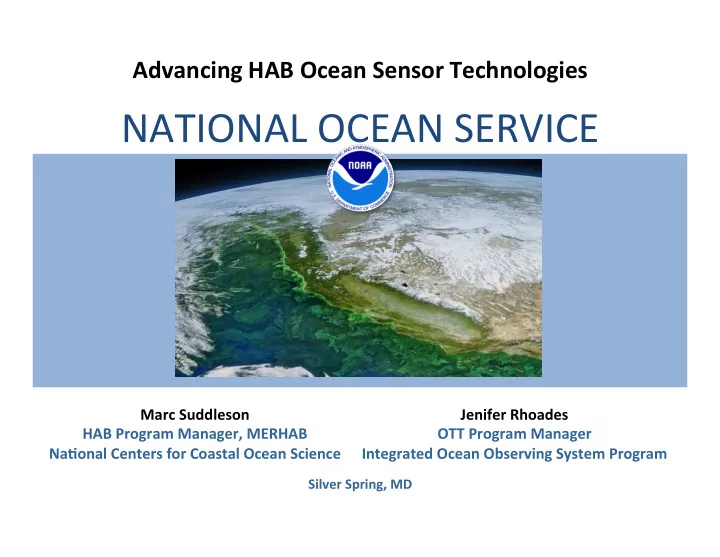
Advancing HAB Ocean Sensor Technologies NATIONAL OCEAN SERVICE Marc Suddleson Jenifer Rhoades HAB Program Manager, MERHAB OTT Program Manager Na8onal Centers for Coastal Ocean Science Integrated Ocean Observing System Program Silver Spring,


slide-1
SLIDE 1

Marc Suddleson HAB Program Manager, MERHAB Na8onal Centers for Coastal Ocean Science Jenifer Rhoades OTT Program Manager Integrated Ocean Observing System Program

NATIONAL OCEAN SERVICE

Silver Spring, MD

Advancing HAB Ocean Sensor Technologies

slide-2
SLIDE 2
  • ceanservice.noaa.gov

NATIONAL OCEAN SERVICE

Harmful Algal Blooms – A Na?onal Problem

slide-3
SLIDE 3
  • ceanservice.noaa.gov

NATIONAL OCEAN SERVICE

2014 - Harmful Algal Bloom and Hypoxia Research & Control Act

  • Improve interagency coordina?on
  • Conduct research
  • Understand causes & impacts
  • Develop beQer monitoring, predic?on

and response

  • Understand roles of climate, nutrients, etc.
  • Toxins in foods and water
  • Methods to suppress\control, prevent.
  • Event Response
  • Reports to Congress

Breve Buster\Glider Karenia cell counts. G.Kirkpatrick Mote,. NOAA ECO\PCMHAB & NCCOS Satellite detection\tracking: Karenia & Microcystis blooms.

  • R. Stumpf. NCCOS

Jellet & Mercury Science toxin

  • kits. NCCOS

and partners

A Na?onal Response to HABs – NOAA’s Mandate

SPATT toxin sampler. R.Kudela UCSC. NCCOS and partners

slide-4
SLIDE 4
  • ceanservice.noaa.gov

NATIONAL OCEAN SERVICE

A Na?onal Response to HABs - Accomplishments

  • Guidelines for freshwater toxins,

health advisories

  • Enhanced HAB Detec?on
  • low cost\simple screening
  • BeQer regulatory confirma?on
  • Real-?me HAB sensors
  • HAB modeling & forecast products
  • HAB event response
  • Understanding effects of HAB toxins
  • n human, animal health

“Tricorder:” Karenia cell

  • counts. J.Paul USF.

NOAA ECO\PCMHAB POSSE: Alexandrium cell

  • ID. L. Connell U.Maine.

NOAA MERHAB HAB-scope:” Karenia cell counts. G.Kirkpatick

  • Mote. NASA &

NCCOS labs

slide-5
SLIDE 5
  • ceanservice.noaa.gov

NATIONAL OCEAN SERVICE

5

NOAA Mandate for Na?onal Ocean Observing System

Integrated Coastal & Ocean Observa?on System Act of 2009

Created IOOS, with NOAA as lead Federal agency “The purposes of this sub?tle are to– (1) establish a na8onal integrated System of ocean, coastal, and Great Lakes observing systems, comprised of Federal and non- Federal components coordinated at the na?onal level by the Na?onal Ocean Research Leadership Council and at the regional level by a network of regional informa?on coordina?on en??es, and that includes in situ, remote, and other coastal and ocean observa8on, technologies, and data management and communica8on systems, and is designed to address regional and na8onal needs for ocean informa8on, to gather specific data on key coastal, ocean, and Great Lakes variables, and to ensure ?mely and sustained dissemina?on and availability of these data…”

slide-6
SLIDE 6
  • ceanservice.noaa.gov

NATIONAL OCEAN SERVICE

6

Outrea

Observa?ons Forecasts/Modeling Data Management User Products Outreach and Educa?on Leverage and Link

slide-7
SLIDE 7
  • ceanservice.noaa.gov

NATIONAL OCEAN SERVICE

Ocean Technology Transi?on

  • IOOS advances technology through the transi?on of
  • cean, coastal, and marine sensors and placorms to
  • pera?ons

7

➢ Sponsors the transi?on of emerging marine observing technologies; ➢ Where there is an exis?ng opera?onal requirement; and ➢ A demonstrated commitment to integrate into opera?ons mode.

slide-8
SLIDE 8
  • ceanservice.noaa.gov

NATIONAL OCEAN SERVICE

HAB Sensors – Ocean Condi?ons

  • Nitrate sensor (U. Maine)
  • Northeast Nutrient Observatory
  • SST/HAB pigments (Satellites)
  • Surface current data (HF radar)

8

NE Nutrient Observatory, Credit: NERACOOS Temporary HF Radar Site. Credit: Libe Washburn California Dept. of Fish and Wildlife

slide-9
SLIDE 9
  • ceanservice.noaa.gov

NATIONAL OCEAN SERVICE

  • In situ observa?ons
  • cells
  • toxins
  • Remote Detec?on
  • Proxy measurements
  • Satellites
  • Rapid “hand-held” field tests
  • Toxins in water
  • Toxins in shellfish/fish

HAB Sensors – Cells and Toxins

slide-10
SLIDE 10
  • ceanservice.noaa.gov

NATIONAL OCEAN SERVICE

10

HAB Sensor Examples - ESP and IFCB

Advancing Harmful Algal Blooms, Water Quality, Ocean Observing, Aquaculture Missions

Texas Network (NCCOS PCMHAB) IFCB AUV (IOOS OTT)

Martha’s Vineyard Observatory (NSF, ONR) EcoMon (NMFS\CINAR) Nauset Marsh (Sea Grant, NCCOS MERHAB)

IFCB AV (IOOS OTT)

  • S. F. Bay (IOOS OTT)

ESP deployments IFCB deployments

  • S. And C. California

(NCCOS ECOHAB)

Catalina Sea Ranch (NMFS)

Outer Coast, Puget Sound (IOOS OTT) Lake Erie (GLERL & NCCOS) Gulf of Maine (NCCOS MERHAB, PCMHAB and IOOS OTT)

slide-11
SLIDE 11
  • ceanservice.noaa.gov

NATIONAL OCEAN SERVICE

HAB Sensors - ESP Story

11

  • Gulf of Maine (2013-2014)
  • Pacific Northwest (2014-2017)
slide-12
SLIDE 12
  • ceanservice.noaa.gov

NATIONAL OCEAN SERVICE

HAB Sensors - IFCB story

12

UCSC

  • WHOI Project (2015-2018)
  • Research prototype field tested Salt Pond, MA early

spring of 2016.

  • Prototype IFCB-AV has successfully field tested in a

JetYak vehicle in Woods Hole Harbor and Salt Pond

  • ProducLon of a pre-commercial IFCB-AV developed.
  • StarLng tesLng on a Liquid RoboLcs Wave Glider.
  • Future tests in Gulf of Mexico
  • San Francisco Bay Project (2014-2017)
  • Lab IFCB Tests Successful
  • IFCB successfully deployed in Santa Cruz Wharf and
  • n a USGS vessel
  • Upcoming Deployment on Dunbarton Bridge
  • USGS and SFEI to fund project in 2017
slide-13
SLIDE 13
  • ceanservice.noaa.gov

NATIONAL OCEAN SERVICE

Imaging FlowCytobot Reduces Harmful Algal BIoom Impacts

No shellfish recalls since 2008.

Early Success #1 – Texas HAB Early Warning

  • Efficient and Effective Shellfish Monitoring
  • Confidence in Shellfish Product Safety

7 HAB early warnings since 2007

Karenia spp. Neurotoxic Shellfish Poisoning Dinophysis spp. Diarrhetic Shellfish Poisoning

IFCB on UTMSI Pier, Port Aransas (L. Campbell)

HAB Sensors : IFCB story

slide-14
SLIDE 14
  • ceanservice.noaa.gov

NATIONAL OCEAN SERVICE

Imaging FlowCytobot Early Success #1 – Texas HAB Early Warning HAB Shellfish Harvesting Closures March 7-April 12, 2008 Oyster Festival in Fulton, TX March 7-9, 2008

HAB Sensors : IFCB story

slide-15
SLIDE 15
  • ceanservice.noaa.gov

NATIONAL OCEAN SERVICE

IFCB and 2G ESP in Nauset Marsh, Cape Cod Spring 2016

generator solar panels 2G ESP IFCB

Early Success #2 – Advancing IFCB for Ocean ObservaBons Imaging FlowCytobot In situ measurement of phytoplankton cells and toxins

IFCB powered by solar panels and generator

Credit: Brosnahan (WHOI)

HAB Sensors : ESP and IFCB story

slide-16
SLIDE 16
  • ceanservice.noaa.gov

NATIONAL OCEAN SERVICE

Partnerships Universi?es, States, Companies

Woods Hole Oceanographic Ins?tu?on, MBARI, U.C. Santa Cruz, USC, U. Washington, NANOOS, and NERACOOS. Washington Departments of Health and Fish & Wildlife McLane Research Laboratories, Inc. Taylor Shellfish, Lummi Indian Tribe

Imaging FlowCytobot Ac?ve NOAA Program Investments

  • Con?nuous, autonomous HAB species and toxin abundance + pathogen detec?on.
  • 10 yrs of buoy, pier-based, and cabled underwater deployments
  • Data suppor?ng NOAA and state science and management needs
  • 2nd genera?on commercially available
  • New applica?ons and next genera?on formats emerging

ESP Capabili?es

NOS\NCCOS HAB Research IOOS Ocean Tech Transfer OAR GLERL, NMFS NW Fisheries Science Ctr.

Development and Status

HAB species & toxins Observa?ons & Technology Transfer Ecological Forecas?ng Aquaculture

HAB Sensors: ESP Summary
slide-17
SLIDE 17
  • ceanservice.noaa.gov

NATIONAL OCEAN SERVICE

17

Partnerships Universi?es, States, Companies

Woods Hole Oceanographic Ins?tu?on Texas A&M and U.C. Santa Cruz Texas State Departments of Health Services and Wildlife McLane Research Laboratories, Inc. Catalina Sea Ranch, LLC (new)

Imaging FlowCytobot

  • Con?nuous, autonomous ID & counts of phytoplankton species.
  • 10 yrs of shipboard, pier-based, and cabled underwater deployments
  • Data suppor?ng NOAA and state science and management needs
  • 1st genera?on commercially available
  • New applica?ons and next genera?on formats emerging

IFCB Status

Ac?ve NOAA Program Investments

NOS\NCCOS HAB Research IOOS Ocean Tech Transfer OAR Sea Grant M.I.T. & TX NMFS Saltonstall-Kennedy

Development and Status

HAB species\community Water quality Observa?ons & Tech Transfer Ecological Forecas?ng Aquaculture

HAB Sensors: IFCB summary

slide-18
SLIDE 18
  • ceanservice.noaa.gov

NATIONAL OCEAN SERVICE

NCCOS HAB Programs

  • FY17 PCMHAB and ECOHAB FFO closed, peer review

underway

  • Future FFOs for ECOHAB, MERHAB and PCMHAB

programs likely to con?nue HAB sensor technology advances. Disclaimer: plans are pending federal appropria?ons

18

slide-19
SLIDE 19
  • ceanservice.noaa.gov

NATIONAL OCEAN SERVICE

Ocean Technology Transi?on

19

  • FFO Open – Closes March

20, 2017

  • Innova?ve proven tech
  • Proof of Concept
  • Proof of Opera?onal Need
  • CommiQed Sponsor

hQp://www.ioos.noaa.gov// project/ocean-technology- transi?on/

slide-20
SLIDE 20
  • ceanservice.noaa.gov

NATIONAL OCEAN SERVICE

Na?onal HAB Forecas?ng and Sensor Networks

WA: research demonstration CA: research demonstration TX:

  • perational

Erie: 2016 initial

  • perations

C.Bay: research Gulf of Maine: research demonstration FL/AL/MS

  • perational

HABHRCA (2014) & IOOS Act are cri?cal

slide-21
SLIDE 21
  • ceanservice.noaa.gov

NATIONAL OCEAN SERVICE

What can sensor industry and partners do?

  • Support NOAA Opera?onal HAB Forecas?ng System to provide

early warning for HABs useful to industry

  • Educate partners on how sensors can address about HAB-related

disrup?ons to their businesses.

  • Engage in developing of monitoring networks and foster regional

collabora?ons.

  • Develop regional collabora?ons
  • Support regional Integrated Ocean Observing System

associa?ons—urge them to include HAB sensors

slide-22
SLIDE 22
  • ceanservice.noaa.gov

NATIONAL OCEAN SERVICE

Thank You!

Contact Informa?on Marc Suddleson, Marc.Suddleson@noaa.gov Jen Rhoades, Jenifer.Rhoades@noaa.gov

22