National Income: Where it Comes From and Where it Goes - - PDF document

national income where it comes from and where it goes
SMART_READER_LITE
LIVE PREVIEW

National Income: Where it Comes From and Where it Goes - - PDF document

Topic 3: National Income: Where it Comes From and Where it Goes National Income National Income CHAPTER


slide-1
SLIDE 1

1

CHAPTER 3 CHAPTER 3

National Income National Income

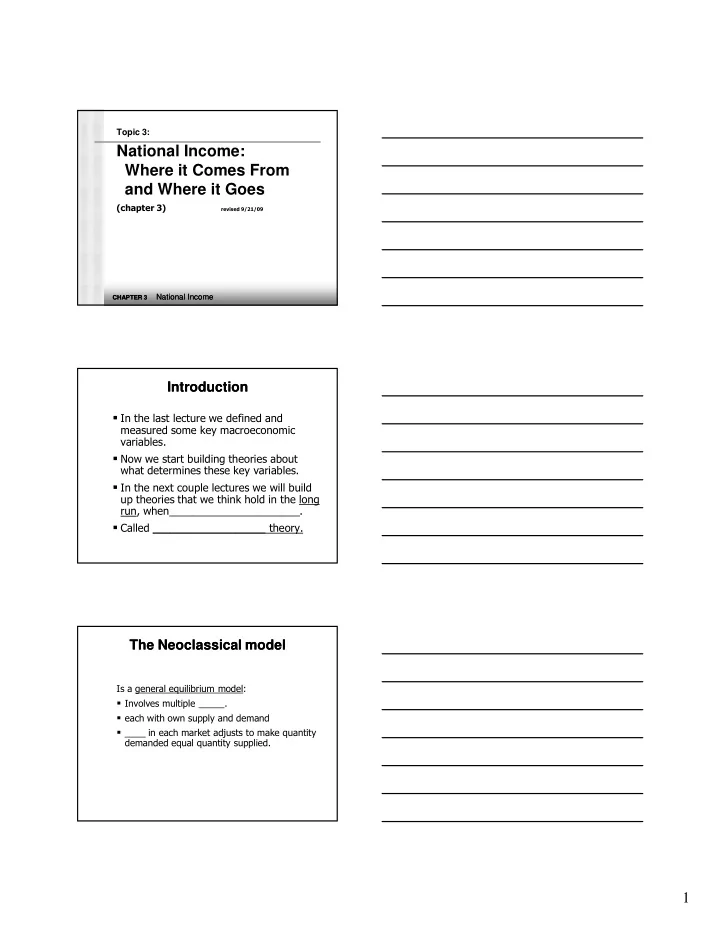
Topic 3:

National Income: Where it Comes From and Where it Goes

  • Introduction

Introduction

  • The Neoclassical model

The Neoclassical model

!

slide-2
SLIDE 2

2

Neoclassical model Neoclassical model

"

# $

  • %

&

# ' $ ( % )

Financial Market Goods Market Labor Market Households Government Firms

saving borrowing borrowing consumption government spending investment production work hiring

Three Markets Three Markets – Three agents Three agents Neoclassical model Neoclassical model

&

  • #* )

+ ,

slide-3
SLIDE 3

3

Neoclassical model Neoclassical model

$*- .* + , %*( +

, /

  • Neoclassical model

Neoclassical model

01

2

"

  • +3

Part 1: Supply in goods market: Part 1: Supply in goods market: Production Production

  • 4!."#*

$ " 4 # 4

slide-4
SLIDE 4

4

The production function The production function

. *

  • " #

5

  • )
  • Returns to scale

Returns to scale

4!."#* +% "4%"#4%# 26#

.% 4#$7$78*

0 4!."#*9 4% 6% :%

Exercise: Exercise: determine returns to scale determine returns to scale

,

  • =

+ $ #7

  • &

! " # " #

slide-5
SLIDE 5

5

Assumptions of the model Assumptions of the model

# " $ "5

  • =

= " " # #

Determining GDP Determining GDP

;

  • +
  • =
  • ! " #

Part 2: Equilibrium in the factors market Part 2: Equilibrium in the factors market <

  • = +

,

slide-6
SLIDE 6

6

Demand in factors market Demand in factors market

&2

>

  • >
  • >
  • ?

Demand in factors market Demand in factors market

&

<

  • Demand in factors market

Demand in factors market

  • 2

' ?411 4

slide-7
SLIDE 7

7

Demand in the factors market Demand in the factors market

#*@ $*

"

.A?-*

Marginal product of labor ( Marginal product of labor (MPL MPL)

& .* " . * '(# 4 ! ." #B#* C ! ." #*

  • )'(#

)'(#

#

  • ! " #
  • &

# A?- # A?- # A?- &

  • +3
slide-8
SLIDE 8

8

Diminishing marginal returns Diminishing marginal returns

&

.* ↑# "

MPL with calculus MPL with calculus

0A?- ∆ D5

<∆#4#

! ."#B#*C ! ."#*

MPL as a derivative MPL as a derivative

&- 0.* # " "

  • ∆ →

+ ∆ − = ∆

E #

! " # # ! " # '(# #

  • &
  • &
  • =

#

  • " #
  • &
slide-9
SLIDE 9

9

)'(# )'(#

#

  • ! " #
  • &

∆#

A?-

  • .*

! ."#B∆-*C ! ."#**

# !# #

Derivative as marginal product Derivative as marginal product

= = =

# $

$ % %

  • ! #

# #

#

∂ = = ∂

#

  • #

* +

,-. *

  • +
  • Return to firm problem: hiring L

Return to firm problem: hiring L

(# 2 '# 9 ∆ 4∆ 1 ∆ 4

  • 6E
  • :E
  • 4E
slide-10
SLIDE 10

10

Firm problem continued Firm problem continued

+5

  • ///////////

'#A?-

  • &

////////& $( D5

Real wage Real wage

"

$ 4 ( 4 $( 4.FG*G.FG*4

"

  • Example: deriving labor demand

Example: deriving labor demand

+

  • =

E 7 E 7 , ,

" # = ////////// '(#

slide-11
SLIDE 11

11

Labor demand continued Labor demand continued

#

=

E 7 E 7

E 7

, ,

, $ " # (

( )

− − −

  • =
  • $

$ E 7 E 7

E 7

, ,

, $ " # (

  • =
  • $

#

# E $7 , ( " # $ = //////////////

  • #

→ +

  • Labor market equilibrium

Labor market equilibrium

"

  • (

)

=

E 7 E 7

E 7

, ,

,

  • $

" # ( =

  • #

# ///////////// → +

  • MPL

MPL and the demand for labor and the demand for labor

  • <
  • '(# 4$G(

H

  • H#

A?--

  • #

↓ → →

slide-12
SLIDE 12

12

Determining the rental rate Determining the rental rate

0!'(# 4$G( "'(" 4///// '(" ↓ ↓ ↓ ↓ " ↑ ↑ ↑ ↑ "'(" 5

  • (2"

'(" 4/////

How income is distributed: How income is distributed:

4 4

  • Euler’s theorem:

Euler’s theorem:

H. 2*3

  • '(#

# '(" " = × + ×

slide-13
SLIDE 13

13

Mathematical example Mathematical example

1, 01"α

α α α#2α α α α

1 + 3 !3"&3 013"α

α α α 3#2α α α α

013α

α α α "α α α α 32α α α α #2α α α α

013α

α α α 32α α α α "α α α α #2α α α α

03x 1"α

α α α #2α α α α

03x !"&#

Mathematical example continued Mathematical example continued

>

'(#0 '("0

>

'(#x #4'("x " +

Outline of model Outline of model

&1 )

+ , )

(

+ ,

  • +

,

slide-14
SLIDE 14

14

Demand for goods & services Demand for goods & services

  • 5 4

6 4 7 4 I . 89*

Consumption, Consumption, 5

5

: 2) //////////

+

"

'(5

+A?4

  • A?E#

The consumption function The consumption function

5 ; )

  • 5. C)*
  • "
  • A?
slide-15
SLIDE 15

15

Consumption function cont. Consumption function cont.

+ 504,-. A? 0///// (

  • A4

Investment, Investment, 6

6

"6 46.*

  • "

5

  • +///////

The investment function The investment function

  • 6

6.* +

  • 1
slide-16
SLIDE 16

16

Government spending, Government spending, 7 7

7

  • 7

&

  • =

=

  • 7

7 ) )

The market for goods & services The market for goods & services

"

  • &
  • &
  • <
  • The loanable funds market

The loanable funds market

&1

  • ; JK

JK

slide-17
SLIDE 17

17

Demand for funds: Investment Demand for funds: Investment

" > ( I

  • > JK

.*

Loanable funds demand curve Loanable funds demand curve

  • 6

6.* "

  • Supply of funds: Saving

Supply of funds: Saving

"

  • > '
  • "
  • > "
slide-18
SLIDE 18

18

Types of saving Types of saving

4 : 4 4B

  • 4. C)*C 5

B) C 7 4

EXERCISE: EXERCISE:

Calculate Calculate the change in saving the change in saving

+A?4ELA?-4$E (∆ ∆ ∆ ∆

∆ ∆ ∆7 4#EE

∆ ∆ ∆) 4#EE

Answers Answers

∆ = ∆ = = ∆ − ∆ − ∆ = ,,, 5 7

slide-19
SLIDE 19

19

digression: digression:

Budget surpluses and deficits Budget surpluses and deficits

> 0)67 :////// 4.) C7 *4 > 0):7 :////// 4.7C) *

  • > 0)47

4

Loanable funds supply curve Loanable funds supply curve

  • &6

. *

  • 5

) 7 = − − −

  • Loanable funds market equilibrium

Loanable funds market equilibrium

  • &6

6.* . *

  • 5

) 7 = − − − Equilibrium real interest rate Equilibrium level

  • f investment
slide-20
SLIDE 20

20

The special role of The special role of r

!

  • (

C 5 C 746 &.5B7* 45 B6 B7 .5* " <5

  • (

<5

CHAPTER 3 CHAPTER 3

National Income National Income

slide 58

Algebra example Algebra example

+2

(

C 4 C 4

)

C ? 0"4#

)

C 50.4,-. 2) C 60; . C 70&)0

Algebra example continued Algebra example continued

) . &7&)* .& 5&6* (

  • 054647

.0.4,-..24 2.4 .0..; . 0///// &60 ; .<,.0////// 50 .4,-..2 0//////

slide-21
SLIDE 21

21

Mastering the loanable funds model Mastering the loanable funds model

"

7 ) .ME#.*=&*

CASE STUDY CASE STUDY

The Reagan Deficits The Reagan Deficits

=#NLE

∆ ∆ ∆ ∆76E

♦ ∆

∆ ∆ ∆):E

&

  • .

*

  • 5

) 7 = − − − 7

↓ ) 5

↑ ↓

CHAPTER 3 CHAPTER 3

National Income National Income

slide 62

  • 1. The Reagan deficits
  • 1. The Reagan deficits, cont.

, cont.

  • &6

#

  • 6.*

# 6#

  • 2. …which causes

the real interest rate to rise…

  • 3. …which reduces

the level of investment.

  • 1. The increase in

the deficit reduces saving…

slide-22
SLIDE 22

22

Chapter summary Chapter summary

# " $

  • %
  • .*

Chapter summary Chapter summary

M "5 .* .* .* 7 "!

  • Chapter summary

Chapter summary

O &

  • &