NANOPARTICLE-ENHANCED POLYMERS FOR ELECTROMECHANICAL ACTUATION AND - - PDF document

nanoparticle enhanced polymers for electromechanical
SMART_READER_LITE
LIVE PREVIEW

NANOPARTICLE-ENHANCED POLYMERS FOR ELECTROMECHANICAL ACTUATION AND - - PDF document

18 TH INTERNATIONAL CONFERENCE ON COMPOSITE MATERIALS NANOPARTICLE-ENHANCED POLYMERS FOR ELECTROMECHANICAL ACTUATION AND ENERGY STORAGE Z. Ounaies 1* , S. Deshmukh 2 , P.Khodaparast 1 , A. Meddeb 2 1 Mechanical Engineering, The Pennsylvania State


slide-1
SLIDE 1

18TH INTERNATIONAL CONFERENCE ON COMPOSITE MATERIALS

1 Introduction and Background Electric field-activated electroactive polymers (EAPs) are an attractive class of smart materials that exhibit electromechanical coupling conversion; hence they can be applied as solid-state actuators and motion or pressure sensors. EAPs have many advantages compared to other classes of materials. They are lightweight, shape conformable, generally have good energy densities, relatively high strain rates, good electromechanical coupling and high

  • bandwidth. However, there are major obstacles to

their transition to applications. Notably they require high actuation voltages, have low blocked stresses and low operating temperatures. These current limitations are linked to inherent polymer properties such as low dielectric constant and low modulus. Our recent efforts in EAP-based nanocomposites provide new avenues to significantly improve their electromechanical response. The combination of properties offered by polymer nanocomposites provides opportunities for going beyond structural reinforcement where engineered electroactive responses and enhanced electrical and dielectric properties would result in multifunctionality. In our study, we show that adding nanoparticles to a polymer system impacts the effective polarization,

  • wing to the large interfacial area that is created. We

find that, depending on the nature of the polarization enhancement, whether due to real charge injection or dipoles, the resulting nanocomposites exhibit electrostrictive actuation. With judicious selection of the polymer system, piezoelectric behavior can be

  • bserved as well.

2 Results 2.1 Electromechanical Actuation Through judicious selection of nanoparticles and polymers we can tailor the electromechanical response of polymer-based nanocomposites. For the purposes of actuation at low driving fields, single wall nanotube (SWNT)-based polymers are

  • investigated. With increases in SWNT content and

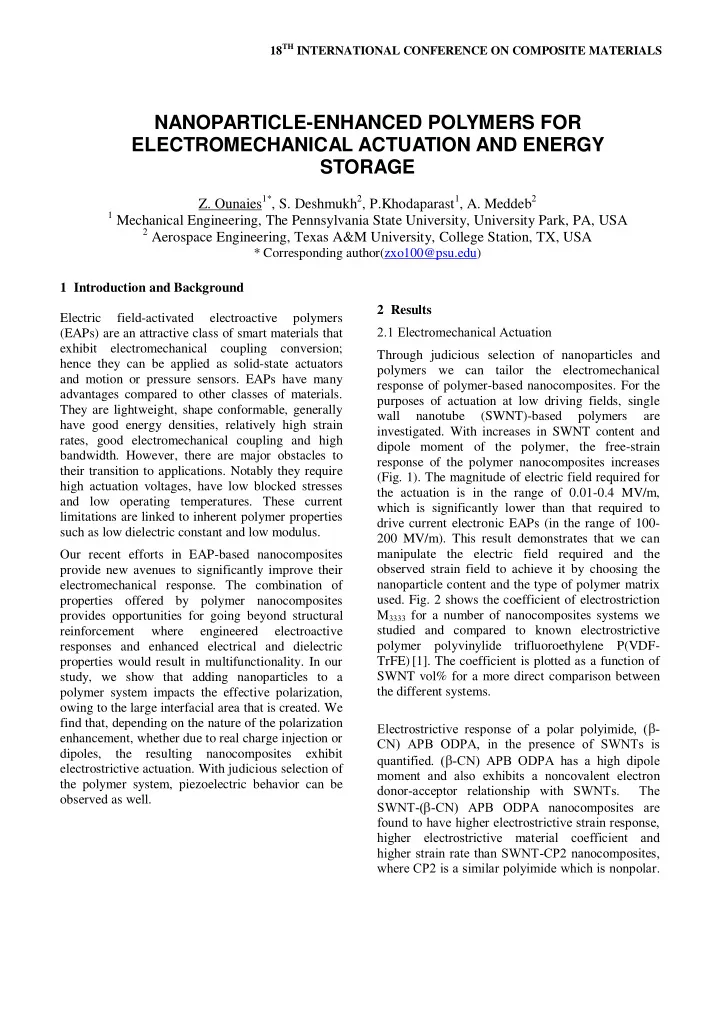
dipole moment of the polymer, the free-strain response of the polymer nanocomposites increases (Fig. 1). The magnitude of electric field required for the actuation is in the range of 0.01-0.4 MV/m, which is significantly lower than that required to drive current electronic EAPs (in the range of 100- 200 MV/m). This result demonstrates that we can manipulate the electric field required and the

  • bserved strain field to achieve it by choosing the

nanoparticle content and the type of polymer matrix

  • used. Fig. 2 shows the coefficient of electrostriction

M3333 for a number of nanocomposites systems we studied and compared to known electrostrictive polymer polyvinylide trifluoroethylene P(VDF- TrFE) [1]. The coefficient is plotted as a function of SWNT vol% for a more direct comparison between the different systems. Electrostrictive response of a polar polyimide, ( - CN) APB ODPA, in the presence of SWNTs is

  • quantified. ( -CN) APB ODPA has a high dipole

moment and also exhibits a noncovalent electron donor-acceptor relationship with SWNTs. The SWNT-( -CN) APB ODPA nanocomposites are found to have higher electrostrictive strain response, higher electrostrictive material coefficient and higher strain rate than SWNT-CP2 nanocomposites, where CP2 is a similar polyimide which is nonpolar.

NANOPARTICLE-ENHANCED POLYMERS FOR ELECTROMECHANICAL ACTUATION AND ENERGY STORAGE

  • Z. Ounaies1*, S. Deshmukh2, P.Khodaparast1, A. Meddeb2

1 Mechanical Engineering, The Pennsylvania State University, University Park, PA, USA 2 Aerospace Engineering, Texas A&M University, College Station, TX, USA

* Corresponding author(zxo100@psu.edu)

Keywords:nanocomposites, capacitors, dielectric constant, electrostriction

slide-2
SLIDE 2

Thermally stimulated current measurements and dielectric relaxation experiments reveal a higher polarization in the SWNT-( -CN) APB ODPA than SWN-CP2 samples. This is attributed to the high dipole moment and SWNT-( -CN) APB ODPA

  • interaction. The effect of electric field frequency on

the electromechanical response is also studied and is found to decrease with frequency, consistent with a dipole-driven actuation. The electromechanical coupling response can be

  • ptimized by the choice of a polymer that displays a

high dipole moment and a strong interaction with the nanoparticles, such as through a noncovalent dipolar

  • interaction. The electromechanical strain response

for our polyimide-based nanocomposite system showed the following salient features: (i) Low actuation electric fields, one to two orders

  • f magnitude lower than those needed for

existing EAPs. (ii) Electrostrictive coefficients that are four to seven orders of magnitude higher than those of known electroactive polymers. (iii) Comparable gravimetric work densities to those

  • f known EAPs.

Despite these promising results, issues regarding dispersion of nanoparticles and high dielectric loss values remain. We address those by introducing in- situ synthesis of nanoparticles in the polymer, and by exploring use of high dielectric, high aspect ratio particles such as titania. Discussion of this study follows.

  • Fig. 1. Thickness strains for PVDF nanocomposites

Fig.2. Comparison of coefficient of electrostriction for a series of polymer-based nanocomposite systems

2.2 Dielectric Enhancement Although we have shown that the inclusion of SWNTs in polymers increases the dielectric properties and leads to electroactive strain at low electric field, presence of SWNTs also increases the loss tangent and lowers the breakdown strength. In a different approach, we investigate addition of TiO2 nanoparticles to PVDF to explore impact on dielectric, loss and breakdown strength. Polyvinylidene Fluoride (PVDF) Kynar 301 is purchased from Arkema Inc. TiO2 rutile nano rods (NR) (10x40nm) and nano wires (NW) (130nmx1.68 m) are products of Nanostructured & Amorphous Materials, Inc and Ishihara Corporation (USA), respectively. TiO2 anatase nano spheres (NS) (15nm diameter) and micro spheres (MS) (0.5 m diameter) are purchased from Nanostructured & Amorphous Materials, Inc and Sigma Aldrich,

  • respectively. Rutile TiO2 particles have a relatively

high dielectric constant around 100 and anatase TiO2 particles have a dielectric constant around 70. The solvent used in the composites is N,N- dimethylacetamide (DMAc) which was purchased from Sigma-Aldrich. The coupling agent is 3- aminopropyltriethoxysilane (APS) purchased from Sigma-Aldrich. 2.3 and 4.6 vol% TiO2-PVDF composites were prepared. Two series of the

E (MV/m)

0.0 0.1 0.2 0.3 0.4 0.5 0.

Strain S33

0.0000 0.0005 0.0010 0.0015 0.0020 0.0025

PVDF+0.4 vol%SWNT disk PVDF+0.67 vol%SWNT disk PVDF+1.33vol% SWNT disk PVDF+0.26 volt%SWNT film

Figure 1. Thickness strains for PVDF nanocomposites

slide-3
SLIDE 3

3 PAPER TITLE

composites were made; the first one with non-treated particles and the second one with functionalized

  • particles. The non-treated titanium dioxide particles

were dried at 195 C for 12 hours under vacuum prior to mixing in order to remove the moisture. Three techniques were used in the preparation of the composites: high shear mechanical mixing with ultrasonication followed by magnetic stirring. The first two techniques are used to pre-disperse the particles in the solvent. After 6 hours of mixing, the particles were added to the dissolved PVDF solution and magnetically stirred. Degassing is an important step before casting the solution on glass plates to remove air bubbles which affect the films porosity and hence their dielectric properties. The dielectric properties of the different composites were measured using a Novocontrol Alpha-A high performance frequency analyzer over a range of frequencies from 10 mHz to 20MHz at room

  • temperature. For each composite, three samples are

tested and the average is calculated. Prior to making the measurements, silver circular electrodes were deposited on both sides of each sample surface. Dielectric constant is influenced by polarization which is composed of atomic, electronic, dipolar and interfacial polarizations. As the applied AC electric field frequency increases, dipoles fail to follow the electric field, leading to a decrease in the dielectric material’s polarization hence its dielectric constant

  • decreases. For the polymer, as the frequency

increases, it becomes harder for the C-F dipole to

  • rient with the AC field. Moreover, the TiO2

dielectric constant decreases with the increase in frequency leading to an overall decrease in the effective dielectric constant of the composites [12]. Fig (a) compares the dielectric constant of the different 4.6 vol% TiO2-PVDF composites to the pure PVDF dielectric constant as a function of

  • frequency. Fig (b) excludes the composite with

nano rods in order to better display the other

  • composites. The nanocomposite made with the nano

rods shows the highest dielectric constant at low

  • frequencies. The nano rods have the smallest

diameter among all the particles and 4 times the aspect ratio of the spheres giving them the highest surface area. This explains the dominance of the NR-PVDF interfacial polarization at frequencies lower than 1 kHz. After this frequency, all the composites’ dielectric constant become close to the pure PVDF constant or even lower. This might be caused by the particles anchoring the polymer’s chains and inhibiting their movement at high frequencies.

(a) (b) Fig 3. Dielectric constant of (a) pure PVDF and 4.6vol% composites (b) pure PVDF and 4.6vol% composites , excluding nanorods.

Fig (a) shows the effect of the functionalization

  • n the dielectric properties of 2.3vol% NW-
  • PVDF. There is an increase in the dielectric

constant after the functionalization through all the frequencies range while the loss tangent remains in the same range.

f (Hz)

10-3 10-2 10-1 100 101 102 103 104 105 106 107 108

'

20 40 60 80 100 120 140 160 Pure PVDF Nano Spheres Micro Spheres Nano Rods Nano Wires

f (Hz)

10-3 10-2 10-1 100 101 102 103 104 105 106 107 108

'

4 6 8 10 12 14 16 18 20 22 Pure PVDF Nano Spheres Micro Spheres Micro Aciculars

slide-4
SLIDE 4

(a) (b) Fig 4. (a) Dielectric constant and (b) loss tangent of pure PVDF and 2.3vol% treated and non-treated TiO2 NW - PVDF composites

Breakdown measurements were carried out using a DC QuadTech hipot tester. For each composite 12 measurements are taken. Weibull

distribution analysis was applied to find the breakdown with 63.5% probability Eb. The energy density is calculated using the equation below: At the lower TiO2 content, 2.3vol%, the composites show a higher dielectric breakdown than the pure PVDF (see Table 1). This increase in dielectric breakdown is further enhanced by functionalization

  • f the TiO2 particles. A stronger interaction between

the functionalized particles and the polymer matrix results in deeper trap sites as compared to the composite with non-functionalized particles [5]. Furthermore, the particles functionalization resulted in a higher dielectric constant. The 2.3vol% NW@APS-PVDF has an enhancement in energy density higher than 100% compared to the pure PVDF while the loss tangent did not increase

  • significantly. This energy density value is higher

than what was reported in [8] where 50vol% of the composite was added particles. Table 1. Effect of functionalization on dielectric breakdown

Eb (MV/m) ' (1kHz) Tan( ) (1kHz) U (J/cc) PVDF 247 7 0.018 1.84 2.3vol% NW 267 7.9 0.020 2.49 2.3vol% NW@APS 274 11.9 0.021 3.96

We note that the significant improvement in the dielectric breakdown and energy storage with such low content of 2.3vol% did not sacrifice the flexibility and of the polymer matrix. Impact of dielectric improvement on electroactive strain is currently under investigation.

  • 3. Conclusion

The combination of properties offered by polymer nanocomposites provides opportunities for going beyond structural reinforcement where engineered electroactive responses and enhanced electrical and dielectric properties would result in

  • multifunctionality. In our study, we show that

adding nanoparticles to a polymer system impacts the effective polarization, owing to the large interfacial area that is created. Moving away from conductive nanoparticles, we explored addition of dielectric nanoparticles such as metal oxide titania. Addition of TiO2 particles to PVDF polymer matrix resulted in an enhancement in the dielectric properties with 2.3wt% loading of functionalized micro aciculars that have an aspect ratio of 14. Impact of dielectric improvement on electroactive strain is currently under investigation.

f (Hz)

10-3 10-2 10-1 100 101 102 103 104 105 106 107 108

'

5 10 15 20 25 30

2.3vol% NW 2.3vol% NW@APS Pure PVDF f (Hz)

10-3 10-2 10-1 100 101 102 103 104 105 106 107 108

Tan( )

0.0 0.1 0.2 0.3 0.4 0.5 0.6 0.7 2.3vol% NW 2.3vol% NW@APS Pure PVDF

slide-5
SLIDE 5

18TH INTERNATIONAL CONFERENCE ON COMPOSITE MATERIALS

References

[1] Q. Zhang, V. Bharti, X. Zhao, “Giant

electrostriction and relaxor ferroelectric behavior in electron irradiated poly(vinylidene fluoride- trifluoroethylene) copolymer”, Science, 280, pp.2101-2104, 1998.

[2] Z. Ounaies, C. Park,P. Lillehei and J.

Harrison,“Evidence of piezoelectricity in SWNT- Polyimide and SWNT–PZT-Polyimide composites”,

  • J. of Therm. Comp. Mat., 21, pp. 393-408, 2008.

[3] L. D. Zhang, et al., "Dielectric behaviour of

Nano-TiO2 bulks," Physica Status Solidi A-Appl Research, vol. 157, pp. 483-491, 1996.

[4] M. Roy, et al., "Candidate mechanisms

controlling the electrical characteristics of silica/XLPE nanodielectrics " Journal of Materials Science, vol. 42, pp. 3789-3799, 2007.

[5] H. Tang, et al., "Nanocomposites with

increased energy density through high aspect ratio PZT nanowires," Nanotechnology, vol. 22, 2011.