Nags Head Setting Population 2,954 (year round) 40,000 (seasonal) - - PowerPoint PPT Presentation

nags head setting
SMART_READER_LITE
LIVE PREVIEW

Nags Head Setting Population 2,954 (year round) 40,000 (seasonal) - - PowerPoint PPT Presentation

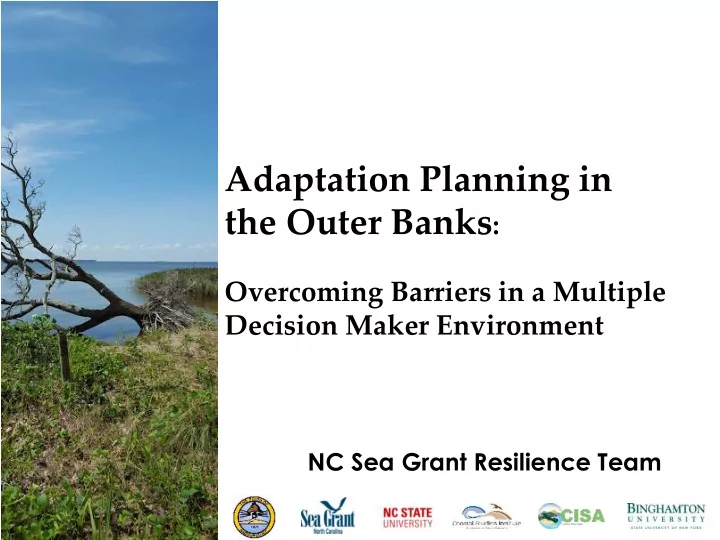
Adaptation Planning in the Outer Banks : Overcoming Barriers in a Multiple Decision Maker Environment NC Sea Grant Resilience Team Nags Head Setting Population 2,954 (year round) 40,000 (seasonal) 11 miles of shoreline 85%


slide-1
SLIDE 1

Adaptation Planning in the Outer Banks:

Overcoming Barriers in a Multiple Decision Maker Environment

NC Sea Grant Resilience Team
slide-2
SLIDE 2

Nags Head

slide-3
SLIDE 3

Setting

  • Population

– 2,954 (year round) – 40,000 (seasonal)

  • 11 miles of shoreline
  • 85% of Town on septic
  • Key Dates-

– Incorporated 1961 – Land Development Plan 1964 – Zoning, Subdivision, Flood Maps 1970’s

slide-4
SLIDE 4

Multiple Decision-Makers

  • Dare County:

– Drinking water – Environmental Health – Emergency management

  • State of North Carolina:

– Roads, drainage in South Nags Head, Hwy 64 – Jockey’s Ridge State Park – CAMA/Floodplain Management – Inlet management

  • Federal Government:

– Nat’l Park Service marshes in South Nags Head – Inlet management

  • Other:

– Nature Conservancy- Nags Head Woods

slide-5
SLIDE 5
  • Two Part-

– Comprehensive Plan – Code Updates

  • Sub-section on Climate

Adaptation & Sea Level Rise

– Integrate actions – Develop Policies

slide-6
SLIDE 6

NC Sea Grant Partnership

  • Vulnerability, Consequences, and Adaptation

Scenario Process (VCAPS)

– Dialogue about hazards, e.g., sea level rise, flooding, coastal storms. – How do these hazards impact Nags Head? – What factors that make consequences better

  • r worse for the Town?
  • VCAPS captures and documents current and

potential actions, both desired and not desired.

slide-7
SLIDE 7

Vulnerability

Ash Wednesday- 1962

slide-8
SLIDE 8

Vulnerability

  • S. Nags Head- 1980
slide-9
SLIDE 9
slide-10
SLIDE 10

Sea Gull Drive

slide-11
SLIDE 11

Sea Gull Drive

slide-12
SLIDE 12

Sea Gull Drive

slide-13
SLIDE 13
slide-14
SLIDE 14

VCAPS supports initial phases

  • f resilience planning and

implementation…

…through group discussion and learning… …supported by real-time diagramming.

slide-15
SLIDE 15

VCAPS Diagrams: Building Blocks

slide-16
SLIDE 16
slide-17
SLIDE 17
slide-18
SLIDE 18

Outcomes

  • Actions fit into major categories:

– Ocean shoreline management – estuarine shoreline management – stormwater management – water (ground/surface) management

slide-19
SLIDE 19
slide-20
SLIDE 20

Outcomes

  • Adaptation Plan
  • Comprehensive Education Plan
  • Commitment to beach nourishment &

living shoreline

  • Mapping-

– Impervious surfaces

  • Higher Standards-

– Higher separation rates for septic – Mandatory inspection program

slide-21
SLIDE 21

Challenges

  • Maintaining water quality
  • Erosion- sound & marsh
  • Maintaining community character and

quality of life

  • Many county, state, federal regulations
  • Identifying tipping points

– Septic system function vs water quality – Erosion and real estate market

slide-22
SLIDE 22

Challenges

  • Local long-term data vs. impact on

decision-making without such data

  • How will the Town fund adaptation?

– Maintenance – Cross-scale collaboration to apply for funding

  • What about issues not within the Town’s

jurisdiction?

slide-23
SLIDE 23

With multiple decision-makers and multiple decisions, Nags Head’s situation may be too complex for simple structured decision-making

  • analysis. There’s a need for decision

support methodologies that could help them move toward increasing resilience.

slide-24
SLIDE 24

Need for additional social science research and engagement to assist the Town with collaboratively developing a work plan to address sea level rise: 1.As part of comprehensive planning and 2.As part of implementation plans.

slide-25
SLIDE 25

A resilient Nags Head means

  • Withstand, respond to, and recover rapidly

from disruptions without long-term damage to the economy or environment;

  • Requires less government funding to

recover, rebuild and redevelop its communities; and

  • Sustains the way that natural systems

provide ecosystem services that directly or indirectly support human survival and quality of life.