} n ops take time T(n) PUSH(S,x) --- O(1) Avg cost per op = - - PDF document

n ops take time t n push s x o 1 avg cost per op t n n
SMART_READER_LITE
LIVE PREVIEW

} n ops take time T(n) PUSH(S,x) --- O(1) Avg cost per op = - - PDF document

Stack Example Stack Example Amortized Analysis: 3 Methods Amortized Analysis: 3 Methods Aggregate Consider a stack data structure with 3 ops } n ops take time T(n) PUSH(S,x) --- O(1) Avg cost per op = T(n)/n (Amortized


slide-1
SLIDE 1

1

Amortized Analysis: 3 Methods Amortized Analysis: 3 Methods

  • Aggregate
  • Accounting --- (Book-Keeping scheme for counting ops
  • Potential
  • “Stored work” viewed as “potential energy”
  • Most flexible & powerful point of view
  • n ops take time T(n)
  • Avg cost per op = T(n)/n

(Amortized Cost)

  • Imprecise – no seperate cost for each item
  • Charge each op an amortized cost
  • Store in “bank” amount not used
  • Later ops can used “banked” work

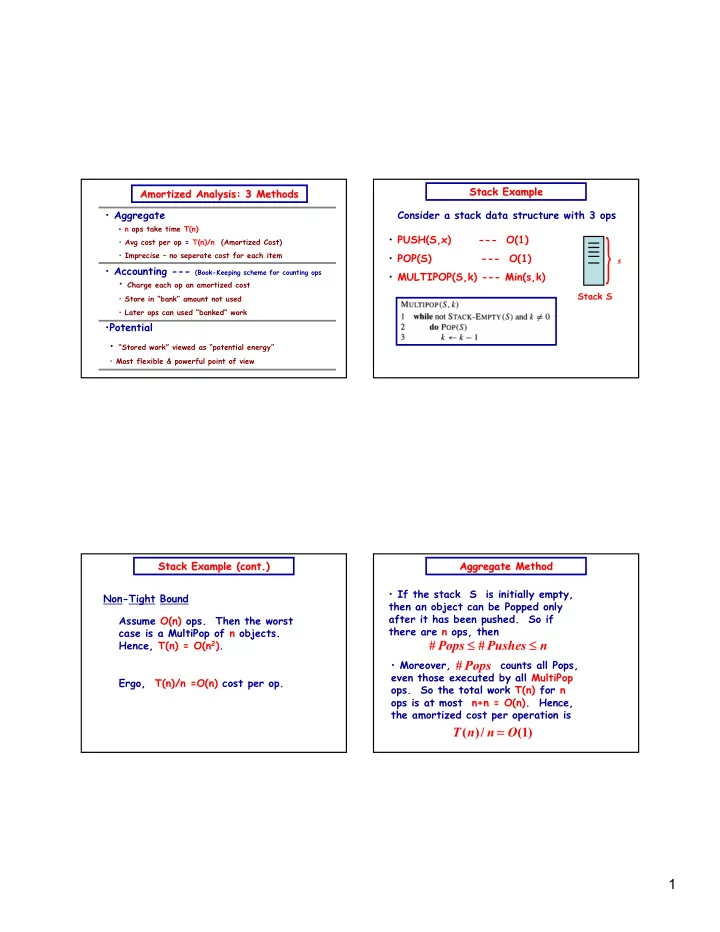
Stack Example Stack Example Consider a stack data structure with 3 ops

  • PUSH(S,x) ---

O(1)

  • POP(S) ---

O(1)

  • MULTIPOP(S,k) --- Min(s,k)

}

s

Stack S

Stack Example (cont.) Stack Example (cont.) Non-Tight Bound Assume O(n) ops. Then the worst case is a MultiPop of n objects. Hence, T(n) = O(n2). Ergo, T(n)/n =O(n) cost per op. Aggregate Method Aggregate Method

  • If the stack S is initially empty,

then an object can be Popped only after it has been pushed. So if there are n ops, then

  • Moreover, counts all Pops,

even those executed by all MultiPop

  • ps. So the total work T(n) for n
  • ps is at most n+n = O(n). Hence,

the amortized cost per operation is

# # Pops Pushes n ≤ ≤ ≤ ≤ # Pops ( )/ (1) T n n O =

slide-2
SLIDE 2

2

Incrementing a Counter: Aggregate Analysis Incrementing a Counter: Aggregate Analysis Incrementing a Counter: Aggregate Analysis Incrementing a Counter: Aggregate Analysis We have a k-bit register which counts up from 0. Value of counter There are two types of bit flip ops:

  • [ ]

[ ]

A

[ ] [ ]

2 A

[ ] [ ]

1 A

[ ] [ ]

1 A k −

Least Sig bit Most Sig bit

[ ] [ ]

1

2

k i i

A i

− =

= ∑

  • Reset to O
  • Set to 1

Cursory Analysis: Non Cursory Analysis: Non-

  • Tight Bound

Tight Bound

  • The computation work for a single bit =

O(k), since worst case is k-1 resets and 1 set.

  • Hence, work for n ops = O(nk)
  • Ergo, Amortized cost =T(n)/n =O(k)

Better Analysis: Tighter Bound Better Analysis: Tighter Bound Observation: If register is initially set to 0, then after a seq of n ops, bit A[i] flips exactly: times, if 0 times, if

/ 2i n    

lg i n ≤     lg i n >    

{

Hence, So,

lg

( ) 2 2 2

n i i i i

n T n n n

∞ − = = = =

  = < = < =    

∑ ∑

( ) ( ) ( )/ (1) T n O n T n n O = ⇒ =

slide-3
SLIDE 3

3

Accounting Method Accounting Method Assign Amortized Costs in such a way that you overcharge on some ops, and undercharge

  • n others.

Overcharge = Actual Cost + Credit Undercharge = Actual Cost –Credit Amortized Cost = Actual Cost Credit But always, Total Actual Cost Total Amortized Cost

±

Stack Example: Accounting Method Stack Example: Accounting Method Actual Costs: Push 1 Pop 1 MultiPop Min(k,s) Amortized Costs: Push 2 Pop 0 MultiPop Stack Example: Accounting Method Stack Example: Accounting Method $8 $6 $6 $4 $2 $3 $5 $2 $4 $3 $3 $2 $2 $1 $1

Push Pop Push Push Push

P=$ P=$ P=$ P=$ P=$ P=$ P=$ P=$ P=$ P=$ P=$ P=$ P=$ P=$ P=$

Total Amortized Cost

$10 $10

Total Credit Tot Act. Cost

$0 $10 $4 $6

MultiP Push

Total Actual Cost Total Amortized Cost

( ) ( )

2 # ( ) ( ) ( ) Push O n T n O n = = = = ⇒ =

Associate Credit with Data Structure

Incrementing Counter: Accounting Method Incrementing Counter: Accounting Method Amortized Costs: Set Bit to 1

  • -- $2

Reset Bit to 0 -- $0

  • Note. A bit cannot be reset unless it has

been set sometime in the past. So if we pay $2 for each Set (which is $1 too much), then there will be $1 left to pay for a Reset, should it occur. Therefore, the total available credit will always be Actual Cost Total Amortized Cost = 2#Sets

≥ ≤ 2 ( ) n O n ≤ = ≤ =

slide-4
SLIDE 4

4

The Potential Method The Potential Method To be Completed Example: A Dynamic Table Example: A Dynamic Table Example: A Dynamic Example: A Dynamic Table(Cont Table(Cont.) .) Example: A Dynamic Example: A Dynamic Table(Cont Table(Cont.) .)