n ): Continuous Models (state trajectory: Ordinary Differential - - PowerPoint PPT Presentation

n continuous models state trajectory ordinary
SMART_READER_LITE
LIVE PREVIEW

n ): Continuous Models (state trajectory: Ordinary Differential - - PowerPoint PPT Presentation


slide-1
SLIDE 1

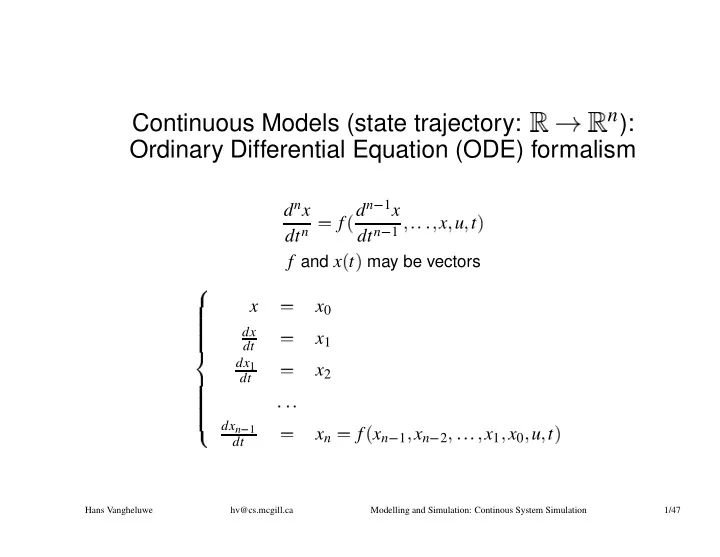
Continuous Models (state trajectory:

n):

Ordinary Differential Equation (ODE) formalism

dnx dtn

  • f

dn

1x

dtn

1

✄ ☎ ☎ ☎ ✄

x

u

t

f and x

t

may be vectors

✝ ✞ ✞ ✞ ✞ ✞ ✞ ✞ ✞ ✟ ✞ ✞ ✞ ✞ ✞ ✞ ✞ ✞ ✠

x

  • x0

dx dt

  • x1

dx1 dt

  • x2
☎ ☎ ☎

dxn

1

dt

  • xn
  • f

xn

1

xn

2

✄ ☎ ☎ ☎ ✄

x1

x0

u

t

Hans Vangheluwe hv@cs.mcgill.ca Modelling and Simulation: Continous System Simulation 1/47

slide-2
SLIDE 2

Euler discretisation

dx dt

  • f

x

u

t

✆ ☛

x

ti

∆t

✆✍✌

x

ti

∆t

  • f

x

ti

✆ ✄

u

ti

✆ ✄

ti

✆ ☛

x

ti

∆t

✆ ✎
  • x

ti

✆ ☞

∆t f

x

ti

✆ ✄

u

ti

✆ ✄

ti

Hans Vangheluwe hv@cs.mcgill.ca Modelling and Simulation: Continous System Simulation 2/47

slide-3
SLIDE 3

Taylor Series Expansion

x

ti

∆t

  • x

ti

✆ ☞

∆t 1! dx dt

ti

∆t2 2! d2x dt2

ti

∆t3 3! d3x dt3

ti

☞ ☎ ☎ ☎

Is EXACT if expansion is not truncated ERROR

  • O

∆tN

1

if truncated after term N Beyond first derivative, use difference formulas ERROR εN

  • approxN

1

approxN

Hans Vangheluwe hv@cs.mcgill.ca Modelling and Simulation: Continous System Simulation 3/47

slide-4
SLIDE 4

Integration Methods: Euler

Single-step

x0

  • α0

xi

1

  • xi

∆t f

ti

xi

✆ ✄

i

Unsymmetrical: uses only derivative in begin point.

Hans Vangheluwe hv@cs.mcgill.ca Modelling and Simulation: Continous System Simulation 4/47

slide-5
SLIDE 5

Integration Methods: Modified Euler

Single-step

x0

  • α0

k1

  • ∆t f

ti

xi

k2

  • ∆t f

ti

∆t

xi

k1

xi

1

  • xi

k1 2

k2 2

i

Symmetrical: uses derivative in begin and end point.

Hans Vangheluwe hv@cs.mcgill.ca Modelling and Simulation: Continous System Simulation 5/47

slide-6
SLIDE 6

Integration Methods: Midpoint

Single-step

x0

  • α0

k1

  • ∆t f

ti

xi

k2

  • ∆t f

ti

∆t 2

xi

k1 2

xi

1

  • xi

k2

i

Symmetrical: halfway point.

Hans Vangheluwe hv@cs.mcgill.ca Modelling and Simulation: Continous System Simulation 6/47

slide-7
SLIDE 7

Integration Methods: Heun

Single-step

x0

  • α0

k1

  • ∆t f

ti

xi

k2

  • ∆t f

ti

2∆t 3

xi

2k1 3

xi

1

  • xi

k1 4

3k2 4

i

Hans Vangheluwe hv@cs.mcgill.ca Modelling and Simulation: Continous System Simulation 7/47

slide-8
SLIDE 8

Integration Methods: Runge-Kutta Methods

Single-step, q stages (function evaluations per step)

xi

1

  • xi

∆tφ

ti

xi;∆t

φ

ti

xi;∆t

  • q

i

1

ωiki

Explicit method:

ki

  • f

ti

∆tαi

xi

∆t

i

1

j

1

βijkj

✆ ✄

α1

  • Hans Vangheluwe

hv@cs.mcgill.ca Modelling and Simulation: Continous System Simulation 8/47

slide-9
SLIDE 9

Implicit method:

ki

  • f

ti

∆tαi

xi

∆t

q

j

1

βijkj

✆ ✔

nonlinear set of equations in ki

explicit is a special case Order p: exact solution up to polynomial of order p

can determine αi

ωi

βij

For explicit method of order p, at least qmin

p

stages are required: p 1 2 3 4 5 6 7 ... q_min(p) 1 2 3 4 6 7 9 ...

Hans Vangheluwe hv@cs.mcgill.ca Modelling and Simulation: Continous System Simulation 9/47

slide-10
SLIDE 10

Integration Methods: Runge-Kutta 4

Single-step

x0

  • α0

k1

  • ∆t f

ti

xi

k2

  • ∆t f

ti

∆t 2

xi

k1 2

k3

  • ∆t f

ti

∆t 2

xi

k2 2

k4

  • ∆t f

ti

∆t

xi

k3

xi

1

  • xi

k1 6

k2 3

k3 3

k4 6

i

Hans Vangheluwe hv@cs.mcgill.ca Modelling and Simulation: Continous System Simulation 10/47

slide-11
SLIDE 11

Integration Methods: Adams-Bashforth

Multi-step: need lower-step methods for start-up

2-step x0

  • α0

x1

  • α1

xi

1

  • xi

∆t 2

3 f

ti

xi

✆✍✌

f

ti

1

xi

1

✆ ✄

i

1 3-step x0

  • α0

x1

  • α1

x2

  • α2

xi

1

  • xi

∆t 12

23 f

ti

xi

✆✍✌

16 f

ti

1

xi

1

✆ ☞

5f

ti

2

xi

2

✆ ✆ ✄

i

2

Hans Vangheluwe hv@cs.mcgill.ca Modelling and Simulation: Continous System Simulation 11/47

slide-12
SLIDE 12

4-step x0

  • α0

x1

  • α1

x2

  • α2

x3

  • α3

xi

1

  • xi

∆t 24

55 f

ti

xi

✆✍✌

59 f

ti

1

xi

1

✆ ☞

37 f

ti

2

xi

2

✆✍✌

9 f

ti

3

xi

3

✆ ✆ ✄

i

3

Hans Vangheluwe hv@cs.mcgill.ca Modelling and Simulation: Continous System Simulation 12/47

slide-13
SLIDE 13

Integration Methods: Milne

Predictor-corrector

Predictor

x0

  • α0

x1

  • α1

x2

  • α2

x3

  • α3

x

✖ ✗

i

1

  • xi

3

4∆t 3

2f

ti

xi

✆✍✌

f

ti

1

xi

1

✆ ☞

2f

ti

2

xi

2

✆ ✆ ✄

i

3

Corrector

x

k

1

i

1

  • xi

1

∆t 3

f

ti

1

x

k

i

1

✆ ☞

4f

ti

xi

✆ ☞

f

ti

1

xi

1

✆ ✆ ✄

i

2

k

  • 1

2

✄ ☎ ☎ ☎

Hans Vangheluwe hv@cs.mcgill.ca Modelling and Simulation: Continous System Simulation 13/47

slide-14
SLIDE 14

Adaptive Step-size Control

want to attain pre-set minimum (step-wise) accuracy

want mimimum computation Solution: use accuracy estimate to adjust (double/halve) step-size Obtaining accuracy estimate:

  • 1. step halving (e.g., RK4)
  • 2. εN
  • approxN

1

approxN

Hans Vangheluwe hv@cs.mcgill.ca Modelling and Simulation: Continous System Simulation 14/47

slide-15
SLIDE 15

Adaptive Step-size Control

RK4 + RK5

Runge-Kutta Fehlberg (embedded)

k1

  • ∆t f

ti

xi

k2

  • ∆t f

ti

a2∆t

xi

b12k1

✆ ✙ ✙ ✙

k6

  • ∆t f

ti

a6∆t

xi

b61k1

b62k2

☞ ✙ ✙ ✙ ☞

b65k5

xi

1

  • xi

c1k1

c2k2

☞ ✙ ✙ ✙ ☞

c6k6

O

∆t6

x

i

1

  • xi

c

1k1

c

2k2

☞ ✙ ✙ ✙ ☞

c

6k6

O

∆t5

εestim

  • xi

1

x

i

1

  • ∑6

i

1

ci

c

i

ki

Hans Vangheluwe hv@cs.mcgill.ca Modelling and Simulation: Continous System Simulation 15/47

slide-16
SLIDE 16

set initial conditions set [ t_init, t_final] set parameter values t := t_init

YES NO

estimate integration error E E<E_min E>E_max E in [E_min, E_max]

YES NO

delta_t := delta_t*2 delta_t := delta_t/2

integrate over [t, t_new] zero crossing location t_zc t := t_new t := t_zc zero crossing

  • ccurred

in [t,t_new] ?

t >= t_final ?

?

set integrator set initial delta_t set integrator parameters

start

end

iterate to consistent initial conditions

Hans Vangheluwe hv@cs.mcgill.ca Modelling and Simulation: Continous System Simulation 16/47

slide-17
SLIDE 17

Stiff Systems

u

  • 998u

1998v v

999u

1999v u

✁ ✆
  • 1

v

✁ ✆
  • u
  • 2y

z v

y

z u

  • 2e

t

e

1000t

v

e

t

e

1000t

Hans Vangheluwe hv@cs.mcgill.ca Modelling and Simulation: Continous System Simulation 17/47

slide-18
SLIDE 18

Stiff Systems: solvers

x

cx

Explicit: Forward Euler: xi

1

  • xi

∆tx

i

xi

1

1

c∆t

xi

Implicit: Backward Euler: xi

1

  • xi

∆tx

i

1

xi

1

  • xi

1

c∆t

Rosenbrock, Gear, . . . methods

Hans Vangheluwe hv@cs.mcgill.ca Modelling and Simulation: Continous System Simulation 18/47

slide-19
SLIDE 19

Differential Algebraic Equations (DAE)

f

dnx dtn

dn

1x

dtn

1

✄ ☎ ☎ ☎ ✄

x

u

t

  • g

x

t

  • Residual Solvers

DASSL (Petzold) http://www.engineering.ucsb.edu/ cse/software.html

Hans Vangheluwe hv@cs.mcgill.ca Modelling and Simulation: Continous System Simulation 19/47

slide-20
SLIDE 20

Causal continuous-time models

Hans Vangheluwe hv@cs.mcgill.ca Modelling and Simulation: Continous System Simulation 20/47

slide-21
SLIDE 21

Problems with algebraic model solving

DAE-set != DAE-sequence

cycles ? No Yes Set a = b + 3 b = a / 2 Sequence a = 3 b = 3 solve linear nonlinear Set a = d - c b = c + a - 3 c = 6 + d * e d = 2 e = 3 a = 0 b = 0 c = 6 d = 2 e = 3 Sequence d = 2 e = 3 c = 6 + d * e a = d - c b = c + a - 3 sorting

Hans Vangheluwe hv@cs.mcgill.ca Modelling and Simulation: Continous System Simulation 21/47

slide-22
SLIDE 22

Dependency Graph

a = d - c b = c + a - 3 c = 6 + d * e d = 2 e = 3 d e c a b

Hans Vangheluwe hv@cs.mcgill.ca Modelling and Simulation: Continous System Simulation 22/47

slide-23
SLIDE 23

Problems with model re-use: sorting topological sort

d e c a b

  • 1. find_root(s)
  • 2. DFS(root)

DFS(node) { if (not_visited(node)) { mark_visited(node) foreach child_node of node { DFS(child_node) } print(node) } } d e c b a

Hans Vangheluwe hv@cs.mcgill.ca Modelling and Simulation: Continous System Simulation 23/47

slide-24
SLIDE 24

Dependency Cycle (aka Algebraic Loop)

✝ ✞ ✞ ✟ ✞ ✞ ✠

x

  • y

16 y

x

z z

  • 5

can never be sorted due to a dependency cycle aka strong component (every vertex in the component is reachable from every other)

x

y

x

Hans Vangheluwe hv@cs.mcgill.ca Modelling and Simulation: Continous System Simulation 24/47

slide-25
SLIDE 25

May be solved implicitly

✜ ✢ ✢ ✢ ✣

z

  • 5
✝ ✟ ✠

x

y

6 x

y

z

Implicit set of n equations in n unknowns.

non-linear

non-linear residual solver.

linear

numeric or symbolic solution.

Hans Vangheluwe hv@cs.mcgill.ca Modelling and Simulation: Continous System Simulation 25/47

slide-26
SLIDE 26

May be solved symbolically (if linear and not too large)

x

✤ ✤ ✤ ✤ ✤ ✌

6

1

z 1

✤ ✤ ✤ ✤ ✤ ✤ ✤ ✤ ✤ ✤ ✤ ✤

1

1 1 1

✤ ✤ ✤ ✤ ✤ ✤

6

z 2 ; y

✤ ✤ ✤ ✤ ✤

1

6 1

z

✤ ✤ ✤ ✤ ✤ ✤ ✤ ✤ ✤ ✤ ✤ ✤

1

1 1 1

✤ ✤ ✤ ✤ ✤ ✤
  • 6

z 2

✜ ✢ ✢ ✣

z

  • 5

x

6

z 2

y

  • 6

z 2

Hans Vangheluwe hv@cs.mcgill.ca Modelling and Simulation: Continous System Simulation 26/47

slide-27
SLIDE 27

Simple Loop Detection

  • 1. Build dependency matrix D
  • 2. Calculate transitive closure D
  • 3. If True on diagonal of D

, a loop exists Even with Warshall’s algorithm, still O

n3

and don’t know immediately which nodes involved in the loop(s).

Hans Vangheluwe hv@cs.mcgill.ca Modelling and Simulation: Continous System Simulation 27/47

slide-28
SLIDE 28

Tarjan’s O

n m

Loop Detection (1972)

  • 1. Complete Depth First Search (DFS) on G

(possibly multiple DFS trees), postorder numbering FOREACH v IN V dfsNr[v] <- 0 FOREACH v IN V IF dfsNr[v] == 0 DFS(v)

  • 2. Reverse edges in the annotated G

GR

  • 3. DFS on GR starting with highest numbered v

set of vertices in each DFS tree

  • strong component.

Remove strong component and repeat.

Hans Vangheluwe hv@cs.mcgill.ca Modelling and Simulation: Continous System Simulation 28/47

slide-29
SLIDE 29

Set of Algebraic Eqns, no Loops

✝ ✞ ✞ ✞ ✞ ✞ ✞ ✞ ✞ ✟ ✞ ✞ ✞ ✞ ✞ ✞ ✞ ✞ ✠

a

  • b2

3 b

  • sin

c

e

c

d

4

5 d

  • π

2 e

  • u
✁ ✆

Hans Vangheluwe hv@cs.mcgill.ca Modelling and Simulation: Continous System Simulation 29/47

slide-30
SLIDE 30

Sorting, no Loops

A B C E D 1 2 3 4 5

Hans Vangheluwe hv@cs.mcgill.ca Modelling and Simulation: Continous System Simulation 30/47

slide-31
SLIDE 31

Sorting Result

✜ ✢ ✢ ✢ ✢ ✢ ✢ ✢ ✢ ✣

d

  • π

2 e

  • u
✁ ✆

c

d

4

5 b

  • sin

c

e

a

  • b2

3

Hans Vangheluwe hv@cs.mcgill.ca Modelling and Simulation: Continous System Simulation 31/47

slide-32
SLIDE 32

Algebraic Loop (Cycle) Detection

✝ ✞ ✞ ✞ ✞ ✞ ✞ ✞ ✞ ✟ ✞ ✞ ✞ ✞ ✞ ✞ ✞ ✞ ✠

a

  • b2

3 b

  • sin

c

e

c

d

4

5 d

  • π

2 e

  • a2

u

✁ ✆

Hans Vangheluwe hv@cs.mcgill.ca Modelling and Simulation: Continous System Simulation 32/47

slide-33
SLIDE 33

Algebraic Loop (Cycle) Detection

A B C E D 1 2 3 4 5 α1 α3 α2 β1 γ1

Hans Vangheluwe hv@cs.mcgill.ca Modelling and Simulation: Continous System Simulation 33/47

slide-34
SLIDE 34

Algebraic Loop (Cycle) Detection Result

✜ ✢ ✢ ✢ ✢ ✢ ✢ ✢ ✢ ✣

d

  • π

2 c

d

4

5

✝ ✞ ✞ ✟ ✞ ✞ ✠

b

  • sin

c

e

a

  • b2

3 e

  • a2

u

✁ ✆

;

✜ ✢ ✢ ✢ ✢ ✢ ✢ ✢ ✢ ✣

d

  • π

2 c

d

4

5

✝ ✞ ✞ ✟ ✞ ✞ ✠

b

sin

c

e

  • a

b2

3

  • a2

e

u

✁ ✆
  • Hans Vangheluwe

hv@cs.mcgill.ca Modelling and Simulation: Continous System Simulation 34/47

slide-35
SLIDE 35

Continuous System Simulation Languages (CSSLs)

Analog Computers

block oriented vs. equation based

the CSi 1968 CSSL standard

CSSL-IV, ACSL, ADSIM/RT, . . .

Hans Vangheluwe hv@cs.mcgill.ca Modelling and Simulation: Continous System Simulation 35/47

slide-36
SLIDE 36

CSSL Requirements

Easy Model Description (equation based, block oriented)

Integrator control:

– select integrator – (initial) step size – error control – variable initialization – parameter setting

Documentation of model and experiments

Structured: model vs. experiments (re-use)

Hans Vangheluwe hv@cs.mcgill.ca Modelling and Simulation: Continous System Simulation 36/47

slide-37
SLIDE 37

Model Description

DX = INTEG(F-B*X-A*DX, DX0) X = INTEG(DX, X0)

  • r

DX’ = F-B*X-A*DX X’ = DX Initial Conditions at t = 0: X = X0 DX = DX0

Hans Vangheluwe hv@cs.mcgill.ca Modelling and Simulation: Continous System Simulation 37/47

slide-38
SLIDE 38

“CSSL study” structure

Initial Region Dynamic Region Terminal Region Study (simulation experiment) Entry Point Study Termination

Hans Vangheluwe hv@cs.mcgill.ca Modelling and Simulation: Continous System Simulation 38/47

slide-39
SLIDE 39

“CSSL initial region” structure

Study Termination Call Call Initial Subregion Interpreter Integration Initialisation

Hans Vangheluwe hv@cs.mcgill.ca Modelling and Simulation: Continous System Simulation 39/47

slide-40
SLIDE 40

“CSSL dynamic region” structure

Input/Output Subregion System I/O Integration Subregion Solver (integrator) Solver (integrator) Derivative Section Derivative Section Region Termination Hans Vangheluwe hv@cs.mcgill.ca Modelling and Simulation: Continous System Simulation 40/47

slide-41
SLIDE 41

General, state-based simulation kernel

λ δ

X Q Y ti

ω

tf

λ δ

ω

δ

ω

T Hans Vangheluwe hv@cs.mcgill.ca Modelling and Simulation: Continous System Simulation 41/47

slide-42
SLIDE 42

Model-solver Architecture

SOLVER(s) SIMULATOR = solver + model MODEL dynamics MODEL symbolic information

experimentation environment (e.g., parameter input, visulisation)

  • r

simulator "bus" (e.g., HLA)

  • r

Hans Vangheluwe hv@cs.mcgill.ca Modelling and Simulation: Continous System Simulation 42/47

slide-43
SLIDE 43

MSL-EXEC Model Representation

Hans Vangheluwe hv@cs.mcgill.ca Modelling and Simulation: Continous System Simulation 43/47

slide-44
SLIDE 44

#include <math.h> #include <assert.h> #include "MSLE.h" #include "MSLExternal.h" #include "MSLU.h" #include "Circle.h" #define _t_ IndepVarValues[0] #define _x_out_ OutputVarValues[0] #define _y_out_ OutputVarValues[1] #define _x_ DerStateVarValues[0] #define _y_ DerStateVarValues[1] #define _D_x_ Derivatives[0] #define _D_y_ Derivatives[1] CircleClass :: CircleClass(StringType name_arg) { set_name(name_arg); set_description("Circle test."); set_class_name("CircleClass"); set_no_indep_vars(1); set_indep_var(0, new MSLEIndepVarClass("t", "s")); set_no_output_vars(2); set_output_var(0, new MSLEOutputVarClass("x_out", "", 0)); set_output_var(1, new MSLEOutputVarClass("y_out", "", 0)); set_no_der_state_vars(2); set_der_state_var(0, new MSLEDerStateVarClass("x", "", 0.1)); set_der_state_var(1, new MSLEDerStateVarClass("y", "", 0.1));

Hans Vangheluwe hv@cs.mcgill.ca Modelling and Simulation: Continous System Simulation 44/47

slide-45
SLIDE 45

set_no_indep_var_values(1); GetIndepVar(0)->LinkValue(this, MSLE_INDEP_VAR, 0); set_no_output_var_values(2); GetOutputVar(0)->LinkValue(this, MSLE_OUTPUT_VAR, 0); GetOutputVar(1)->LinkValue(this, MSLE_OUTPUT_VAR, 1); set_no_der_state_var_values(2); GetDerStateVar(0)->LinkValue(this, MSLE_DER_STATE_VAR, 0); GetDerStateVar(1)->LinkValue(this, MSLE_DER_STATE_VAR, 1); GetDerStateVar(0)->LinkInitialValue(this, 0); GetDerStateVar(1)->LinkInitialValue(this, 1); GetDerStateVar(0)->LinkDerivative(this, 0); GetDerStateVar(1)->LinkDerivative(this, 1); Reset(); }

Hans Vangheluwe hv@cs.mcgill.ca Modelling and Simulation: Continous System Simulation 45/47

slide-46
SLIDE 46

void CircleClass :: ComputeOutput(void) { _x_out_ = _x_; _y_out_ = _y_; } void CircleClass :: ComputeInitial(void) { } void CircleClass :: ComputeState(void) { _D_x_ = _y_; _D_y_ = -_x_; } void CircleClass :: ComputeTerminal(void) { } #undef _t_ #undef _x_out_ #undef _y_out_ #undef _x_ #undef _y_

Hans Vangheluwe hv@cs.mcgill.ca Modelling and Simulation: Continous System Simulation 46/47

slide-47
SLIDE 47

MSL-EXEC simulator demo

Hans Vangheluwe hv@cs.mcgill.ca Modelling and Simulation: Continous System Simulation 47/47