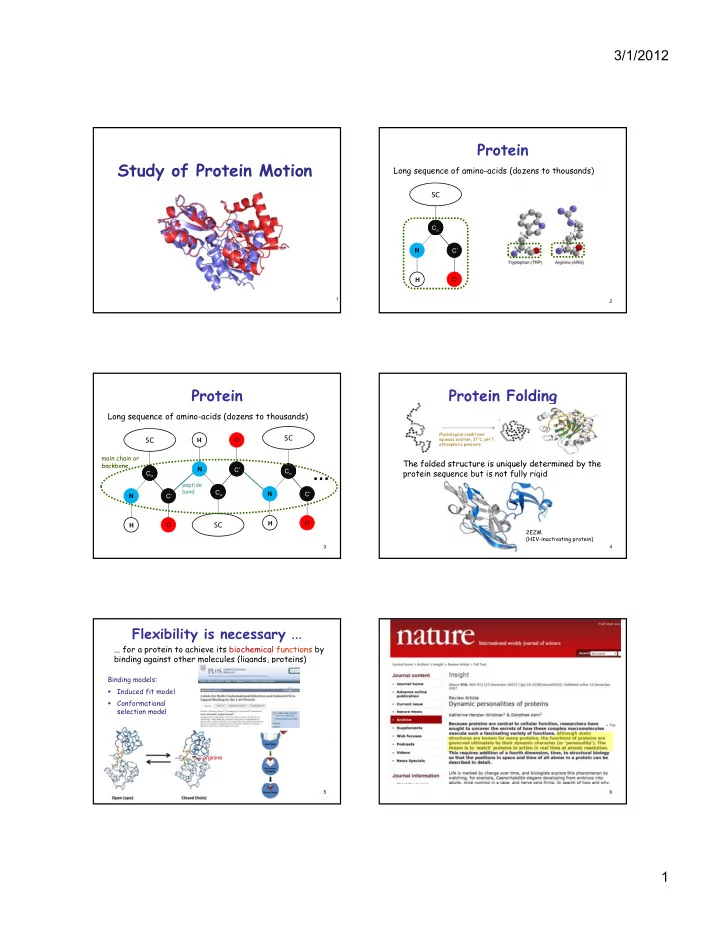
SLIDE 6 3/1/2012 6 Kino-Geometric Conformational Sampling
Computational challenges: — Requires satisfying often antagonistic constraints: kinematic and volume exclusion constraints — Folded conformations form a relatively tiny region
- f the conformational space How to hit this region?
31
D1 Di Dj Dk Dn Conformation space Folded state
- f the conformational space. How to hit this region?
Kino-Geometric Conformational Sampling
— ROCK (Rigidity Optimized Conformational Kinetics) [Zavodsky et al., 2004] — FRODA (Framework Rigidity Optimized Dynamic Algorithm) [Wells et al., 2005, Farrell et al., 2010] — KGS (Kino-Geometric Sampling) [Yao et al. 2011] — PEM (Protein Ensemble Method) [Shehu et al 2006]
32
PEM (Protein Ensemble Method) [Shehu et al., 2006] 1. Initialize conformation distribution Δ to {qgiven} 2. Iterate a. Pick q from Δ b. Deform q into new conformation qnew
Kino-Geometric Conformational Sampling
— ROCK (Rigidity Optimized Conformational Kinetics) [Zavodsky et al., 2004] — FRODA (Framework Rigidity Optimized Dynamic Algorithm) [Wells et al., 2005, Farrell et al., 2010] — KGS (Kino-Geometric Sampling) [Yao et al. 2011] — PEM (Protein Ensemble Method) [Shehu et al 2006]
33
1. Initialize conformation distribution Δ to {qgiven} 2. Iterate a. Pick q from Δ b. Deform q into new conformation qnew PEM (Protein Ensemble Method) [Shehu et al., 2006]
Kino-Geometric Conformational Sampling
— ROCK (Rigidity Optimized Conformational Kinetics) [Zavodsky et al., 2004] — FRODA (Framework Rigidity Optimized Dynamic Algorithm) [Wells et al., 2005, Farrell et al., 2010] — KGS (Kino-Geometric Sampling) [Yao et al. 2011]
1. Select conformation q in Δ
ROCK and FRODA: q is most recent conformation on Δ KG k d d h b b l l d
34
KGS: q is picked at random with probability inverse to sampling density
2. Select stable H-bonds in q
ROCK and FRODA: select H-bonds with energy less than a threshold KGS: uses a regression tree trained from Molecular Dynamics data
3. Perform rigidity analysis in q
ROCK, FRODA, and KGS: transform kinematic constraints into distance constraints between atoms, run Pebble Game algorithm to identify all rigid groups of atoms
4. Deform q into qnew
ROCK: Perturb dihedral angles and close cycles by minimizing to zero a measure of closure violation FRODA: Perturb all atom positions and reform rigid groups of atoms KGS: Perturb dihedral angles in null space
5. Check qnew for volume exclusion
Statistics for Two Proteins
2EZM # atoms: 992 # rigid groups: 503 # cycles: 47 2LAO 84 # atoms: 3649 # rigid groups: 1023 # cycles: 84
35
Kino-Geometric Conformational Sampling
— ROCK (Rigidity Optimized Conformational Kinetics) [Zavodsky et al., 2004] — FRODA (Framework Rigidity Optimized Dynamic Algorithm) [Wells et al., 2005, Farrell et al., 2010] — KGS (Kino-Geometric Sampling) [Yao et al. 2011]
1. Select conformation q in Δ
ROCK and FRODA: q is most recent conformation on Δ KG k d d h b b l l d
36
KGS: q is picked at random with probability inverse to sampling density
2. Select stable H-bonds in q
ROCK and FRODA: select H-bonds with energy less than a threshold KGS: uses a regression tree trained from Molecular Dynamics data
3. Perform rigidity analysis in q
ROCK, FRODA, and KGS: transform kinematic constraints into distance constraints between atoms, run Pebble Game algorithm to identify all rigid groups of atoms
4. Deform q into qnew
ROCK: Perturb dihedral angles and close cycles by minimizing to zero a measure of closure violation FRODA: Perturb all atom positions and reform rigid groups of atoms KGS: Perturb dihedral angles in null space
5. Check qnew for volume exclusion