MVDC PLUS Managing the future grid Bridge the distance Connecting - - PowerPoint PPT Presentation

mvdc plus
SMART_READER_LITE
LIVE PREVIEW

MVDC PLUS Managing the future grid Bridge the distance Connecting - - PowerPoint PPT Presentation

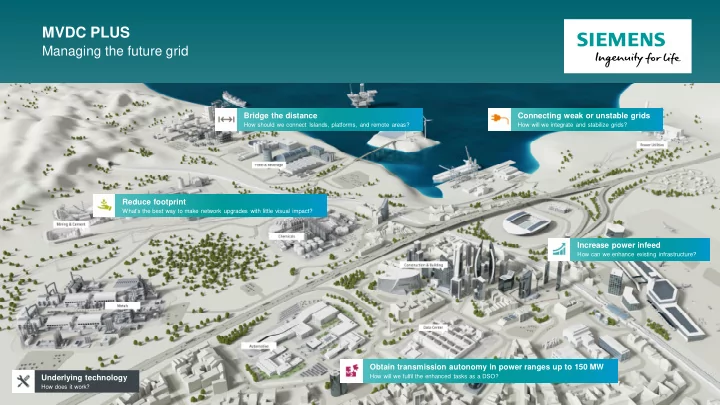
MVDC PLUS Managing the future grid Bridge the distance Connecting weak or unstable grids How should we connect Islands, platforms, and remote areas? How will we integrate and stabilize grids? Reduce footprint Whats the best way to make


slide-1
SLIDE 1

Increase power infeed

How can we enhance existing infrastructure?

Connecting weak or unstable grids

How will we integrate and stabilize grids?

Underlying technology

How does it work?

Reduce footprint

What’s the best way to make network upgrades with little visual impact?

Obtain transmission autonomy in power ranges up to 150 MW

How will we fulfil the enhanced tasks as a DSO?

Bridge the distance

How should we connect Islands, platforms, and remote areas?

MVDC PLUS

Managing the future grid

slide-2
SLIDE 2

MVDC

Customer benefits Challenges

§ Growing number of decentralized and volatile energy sources § Stabilize weak networks § Provide high-quality power supply § Optimize and control load flow § Serve spot markets

Solution

Connecting weak or unstable grids

How will we integrate and stabilize grids?

slide-3
SLIDE 3

Customer benefits Challenges Solution

§ Load flow control through MVDC: Connect grids via active elements that control load flow and provide reactive power § Decouple grids with different frequencies, voltage levels and quality with DC link

MVDC

Connecting weak or unstable grids

How will we integrate and stabilize grids?

slide-4
SLIDE 4

Customer benefits

Connecting weak or unstable grids

How will we integrate and stabilize grids?

Challenges Solution

Simple integration of volatile energy sources Safeguarding the power supply, power exchange between grids to optimize losses and asset utilization Grid stabilizing, load flow control, grid independence. Improved grid quality

slide-5
SLIDE 5

DSO

Customer benefits Challenges

§ Connect remote energy loads (for example, islands, industries, small cities) § Reduce CO2 footprint and prevent pollution (for example, diesel generators) § Distance of 110-kV AC lines limited due to reactive power losses

Solution

Bridge the distance

How should we connect islands, platforms, and remote areas?

slide-6
SLIDE 6

Customer benefits Challenges Solution

§ Install compact and cost-efficient medium-voltage DC connections § DC Link via cable or compact overhead lines § Economical power transmission over long distances § Remote restart of autark areas with taylormade black-start functionality

Bridge the distance

How should we connect islands, platforms, and remote areas?

DSO

MVDC MVDC

slide-7
SLIDE 7

Customer benefits

Bridge the distance

How should we connect islands, platforms, and remote areas?

Challenges Solution

Reduced costs for transport, storage, and maintenance for diesel generators, for example Cost advantage due to higher efficiency compared with HVAC Reduced CAPEX due to larger MV supplier base and commodities Reduced visual and environmental impact (approvals and CO2 reduction)

slide-8
SLIDE 8

Increase power infeed

How can we enhance existing infrastructure?

Customer benefits Challenges

§ Increase rating of existing lines to satisfy growing power demand § Connect urban centers with outside transmission system § Improve grid stability without network expansion

Solution

slide-9
SLIDE 9

Increase power infeed

How can we enhance existing infrastructure?

Customer benefits Challenges Solution

§ Convert from existing AC to DC system that enables greater power transfer § Improve grid stability with MVDC PLUS system that provides STATCOM functionality

slide-10
SLIDE 10

Customer benefits

Increase power infeed

How can we enhance existing infrastructure?

Challenges Solution

Avoid network expansions Increased asset utilization by up to 20-80 percent more transmitted power MVDC PLUS converters provide grid stabilization features

slide-11
SLIDE 11

Obtain transmission autonomy in power ranges up to 150 MW

How will we fulfil the enhanced tasks as a DSO?

Customer benefits Challenges

§ Connect regions where no HV connection is available § Additional connection of energy producers to loaded areas § Get more transmission autonomy § Reduce transmission and dispatch fees

Solution

slide-12
SLIDE 12

Obtain transmission autonomy in power ranges up to 150 MW

How will we fulfil the enhanced tasks as a DSO?

Customer benefits Challenges Solution

§ Establish direct MVDC transmission links and additional grid nodes

MVDC

slide-13
SLIDE 13

Customer benefits

Obtain transmission autonomy in power ranges up to 150 MW

How will we fulfil the enhanced tasks as a DSO?

Challenges Solution

Be more independent of HV More flexibility for line planning Enhanced possibilities for integrating decentral energy supply

slide-14
SLIDE 14

Reduce footprint

What’s the best way to make network upgrades with little visual impact?

Customer benefits Challenges

§ High visual impact of HV lines with large lattice structures § Public resistance against high voltage lines § Getting permits for new HV corridors is becoming nearly impossible

Solution

slide-15
SLIDE 15

Reduce footprint

What’s the best way to make network upgrades with little visual impact?

Customer benefits Solution

§ Medium-voltage level allows for lines with heights below the treetops (<15 m height) § Simple MV overhead lines require smaller corridors § MV overhead lines with wood poles or simple steel structures

Challenges

slide-16
SLIDE 16

Reduce footprint

What’s the best way to make network upgrades with little visual impact?

Challenges Solution Customer benefits

Low visual impact Faster and less complex implementation that speeds up construction and permitting Get public acceptance for infrastructure upgrades Lowering stranded planning investments

slide-17
SLIDE 17

Grids are facing new challenges from decentralization and renewables

Underlying technology Past: Unidirectional energy flow HV MV LV via alternating current (AC) Future: Omnidirectional energy flows that require control

High-voltage transmission network ≥220 kV Regional sub-transmission network 110 kV Medium-voltage distribution network ≤33 kV Low-voltage level ≤1 kV

Distance increases

>

slide-18
SLIDE 18

MVDC PLUS combines the best of AC and DC transmission

Underlying technology § Simple design § Robust and reliable technology § Cheap and can be applied with no power electronics § Easy integration into existing transmission networks

DC AC AC

§ Power transmission over long distances § Same power transfer at lower voltage level possible § No additional reactive power compensation equipment necessary § Facilitates connection of asynchronous systems § Seamless control of the active power flow § Low contribution to short-circuit currents

Alternating current Direct current

< >

slide-19
SLIDE 19

Udp Udn Uac Underlying technology

Modular multilevel converter in MVDC PLUS ensures stable power quality

< >

slide-20
SLIDE 20

May I introduce myself? I’m cost-efficient and fast thanks to standardized type ratings

Underlying technology

Converter tower with IGBT Control & Protection MVDC PLUS is based on HVDC PLUS technology, standardized for different type rates with positive impacts on costs and execution time

1 2 1 2

< >

slide-21
SLIDE 21

Underlying technology < Back to overview

Converter tower with IGBT

< >

slide-22
SLIDE 22

Control and protection system

Protection SCADA, communication, fault recording, IT security Closed-loop control Station control Operation via operator interface Switchyard control Interlocking Start-up/shut-down Sequence of event recording Controller setting Communication with SCADA via standard IEC telecontrol Separated process and service LAN Signal recording 1 ms time stamp Remote access routed through firewalls Terminal server (DMZ) optional AC feeder protection Transformer protection Converter AC busbar protection DC supervision Converter protection DC line/cable protection Active power control Bi-directional power flow STATCOM operation AC voltage control Black start (*) AC fault ride-through (**)

* Optional and customized ** Depending on DC line configuration

Underlying technology < Back to overview

< >

slide-23
SLIDE 23

Control and protection system is based on SIMATIC processing systems and PLUSCONTROL

Underlying technology Plant level

Control and DC protection system with time synchronization and fault recording, diagnostic PC

Operator level

SIMATIC S7-1500 station control & operator interface

Field level

Converter control, measuring interfaces, I/O interfaces, AC protection relays

Compact panel setup in a 3m x 0.6m x 2.2m row preassembled in kiosk Panels key-locked

Control and protection system hierarchy

SIMATIC S7 and SIMATIC TDC

Virtual HMI Remote SCADA Service LAN8 TP-1500 comfort touch panel S7-1500 Process LAN SIMATIC TDC GPS Fault recorder Service PC I/O units Cooling control SIMATIC S7 AC protection SIPROTEC5 Converter control PLUSCONTROL Measuring transducers Process LAN

< >