Mutually supportive implementation of the Plant Treaty and Nagoya - - PowerPoint PPT Presentation

mutually supportive implementation of the plant treaty
SMART_READER_LITE
LIVE PREVIEW

Mutually supportive implementation of the Plant Treaty and Nagoya - - PowerPoint PPT Presentation

Mutually supportive implementation of the Plant Treaty and Nagoya Protocol Michael Halewood, Ana Bedmar June 15, 2016 Genetic Resources Policy Initiative (GRPI) 2012 present with 8 countries: Bhutan, Nepal, Uganda, Rwanda, Cote DIvoire,


slide-1
SLIDE 1

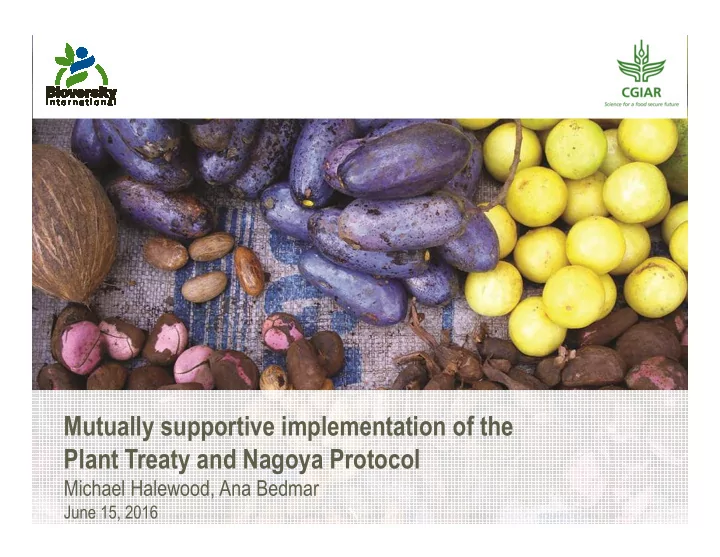
Mutually supportive implementation of the Plant Treaty and Nagoya Protocol

Michael Halewood, Ana Bedmar

June 15, 2016

slide-2
SLIDE 2

Genetic Resources Policy Initiative (GRPI)

  • 2012 – present with 8 countries: Bhutan, Nepal, Uganda, Rwanda, Cote D’Ivoire, Burkina

Faso, Guatemala and Costa Rica;

  • Under the overall coordination and guidance framework of the UN FAO/Treaty

Secretariat/Bioversity International Joint Capacity Building Programme for Developing Countries on the Implementation of the Treaty and its multilateral system (MLS).

  • Core theme: National-level policies for

implementing the MLS of access and benefit- sharing (ABS) in harmony with the Nagoya Protocol (NP).

GRPI blog: https://grpi2.wordpress.com/about/grpi-2/

slide-3
SLIDE 3

Genetic Resources Policy Initiative (GRPI)

Complementary, supportive activities:

Research on policy actors’ network structure Forging links with farmers through community seed banks Research on germplasm flows, and needs to adapt to climate changes

slide-4
SLIDE 4

Case study: Zambia

Potentially adapted material from national gene bank (present): 34 out of 98 accessions

slide-5
SLIDE 5

Potentially adaptable material from national gene bank (2050’s): 11 accessions

slide-6
SLIDE 6

Geographic origin of 22,000 accessions of maize in collections around the World

slide-7
SLIDE 7
slide-8
SLIDE 8
slide-9
SLIDE 9

Genetic Resources Policy Initiative (GRPI)

Main achievements by the end of 2015:

  • All countries had drafted new or revised policies and laws to implement the

ITPGRFA/MLS (considering the interfacing with the CBD and its NP), submitted these to the relevant authorities for approval, and lobbied for their review/approval by the relevant authority.

  • Burkina Faso, Costa Rica, Guatemala, Nepal and Uganda had identified competent

authorities for ITPGRFA/MLS implementation and formalized their responsibilities and roles. Côte d’Ivoire drafted guiding rules and regulations for a competent authority.

  • Costa Rica and Uganda identified accessions to be included in the MLS and

prepared the notification for the Treaty Secretariat about them. Bhutan, Burkina Faso, Guatemala and Nepal identified accessions to be included with notification pending.

slide-10
SLIDE 10
slide-11
SLIDE 11

Lessons learned

  • Policy implementation projects that do not include capacity building to help

countries take advantage of the MLS as recipients and users of PGRFA (and instead focus entirely on putting systems in place for them to supply PGRFA) are less likely to make progress;

  • Policy development and implementation efforts need to be accompanied by well-

funded, wide-reaching communication campaigns to raise awareness among stakeholders and to place indirect pressure on policymakers to take action;

  • MLS policy development projects should engage and provide training for

national juridical scientists/lawyers from the beginning, and support their participation throughout the project;

slide-12
SLIDE 12

Lessons learned

  • Most developing countries need to adopt new, or improve existing, national

PGRFA information systems to manage and publish information about materials they are making available through the MLS;

  • progress implementing the multilateral system can be either slowed down
  • r accelerated depending upon the quality of links it has to national level

efforts to implement the NP on ABS.

  • National stakeholders (both governmental and non-governmental) are increasingly

demand for focus on both the ITPGRFA/MLS and the Nagoya Protocol

  • Mutually supportive implementation requires that key actors from Ag and Env

must overcome long settled patterns of competitiveness and mutual disregard

  • f these agencies.
slide-13
SLIDE 13

Lessons learned [from core GRPI work with 8 countries]

  • ITPGRFA and Nagoya Protocol still at risk of marginalization, and lack of

true integration into national programs and plans, from local to national

  • levels. Need champions to push for integration and exploitation of ABS

measures in national development strategies, climate change adaptation plans, rural development policies, etc,

  • The MLS and Nagoya Protocol are not self-executing; that is to say, it is

not enough to simply ratify the ITPGRFA for stakeholders in countries to be able to take advantage of them in support of broader policy objectives

  • Need practical models and tools for streamlined stakeholder

engagement and decision making

slide-14
SLIDE 14

Slide 13 HM7 i will shorten these. just wanted to get them in somewhere.

Halewood, Michael (Bioversity), 6/13/2016

slide-15
SLIDE 15
  • Organized by the ABS Capacity Development

Initiative, in collaboration with the Secretariats of the CBD and of the ITPGRFA and hosted by Bioversity

  • International. January 2013, Rome, Italy.
  • Publication: Implementing ‘mutually supportive’

access and benefit sharing mechanisms under the Plant Treaty, Convention on Biological Diversity, and Nagoya Protocol (Halewood et al., 2013)

  • Publication: The interface between the NP on ABS

and the ITPGRFA at the international level: Potential issues for consideration in supporting mutually supportive implementation at the national level (Cabrera Medaglia et al., 2013)

  • The workshop report is available at http://www.abs-

initiative.info/629.html

Partnership with the ABS Capacity Development initiative, Secretariat of CBD, ITPGRA

2013: Expert workshop ‘The International Treaty and the Nagoya Protocol: Towards mutual supportiveness in the implementation of both instruments at the national level’.

slide-16
SLIDE 16

Partnership with the ABS Capacity Development initiative, Secretariat of CBD, ITPGRA

2014: The International Treaty and the Nagoya Protocol – A tandem workshop for National Focal Points. 3 to 6 June 2014, FAO, Rome, Italy.

  • Jointly organized by the ABS Capacity Development Initiative and Bioversity International

and in cooperation with the Secretariats of the CBD and the ITPGRFA.

  • Aimed at increasing the understanding of the interface of the Nagoya Protocol and the

ITPGRFA’s multilateral system (MLS) of access and benefit-sharing.

  • The workshop brought together national focal points for both the CBD/NP and the

ITPGRFA from 20 countries, representatives of the Secretariats of both instruments, independent experts, and representatives of stakeholder groups whose daily activities conserving, providing, accessing, using genetic resources often cuts across the regulatory division between the CBD/NP and the ITPGRFA/MLS.

  • Publication: Mutually supportive implementation of the Plant Treaty and the Nagoya

Protocol: A primer for national focal points and other stakeholders

slide-17
SLIDE 17
slide-18
SLIDE 18

Partnership with the ABS Capacity Development initiative, Secretariat of CBD, ITPGRA

  • Jointly organized by the ABS Capacity

Development Initiative and Bioversity International in cooperation with the African Union Commission and the Secretariats of the CBD and the ITPGRFA;

  • Brought together experts, stakeholders and

policymakers to develop tools and methods in support of coordinated, mutually supportive implementation of the NP on ABS and the MLS under the ITPGRFA in ways that complement and support complementary national objectives related to climate change adaptation, poverty alleviation, food security and conservation. 2015: Embedding mutually supportive implementation of the Plant Treaty and the Nagoya Protocol in the context of broader national policy goals – A workshop for national teams of policy actors. 16 to 20 November 2015 International Livestock Research Institute, Addis Ababa, Ethiopia

HM6

slide-19
SLIDE 19

Slide 17 HM6 can you put another picture that is not the african union. something fun. better yet, lets put the star with the 5 positions on it to drive home the emphasis on the expansion in scope of involved actors from countries.

Halewood, Michael (Bioversity), 6/13/2016

slide-20
SLIDE 20
slide-21
SLIDE 21

Partnership with the ABS Capacity Development initiative, Secretariat of CBD, ITPGRA

2016: Workshop in Asia for National ITPGRFA and Nagoya Protocol

focal points (work in progress)

slide-22
SLIDE 22

Partnership with the African Union Commission

Guidelines for Nagoya Protocol adopted by the AUC in 2015 available at: Working on document re mutually supportive implementation of ITPGRFA to complement

slide-23
SLIDE 23

Mutually supportive implementation of the Plant Treaty and the Nagoya Protocol

  • Project conducted with the support of

the Darwin Initiative - a UK Government Funded Programme;

  • Carried out in collaboration with the

ABS Capacity Development Initiative, the Secretariats of the CBD and the ITPGRFA, African Union Commission, National NP and ITPGRFA focal points

  • f Madagascar and Benin;
  • The project responds through a

combination of research and capacity building to implement the ITPGRFA and the NP in mutually supportive manners and so that it respond to local realities, contributing to development benefits;

slide-24
SLIDE 24

Mutually supportive implementation of the Plant Treaty and the Nagoya Protocol

  • Works simultaneously at community

level (4 sites – two in each country) and national level

  • Community Biodiversity Registers,

climate change adaptation needs, conservation investment plans, and protocols

  • National implementing mechanisms
  • Training for functionaries .
  • Poverty alleviation challenge.
slide-25
SLIDE 25

Participatory exercises with farmers

Participatory exercises with farmers in Benin, December 2015 The project on the press in Madagascar The project on the press in Benin

slide-26
SLIDE 26
slide-27
SLIDE 27

Decision making tool: Table of contents

In June 2015, a workshop was

  • rganized in Rome

provided the

  • pportunity to

national partners from ten countries to provide feedback and inputs to the decision making tool.

Bioversity International. Credits: Sara Piscopo

slide-28
SLIDE 28

Useful links

  • Information about the mutually supportive implementation of the ITPGRFA and the

CBD/Nagoya Protocol: http://www.bioversityinternational.org/research- portfolio/policies-for-plant-diversity-management/mutual-implementation-of- nagoya-protocol-and-plant-treaty/

  • Information about the workshop held in Rome, 2014:
  • Information about the Darwin Initiative Project: http://bit.ly/DarwinInitiative
  • Information about the workshop held in Addis, 2015:

http://www.bioversityinternational.org/treaty_nagoya_workshop_2015/

slide-29
SLIDE 29

Thank you

www.bioversityinternational.org/subscribe

@BioversityInt

Name Surname n.surname@cgiar.org