Multipurpose Acoustic Sensor for Los Alamos National Laboratory - - PowerPoint PPT Presentation

multipurpose acoustic sensor for
SMART_READER_LITE
LIVE PREVIEW

Multipurpose Acoustic Sensor for Los Alamos National Laboratory - - PowerPoint PPT Presentation

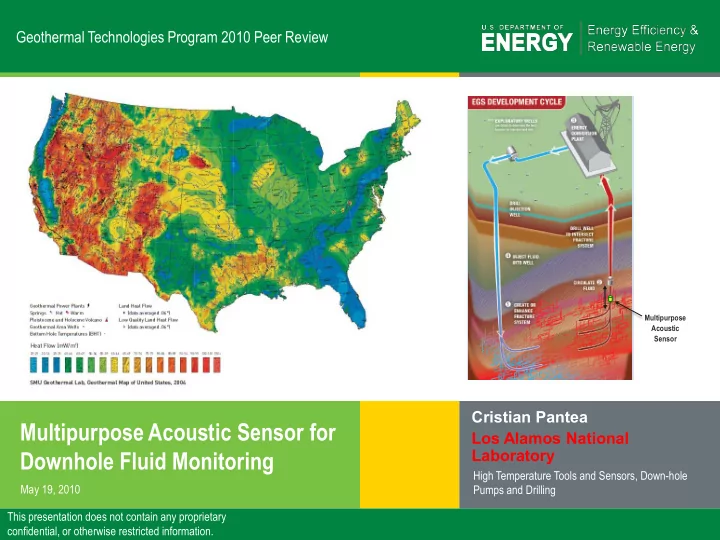
Geothermal Technologies Program 2010 Peer Review Multipurpose Acoustic Sensor Public Service of Colorado Ponnequin Wind Farm Cristian Pantea Multipurpose Acoustic Sensor for Los Alamos National Laboratory Downhole Fluid Monitoring High


slide-1
SLIDE 1

1 | US DOE Geothermal Program eere.energy.gov

Public Service of Colorado Ponnequin Wind Farm

Geothermal Technologies Program 2010 Peer Review

Multipurpose Acoustic Sensor for Downhole Fluid Monitoring

Cristian Pantea Los Alamos National Laboratory

High Temperature Tools and Sensors, Down-hole Pumps and Drilling May 19, 2010 This presentation does not contain any proprietary confidential, or otherwise restricted information.

Multipurpose Acoustic Sensor

slide-2
SLIDE 2

2 | US DOE Geothermal Program eere.energy.gov

– Timeline

  • Project start date: Oct 2009
  • Project end date: Sep 2011
  • Percent complete: 18 %

– Budget

  • Total project funding:

$ 894,000

  • DOE share:

$ 894,000

  • Awardee share:

$ 0

  • Funding received in FY09:$ 536,400
  • Funding for FY10:

$ 357,600

– Barriers

  • Site/Well Characterization Barrier D: Characterization –

Subsurface environments in EGS regimes are inhospitable to existing downhole, in-situ characterization methods.

  • Demonstrate sensor capabilities that can be employed at a

depth of 220 Bar and operation temperatures of 374°C.

– Partners: N/A

Overview

slide-3
SLIDE 3

3 | US DOE Geothermal Program eere.energy.gov

Relevance/Impact of Research

  • Novel sensor design based on acoustics.
  • Determine in real-time and in a single sensor package multiple

parameters: temperature, pressure, fluid flow; and fluid properties, such as density, viscosity, fluid composition.

  • Needed especially in Site/Well Characterization.
  • All components, such as transducers, cables and electronics are

commercially available.

  • The unique design of the sensor allows its operation at very high

temperature and pressure (22 MPa and 374°C). The active parts of the sensor are piezoelectric materials that can withstand adverse conditions of very high pressure and temperature.

  • Advantages: (1) low power consumption, (2) all solid-state and rugged,

(3) can withstand high temperature and pressure, (4) low cost, and (5) will replace 5-7 current instruments with a single one.

slide-4
SLIDE 4

4 | US DOE Geothermal Program eere.energy.gov

Scientific/Technical Approach

  • Fluid composition including density and viscosity at various depths in a borehole provides

geothermal reservoir properties.

  • Borehole temperature at various depths provide diagnostic measurements for geothermal

reservoir characterization:

  • determines thermal gradient along the borehole
  • provides location of borehole fracture intersections
  • allows estimation of thermal drawdown and recovery rates of the circulating systems

* The temperature provides diagnostic data during drilling, cementing, pressurization, and hydraulic-fracturing operations.

  • Borehole pressure at various depths:
  • determines pressure gradient along the borehole
  • provides location of borehole fracture intersections
  • can provide information related to recovery rates of the circulating systems.
  • Fluid flow determination provides fluid-flow patterns in a borehole. A typical borehole has

fractures in several zones. The fluid flow can help characterize the man-made reservoir by:

  • determining the nature and location of the fractures,
  • determining the location and the amount of fluid that leaves and enters the borehole, and
  • determining the relative contribution of each fracture to the total reservoir.
slide-5
SLIDE 5

5 | US DOE Geothermal Program eere.energy.gov

Scientific/Technical Approach

  • The underlying physical basis of the sensing technique proposed

here is the Swept Frequency Acoustic Interferometry (SFAI) technique and resonance tracking. Sound speed = 2d∆f ∆ f =frequency spacing δf =peak width Sound absorption ∼ δf

There can be hundreds of such resonance peaks in a typical spectrum

Input signal System response

∆f δf

slide-6
SLIDE 6

6 | US DOE Geothermal Program eere.energy.gov

Scientific/Technical Approach

  • For every material in a sensor, there is an interdependent relationship

between its fundamental resonance frequency and temperature, which can be used to measure temperature accurately.

  • A cross-correlation analysis of the frequency spectrum on a dual

electrode design on the piezoelectric cylinder provides fluid flow measurement.

  • Task 1: Materials identification, completed.
  • Task 2: (Started) Will run for the entire duration of the project. Good

progress to-date. Investigated different approaches for signal processing.

  • Task 3: Performed preliminary investigations related to sensor geometry.
slide-7
SLIDE 7

7 | US DOE Geothermal Program eere.energy.gov

Accomplishments, Expected Outcomes and Progress

  • Identified materials and equipment needed for sensor

development.

Common transducers have low Curie Temperature (TC) → the transducer loses its piezoelectric property completely at temperatures close to TC . PZT: 195 – 350°C; LiNbO3: 1150°C, La3Ga5.5Ta0.5O14: > 1200°C.

Pressure vessel High temperature coaxial cable

Can be used at very high temperature: 600°C, and under very aggressive media. Sheath: Copper lined stainless steel Core: Copper Insulator: mineral powder

slide-8
SLIDE 8

8 | US DOE Geothermal Program eere.energy.gov

Accomplishments, Expected Outcomes and Progress

Temperature Determination Experiments

LiNbO3 transducer Temperature range: room temperature to 450ºC. Natural resonances of the transducer are tracked using SFAI.

slide-9
SLIDE 9

9 | US DOE Geothermal Program eere.energy.gov

Accomplishments, Expected Outcomes and Progress

Lithium Niobate Transducer Reflectivity Spectrum: 300 kHz < f < 5 MHz

There are several natural resonances present in the frequency spectrum, each corresponding to different modes of vibration of the transducer.

slide-10
SLIDE 10

10 | US DOE Geothermal Program eere.energy.gov

Accomplishments, Expected Outcomes and Progress

Region VI – Center Frequency “Split Peak”  Messy & Hard to Track

The center frequency of a transducer is the obvious choice for tracking temperature and/or pressure

  • changes. However, in this case it turns out to be

very difficult to track. Tracking any of the other characteristic resonances

  • f the transducer is a better choice, e.g. see the

temperature dependence of Region III below.

Region III – 1.58 MHz Resonance Single Peak Clean & Easy to Track

slide-11
SLIDE 11

11 | US DOE Geothermal Program eere.energy.gov

Accomplishments, Expected Outcomes and Progress

Region III – 1.58 MHz Resonance

No Temperature Hysteresis!

The temperature tracking is independent of cooling or heating cycle.

slide-12
SLIDE 12

12 | US DOE Geothermal Program eere.energy.gov

Accomplishments, Expected Outcomes and Progress

Rectangular geometry

  • Standing waves: sin(kx)
  • Resonance:
  • Sound Speed:

L cn fn 2 =

f L c ∆ = 2

  • Standing waves: Jb(kr) (Bessel Functions)
  • Sound Speed:
  • Good approximation when

(for water and D=3.0 cm, flow=500kHz)

f D c ∆ = 2

30

low

c f D π >

Sensor geometry

Cylindrical geometry

Preliminary theoretical investigation of both geometries was performed. A good agreement between the experimental data and the theory was observed. Further refinement

  • f the final design is under works.

L

D

slide-13
SLIDE 13

13 | US DOE Geothermal Program eere.energy.gov

Accomplishments, Expected Outcomes and Progress

  • The work performed is on schedule. Materials for sensors were

identified and procured. We are working toward theoretical modeling and sensor geometry. Good progress on both tasks.

  • Acoustics team:

– PI: Cristian Pantea, 7+ years experience in high pressure – high temperature condensed matter physics (typical ranges of up to 10 GPa and 2200°C), and 6+ years experience in acoustics. – Co-PI: Dipen Sinha, 25 years experience in sensor development in a wide range of fields from biomedical to geological. He is the inventor of the SFAI technique and has 20 patents and three R&D100 awards. – Hired postdoc at the beginning of this year: Blake Sturtevant, recently graduated PhD in Acoustics and Materials Science. His specialty is piezoelectric materials with high temperature stability.

  • Selected for one of the two technical presentations for the New

Mexico Office of Recovery and Reinvestment leaders visit at LANL, Mar 30, 2010, represented by former NM governor Toney Anaya.

slide-14
SLIDE 14

14 | US DOE Geothermal Program eere.energy.gov

Project Management/Coordination

$0 $5,000 $10,000 $15,000 $20,000 $25,000 $30,000 $35,000 $40,000 $45,000 $50,000 Plan Actual

  • Coordinating the work performed by the team.
  • Coordinating and mentoring the newly hired postdoc.
  • Monthly checks on budget situation.
  • Constant monitoring of work performed and future directions.
  • Spending according to plan. Fluctuations are due to a slow start, and

later on due to major equipment acquisition.

Spend plan

slide-15
SLIDE 15

15 | US DOE Geothermal Program eere.energy.gov

Future Directions

  • Theoretical modeling and algorithm development (rest of

FY 2010 and FY 2011)

  • Sensor geometry (rest of FY 2010 and FY 2011)

– Investigate the best sensor geometry able to withstand adverse conditions of pressure, temperature, and corrosive media. – Optimize sensor geometry – Develop sensor for pressure determination

  • Flow measurements and fluid composition (FY 2011)

– Develop sensor component for flow measurements – Develop sensor component for fluid composition determination

  • Temperature and pressure calibration (FY 2011)

– Build multipurpose acoustical sensor to incorporate all desired measurements – Test at in-situ conditions characteristic to geothermal reservoirs – Perform calibration of multipurpose acoustic sensor

slide-16
SLIDE 16

16 | US DOE Geothermal Program eere.energy.gov

  • Identified and acquired sensor materials that can

withstand adverse conditions characteristic of EGS.

  • Identified and acquired equipment necessary for the

multipurpose acoustic sensor development.

  • Initiated work on theoretical modeling and algorithm

development for data analysis.

  • Initiated work on sensor geometry.
  • Solved problems related to high uncertainty determination
  • f temperature

– The natural resonance of the ‘pure compressional’ mode of the transducer can’t be used in temperature determination – However, lower vibrational modes can be used reliably.

Summary