Multilateral Military Ops: Learning from Afghanistan and Libya - - PowerPoint PPT Presentation

multilateral military ops
SMART_READER_LITE
LIVE PREVIEW

Multilateral Military Ops: Learning from Afghanistan and Libya - - PowerPoint PPT Presentation

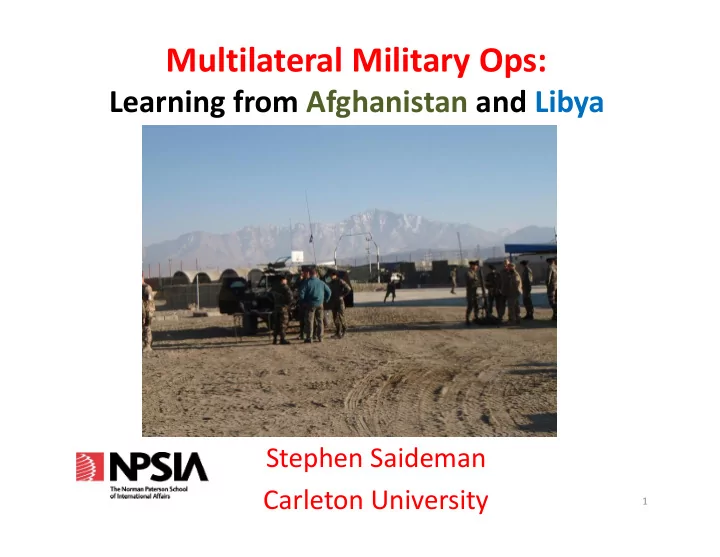
Multilateral Military Ops: Learning from Afghanistan and Libya Stephen Saideman Carleton University 1 Canada Was Not Alone Extension Decisions Big Mistake Entering W/ Insufficient Forces Detainees Geographic FocusOne War or

slide-1
SLIDE 1

Multilateral Military Ops:

Learning from Afghanistan and Libya

Stephen Saideman Carleton University

1

slide-2
SLIDE 2

Canada Was Not Alone

  • Extension Decisions
  • Big Mistake Entering W/ Insufficient Forces
  • Detainees
  • Geographic Focus—One War or Twenty-Plus?

Benchmarks in Kandahar vs. War in Afghanistan

slide-3
SLIDE 3

Coalitions vs. the Alliance

  • Coalitions Of the Willing Not So Willing

– Not Caveat-Free, Red Card-Free

  • Technical Interoperability

– Lots of “Under Radar” Stuff Went Fine in A-stan

  • CA w/UK/Dutch/US

– Difficult Coordination in/over Libya Before NATO Took Over

slide-4
SLIDE 4

Much Intra-Alliance Variation

  • Afghanistan

– Changing Commanders – CAVEATS!

  • Discretion: Red Cards, Phone Calls, Capability Limits

– Oversight Varies Widely – Mixed Incentives

  • Libya: Bombers vs. NFZ vs. Embargo vs. Zilch
slide-5
SLIDE 5

Public Opinion and Discretion

Germany Italy Norway Spain Sweden Turkey France Netherlands Australia Canada Denmark Poland UK US 1 2 3 15% 25% 35% 45% 55%

D i s c r e t i

  • n

Public Support for the Mission

slide-6
SLIDE 6

Trends in Canadian P.O. & Caveats

6

Tight Caveats

Looser/ Fewer Restrictions

slide-7
SLIDE 7

Is It About Culture?

  • A shared understanding of purpose of military

and of force matters

– Germany, Germany, Germany

  • Two Problems

– Variation: Can it account for changes over the short term? – Does Not Account for Non-German Cases

7

slide-8
SLIDE 8

Inherent in Multilateral Ops

  • NATO

– Essential to NATO—Consensus Required

Article V: each member “will assist the Party or Parties so attacked by taking forthwith, individually and in concert with the other Parties, such action as it deems necessary…”

  • Always Civilian Control of the Military
  • But Much Variation in How Control is Exercised
slide-9
SLIDE 9

Means of Democratic Control

  • Selection of Agents: Choose commanders whose

preferences closely match those of principals

  • Constraint: Availability of Alternatives
  • Discretion: Determine Agent’s Authority

– Under What Conditions Can Commander Make Decision

  • r Have to Call Home?

– Caveats, Capability Restrictions

  • Oversight: Monitor Agent’s Behavior

– Passively or actively, Regularly or irregularly – Are Those Back Home Attentive? Engaged?

  • Sanctions: Penalize/Reward Agent Performance

– Commander’s tenure & promotion contingent on what?

9

slide-10
SLIDE 10

Democratic Institutions

Single Party Parl/Pres

  • Agent Selection
  • Discretion via

Capabilities

  • Oversight

– Varies among principals

  • Incentives

– Canada vs Australia

  • Depends on Personality

Coalition Government

  • Discretion

– Caveats, Phone Calls – Capabilities

  • Oversight
  • Depends on

Composition

– Left, Right, Center – Broad/Narrow

Institutions of Civil-Military Relations (History) Matter

10

slide-11
SLIDE 11

Institutions and Caveats

11

Country Institutional Type Caveats Belgium Coalition Parliament Tight Denmark Coalition Parliament Loose Germany Coalition Parliament Tight  Less Tight Italy Coalition Parliament Tight Netherlands Coalition Parliament Medium, Gone Norway Coalition Parliament Loose to Medium Sweden Coalition Parliament Medium Australia Coalition Parliament until 2007, Majority Parliament Medium Canada Minority Parliament Tight, then Loose, Tight France Premier-Presidential Medium, then Loose Poland Premier-Presidential Loose Romania Premier-Presidential Tight Spain Majority Parliament Tight Turkey Majority Parliament Tight UK Majority Parliament Loose US Presidential Loose

slide-12
SLIDE 12

Libya

Country Institutions Ideology Maximum Effort Belgium Caretaker government NA Air Strikes Germany Majority Coalition Right-Center None Greece Majority Coalition Left Naval Embargo Italy Majority Coalition Right-Center Air Strikes Norway Majority Coalition Left-Center Air Strikes UK Majority Coalition Right-Center Air Strikes + Canada Minority  Majority Parliament Right Air Strikes Denmark Minority Coalition Right-Center Air Strikes Netherlands Minority Coalition Right-Center No Fly Zone Sweden Minority Coalition Right-Center No Fly Zone Spain Minority Parliament Left-Center No Fly Zone Turkey Majority Parliament Right-Center Naval Embargo France Premier-Presidential Right-Center Air Strikes + Bulgaria Premier-Presidential Right Naval Embargo Romania Premier-Presidential Right-Center Naval Embargo Poland Premier-Presidential Right-Center None Portugal Premier-Presidential Left  Broad None United States Presidential Left-Center Air Strikes 12

slide-13
SLIDE 13

Implications

  • Mission Design for Canada
  • Moderately Predictable Allies
  • Tendency to Rely on SOF
  • Uneven Burden-Sharing May Mean Fewer Ops

13

slide-14
SLIDE 14
  • Strategies to Mitigate
  • Coalitions of the Willing

≠ Workaround

  • Smart Defence is

Problematic

14

Lessons