Mucosal Resection in the Management of Early Oesophageal Cancer 12 - - PowerPoint PPT Presentation

mucosal resection in the management of
SMART_READER_LITE
LIVE PREVIEW

Mucosal Resection in the Management of Early Oesophageal Cancer 12 - - PowerPoint PPT Presentation

The Newcastle Experience of Endoscopic Mucosal Resection in the Management of Early Oesophageal Cancer 12 th November 2014 The Growing Role for EMR Increasing focus on early detection and treatment of oesophageal cancer Endoscopic


slide-1
SLIDE 1

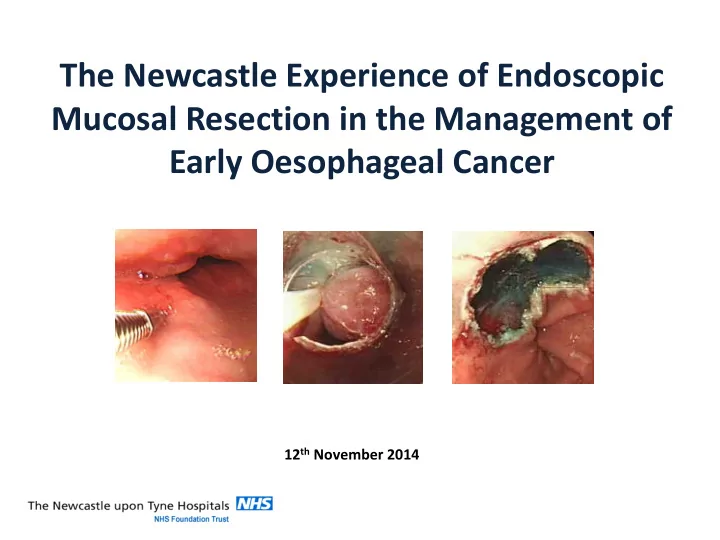
The Newcastle Experience of Endoscopic Mucosal Resection in the Management of Early Oesophageal Cancer

12th November 2014
slide-2
SLIDE 2

The Growing Role for EMR

  • Increasing focus on early detection and treatment of
  • esophageal cancer
  • Endoscopic mucosal resection (EMR) provides important

staging information and treatment for early cancers1

  • 1. Long-term Efficacy and Safety of Endoscopic Resection for Patients With Mucosal Adenocarcinoma of the Esophagus. Pech O, May A, Manner H et al.

Gastroenterology 2014 146(3):652-660

slide-3
SLIDE 3

The Growing Role for EMR

  • Increasing focus on early detection and treatment of
  • esophageal cancer
  • Endoscopic mucosal resection (EMR) provides important

staging information and treatment for early cancers1

  • UK experience of EMR is limited
  • Mortality rates associated with surgery have fallen

significantly

  • Long-term outcomes following surgery for early cancer

are excellent

  • 1. Long-term Efficacy and Safety of Endoscopic Resection for Patients With Mucosal Adenocarcinoma of the Esophagus. Pech O, May A, Manner H et al.

Gastroenterology 2014 146(3):652-660

slide-4
SLIDE 4

Aims

Review the introduction of EMR in the Northern Oesophago-Gastric Unit

slide-5
SLIDE 5

Methods

  • All oesophageal EMRs since 2006
  • Prospective database
  • All patients discussed in MDM
  • Suction cap technique2
  • All EMRs performed by surgeons
  • Circumferential biopsies taken after EMR performed
  • Surgery recommended for patients with submucosal disease3 or involved

resection margins

  • 2. Randomized trial on endoscopic resection-cap versus multiband mucosectomy for piecemeal endoscopic resection of early Barrett's neoplasia. Pouw RE, van

Vilsteren, Peters FP et al. Gastrointest Endosc 2011;74(1):35-43

  • 3. Lymph node metastasis in early esophageal adenocarcinoma. Griffin SM, Burt AD, Jennings NA. Ann Surg 2011;254(5):731-6
slide-6
SLIDE 6

Results

  • 86 EMRs performed on 66 patients
  • Median age 71 years (range 38-84)
  • Overall complication rate 3.5%
  • 2 patients had radiological evidence of perforation
  • 1 repeat endoscopy for bleeding
  • Adenocarcinoma identified in 33 specimens
  • Represented upstaging from HGD in nine patients
slide-7
SLIDE 7

Adenocarcinoma (n=33) T1a (n=23) Endoscopic Surveillance (n=17) Surgery* (n=3) Surgery (n=3) Radical Radiotherapy (n=3) T1b (n=10) Surgery (n=4) Unfit/Declined Surgery (n=6)

Results

slide-8
SLIDE 8

Adenocarcinoma (n=33) T1a (n=23) Endoscopic Surveillance (n=17) Surgery* (n=3) Surgery (n=3) Radical Radiotherapy (n=3) T1b (n=10) Surgery (n=4) Unfit/Declined Surgery (n=6)

pT1bN2 n=1 pT1bN0 n=2 No residual tumour n=1 pT1aN0 n=2 No residual tumour n=1

Results

slide-9
SLIDE 9

Adenocarcinoma (n=33) T1a (n=23) Endoscopic Surveillance (n=17) Surgery* (n=3) Surgery (n=3) Radical Radiotherapy (n=3) T1b (n=10) Surgery (n=4) Unfit/Declined Surgery (n=6)

Results

slide-10
SLIDE 10

Adenocarcinoma (n=33) T1a (n=23) Endoscopic Surveillance (n=17) Surgery (n=3) Surgery (n=3) Radical Radiotherapy (n=3) T1b (n=10) Surgery (n=4) Unfit/Declined Surgery (n=6)

Results

slide-11
SLIDE 11

Adenocarcinoma (n=33) T1a (n=23) Endoscopic Surveillance (n=17) Surgery (n=3) Surgery (n=3) Radical Radiotherapy (n=3) T1b (n=10) Surgery (n=4) Unfit/Declined Surgery (n=6)

pT1aN0 n=2 pT1bN0 n=1

Results

slide-12
SLIDE 12

Outcomes

  • Median follow up of 19 months (4-74)
  • Three T1a patients required surgery after initial surveillance at

15, 17 and 27 months

  • Single T1b patients treated with oesophagectomy developed

metastatic recurrence 24 months post-EMR

slide-13
SLIDE 13

Conclusions

  • EMR playing an important role in the staging and management of early
  • esophageal cancer
  • All patients undergoing EMR should be staged and discussed at MDM
  • Surveillance following EMR is essential to allow treatment of disease

recurrence

  • Treatment with EMR does not appear to disadvantage patients who

develop local disease recurrence

  • Care must be taken with submucosal disease which has the potential for

nodal and metastatic dissemination

  • Importance of treatment of residual Barrett’s with ablation
slide-14
SLIDE 14

Acknowledgements

L Dunn, S Wahed, R Jones K Wynne, D Karat, J Shenfine, N Hayes, A Immanuel, SM Griffin H Jaretzke