MTUS Formulary The initial MTUS Formulary provided for a list of - - PowerPoint PPT Presentation

mtus formulary
SMART_READER_LITE
LIVE PREVIEW

MTUS Formulary The initial MTUS Formulary provided for a list of - - PowerPoint PPT Presentation

MTUS Formulary The initial MTUS Formulary provided for a list of drug ingredients (generic drug names) and their indicated uses Some stakeholders requested more specificity, suggesting the use of National Drug Codes (NDCs) for the listed


slide-1
SLIDE 1

MTUS Formulary

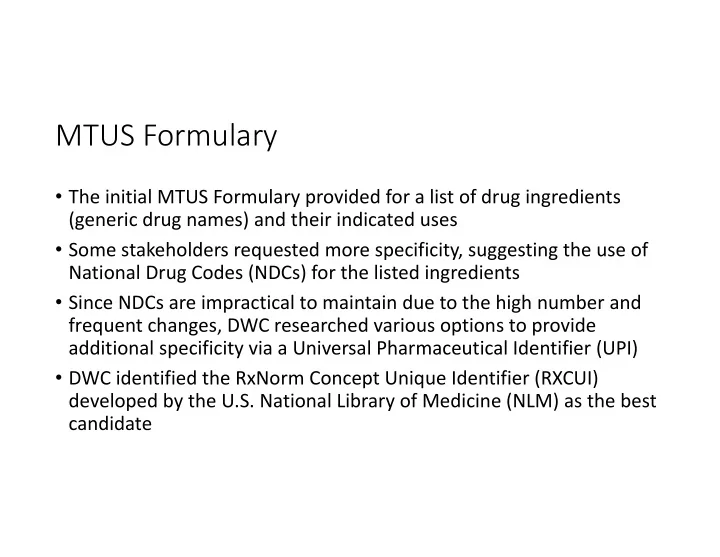
  • The initial MTUS Formulary provided for a list of drug ingredients

(generic drug names) and their indicated uses

  • Some stakeholders requested more specificity, suggesting the use of

National Drug Codes (NDCs) for the listed ingredients

  • Since NDCs are impractical to maintain due to the high number and

frequent changes, DWC researched various options to provide additional specificity via a Universal Pharmaceutical Identifier (UPI)

  • DWC identified the RxNorm Concept Unique Identifier (RXCUI)

developed by the U.S. National Library of Medicine (NLM) as the best candidate

slide-2
SLIDE 2

Why RXCUI

  • Non‐proprietary – RxCUI information is available without charge to the

user.

  • One number – RxCUIs group each chemically distinct drug into a single

code regardless of manufacturer or package size.

  • Easier to maintain – Maintaining RxCUIs will be easier than NDCs as there is

a one RxCUI to many NDCs relationship.

  • NDC Crosswalks – Parties that wish to do so can crosswalk RxCUIs to NDCs
  • United States Pharmacopeia (USP) Compendial Nomenclature – USP

nomenclature, which establishes the nonproprietary (i.e. generic) name of drugs, is integrated into the RxNORM/RxCUI.

slide-3
SLIDE 3

Why RXCUI

  • Used by Centers for Medicare and Medicaid Services (CMS) to

determine if health plans are complying with Affordable Care Act essential health benefit (drug coverage) requirements

  • RxCUI values are one of the two numeric identifiers (NDC number is

the other) used by SureScripts in transmitting drug identification in e‐ prescribing

  • Drug pricing compendia such as First Data Bank fully support RXCUI

within their data

  • Identified in federal law as the standard as the standardized

nomenclature used within electronic health systems

slide-4
SLIDE 4

Implementing UPI (RXCUI)

  • UPI provides desired specificity when it is tied to a specific drug,

strength and dosage form

  • DWC identified strengths and dosage forms for each MTUS Formulary

ingredient

  • For each unique drug/strength/dosage form combination, a unique

RXCUI was identified

  • This expanded spreadsheet was discussed and displayed at the last

committee meeting.

slide-5
SLIDE 5

Target Stakeholders

  • Concern by committee that the UPI/RXCUI would add a burden on or

confuse prescribers who are trying to understand which drugs are listed

  • Prescribers are not the target stakeholders
  • The UPI/RXCUI is a tool to assist claims processors (plans and PBMS)

in identifying drugs within their claims processing systems

  • The UPI/RXCUI a purely optional identifier that interested parties can

use for system purposes

  • For example, a PBM could use the detailed drug/strength/dosage

form listings to program their systems independent of the UPI/RXCUI

slide-6
SLIDE 6

Prescribers

  • As noted, prescribers should not look at the UPI/RXCUI as a tool they

have to use.

  • Prescribers are probably better served by an MTUS Formulary listing

that can provide the minimum amount of information they need to treat a patient

  • DWC can work with the committee to create a MTUS Formulary list

which meets the needs of prescribers

  • For example, a drug list aggregated by therapeutic category, exempt

status and alpha listed by brand name

slide-7
SLIDE 7
slide-8
SLIDE 8

Recommendation

  • Given the various options, RXCUI is best option for a UPI
  • No additional cost to DWC (some level of cost to PBMs if they choose to use)
  • Easier for DWC to maintain than NDCs
  • Freely available
  • Federal statute mandates its use as the standard for identifying drugs among

diverse healthcare information systems

  • Committee work with DWC to establish MTUS Formulary listing(s) for

prescribers to reference