MSMS (02PCYQW) 2016-2017 Organization: the course is composed of - - PowerPoint PPT Presentation

msms 02pcyqw 2016 2017
SMART_READER_LITE
LIVE PREVIEW

MSMS (02PCYQW) 2016-2017 Organization: the course is composed of - - PowerPoint PPT Presentation

MSMS (02PCYQW) 2016-2017 Organization: the course is composed of two parts: the first part is devoted to the Lagrange (LAG) approach the second part is devoted to the Bond-Graph (BG) approach Each part takes approximately 50


slide-1
SLIDE 1

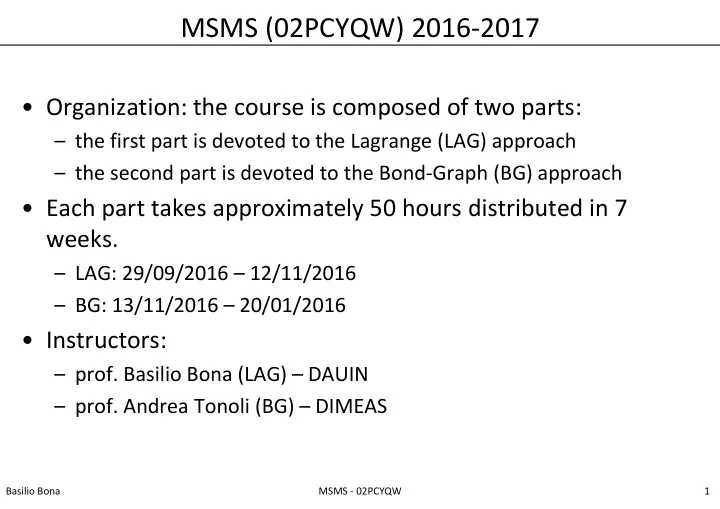
MSMS (02PCYQW) 2016-2017

  • Organization: the course is composed of two parts:

– the first part is devoted to the Lagrange (LAG) approach – the second part is devoted to the Bond-Graph (BG) approach

  • Each part takes approximately 50 hours distributed in 7

weeks.

– LAG: 29/09/2016 – 12/11/2016 – BG: 13/11/2016 – 20/01/2016

  • Instructors:

– prof. Basilio Bona (LAG) – DAUIN – prof. Andrea Tonoli (BG) – DIMEAS

Basilio Bona MSMS - 02PCYQW 1

slide-2
SLIDE 2

MSMS (02PCYQW) 2016-2017

  • Exam Rules: the exam is written. It is unique, but consists of

two parts:

– LAG part: 1-3 exercises (usually 2); the exam lasts approx. 1h 15m; books and notes CAN be used.

Examples will be given during the course.

– BG part: 1-3 exercises (usually 2); the exam lasts approx. 1h 15m; books and notes CANNOT be used.

Examples will be given during the course.

– The final mark is the arithmetic mean between the two marks.

  • Read the rules here

http://www.ladispe.polito.it/corsi/meccatronica/02PCYQW/2016-17/exams.html

MSMS - 02PCYQW 2 Basilio Bona

slide-3
SLIDE 3

MSMS (02PCYQW) 2016-2017

  • Lessons schedule

Mon 13:00 – 16:00 room 1B Wed 08:30 – 10:00 room 11T Thu 13:00 – 16:00 room 1B

  • No Labs during the course
  • Web page for the LAG part

http://www.ladispe.polito.it/corsi/meccatronica/02PCYQW/2016-17/

  • Textbook for the LAG part
  • B. Bona “Dynamic Modelling of Mechatronic Systems” CELID, 2013

Available at CLUT bookstore

Basilio Bona MSMS - 02PCYQW 3

slide-4
SLIDE 4

Other textbooks

  • LAG: Fundamentals of Applied Dynamics

J.H. Williams, Jr. Wiley 1996 available at the Electronic Department Library

  • BG: System Dynamics: A Unified Approach

D.C. Karnopp, D.L. Margolis, R.C. Rosenberg Wiley Interscience 1990 available at the PoliTo Central Library

Basilio Bona MSMS - 02PCYQW 4

slide-5
SLIDE 5

Motivations

  • Mechatronic systems often consist of a complex interaction of

moving structures, controlled by electronic circuits and by software programs.

Basilio Bona MSMS - 02PCYQW 5

  • In order to be able to write good

algorithms for control or simulation, it is necessary to know how the various mechanical + electrical parts interact.

  • This means that one must be able to produce a

consistent mathematical description (= model) of the overall mechanical + electrical system.

  • The scope of MSMS is precisely to teach how to

produce mathematical equations modelling the system.

slide-6
SLIDE 6

Why Modelling is necessary

  • Models are useful for

– simulation, to predict future behaviour of systems, – identification and parameter estimation, to find the numerical values of the unknown system parameters (masses, friction coefficients, elastic modes, etc.) – control design, to write control algorithms to improve the system performances.

  • Models can be implemented as

– Hardware models ... very rare – Software models ... very common (MATLAB language is a popular choice for models description and analysis.)

Basilio Bona MSMS - 02PCYQW 6

slide-7
SLIDE 7

Models = Differential Equations

  • Models are described using the language of physics, i.e., the

laws of mechanics and/or electromagnetism.

  • These laws are expressed as differential equations, i.e., they

include first and second order time derivatives of some physical quantity.

  • Example: the Newton law of linear motion
  • This is an equation relating the second order time-derivative
  • f the position x of a body having mass m, with the applied

external force f

Basilio Bona MSMS - 02PCYQW 7

f mx f x m = ⇔ = ɺɺ ɺɺ

slide-8
SLIDE 8

What is required

  • To find the correct model equations it is necessary to

understand how the motion is mathematically represented in 3D space

  • Motion includes translations and rotations

– first, it is necessary to describe bodies with reference frames, – then it is necessary to describe motion of reference frames and their representations

  • The mathematical tools required are essentially vectors and

matrices: vector and matrix analysis is a topic that a student must know in details

Basilio Bona MSMS - 02PCYQW 8

slide-9
SLIDE 9

Necessary prerequisites

  • Physics: concepts related to kinematics and dynamics (forces

and torques), and notions of electrical circuits.

  • Vectors: used to represent many physical quantities.
  • Matrices: matrix calculus is used to represent rotations,

transformations and other important physical equivalents.

  • Basic MATLAB/SIMULINK: this software environment is not

required for the exam, but it is useful for the rest of the Mechatronics curriculum (and will be extensively used in the Robotics course at Semester 2).

MSMS - 02PCYQW 9 Basilio Bona

slide-10
SLIDE 10

Topics – Lagrange method

  • Reference Frames and Roto-translations
  • Rigid Body Kinematics
  • Rigid Body Dynamics

– Point Mass and Distributed Mass System – Mathematical Formulation

  • Rotation of the reference frame
  • Principal inertia matrix
  • Parallel axes theorem

– Angular momentum and Euler Equation – Virtual Work Principle – Lagrange Equations in Mechanical Systems

  • Kinetic energy and co-energy
  • Potential energy
  • Generalized forces in holonomic systems
  • Lagrange equations with holonomic constraints
  • Lagrange equations with non-holonomic constraints
  • Characterization of the Lagrange equations

MSMS - 02PCYQW 10 Basilio Bona

slide-11
SLIDE 11

Topics – Lagrange method

  • Electrical Systems Dynamics – Lagrange method
  • Electromechanical Systems Dynamics – Lagrange method
  • State variables and state equations

MSMS - 02PCYQW 11 Basilio Bona

slide-12
SLIDE 12

Basilio Bona MSMS - 02PCYQW 12

Lagrange function Kinetic (co-)energy Potential energy Virtual works Forces Velocities

Linear Angular Linear Angular

Positions = coordinates

Linear Angular Vectors Scalars

slide-13
SLIDE 13

Basilio Bona MSMS - 02PCYQW 13

  • Lagrange function
  • Energies
  • Virtual works
  • Velocities
  • Positions
slide-14
SLIDE 14

Examples

Basilio Bona MSMS - 02PCYQW 14

slide-15
SLIDE 15

Examples

MSMS - 02PCYQW 15 Basilio Bona