MS and Physical Activity(PA) 1 6/18/2015 Physical Inactivity - - PDF document

ms and physical activity pa
SMART_READER_LITE
LIVE PREVIEW

MS and Physical Activity(PA) 1 6/18/2015 Physical Inactivity - - PDF document

6/18/2015 The effects of Yoga on impairments of body function, activity limitations and participation for people with MS: A review Blthn Casey PhD Candidate University of Limerick, Ireland. MS and Physical Activity(PA) 1 6/18/2015 Physical


slide-1
SLIDE 1

6/18/2015 1

The effects of Yoga on impairments of body function, activity limitations and participation for people with MS: A review

Bláthín Casey PhD Candidate University of Limerick, Ireland.

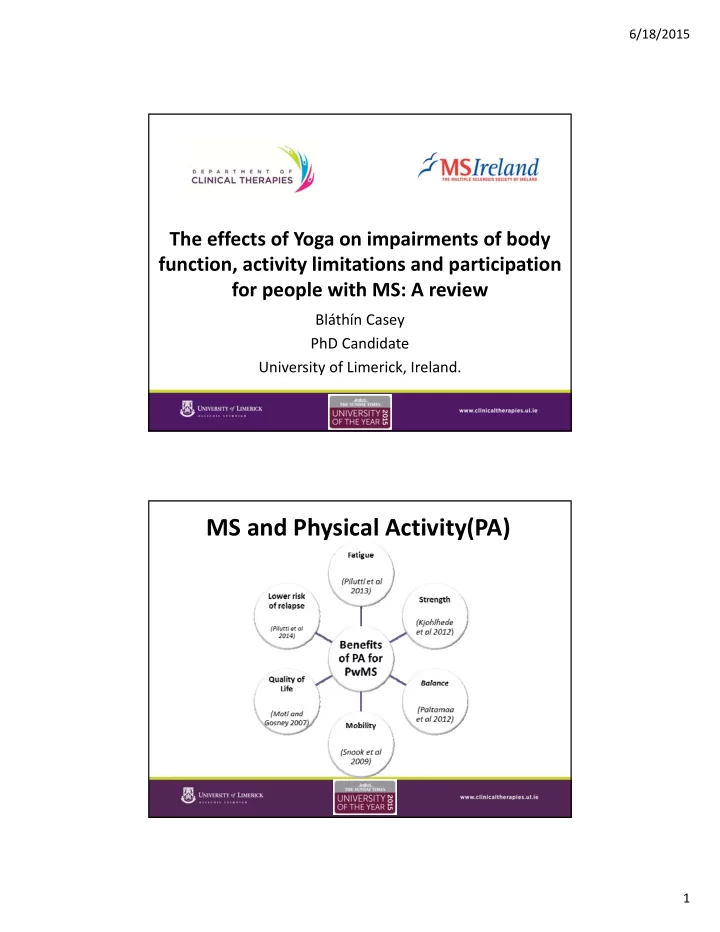
MS and Physical Activity(PA)

slide-2
SLIDE 2

6/18/2015 2

Physical Inactivity

  • Subjective and objective findings of physical

inactivity in people with MS (Sandroff et al 2012, Motl et al 2005).

  • People with MS have a 2.4 fold increased risk of

dying due to cardiovascular disease than the general population(Lalmohamed et al. 2012), this associated with decreased physical activity.

  • Need to change PA behaviour

The Activity Matters Website

  • Aims to develop a web based resource to enable

pwMS to become more active.

Activity Matters

Embedded in Theory Behaviour Change and Knowledge Translation Needs of PwMS Research Evidence

slide-3
SLIDE 3

6/18/2015 3

Exercise Options

  • PwMS want to be able to chose what exercise they

do ( Hale et al 2012)

  • Our qualitative data supports this and suggests

exercise options including Yoga, Walking and Swimming (Casey et al 2015).

Poster RH 17

Yoga‐ A Review

  • Aim‐ To examine the effectiveness of Yoga on

impairments of body function and structure, activity limitations and participant restrictions in pwMS (WHO 2001).

  • To assess the quality of research in the area.
slide-4
SLIDE 4

6/18/2015 4

Methods

  • Systematic Search:

‐ EBSCO (AMED; Biomedical Reference Collection; CINHAL Plus Full Text; MEDLINE; PsychArticles; PyschINFO; SPORT Discus.) ‐ SCOPUS

  • Inclusion Criteria:
  • Quality Tools:

‐ PEDro Scale and Cochrane Tool for Risk of Bias

Population Intervention Comparison Outcome

Definite diagnosis

  • f MS.

One intervention group must be

  • nly Yoga

Randomised Control Design, comparing to control or other non‐yoga intervention Measure at least one outcome in any

  • f the domains of the ICF, body

function, activities or participation.

Prisma Flow Diagram

slide-5
SLIDE 5

6/18/2015 5

Author Comparison N= EDSS Yoga Type Ahmadi et al 2010 Wait list control 21 1‐4 Hatha Ahmadi et al 2013 Usual care Treadmill walking 31 1‐4 Hatha Doulatabad et al 2013 No intervention 60 Not reported “pain managing yoga” Garrett et al 2012 Waiting list control Group Physio Group gym 242 1‐6 Breathing exercises, Asanas, Relaxation Hogan et al 2014 Group physio Individual physio 115 6.5 Relaxation, meditation, breathing, stretching Oken et al 2004 Wait list control Exercise 57 1.5‐6 Iyengar Velikonjaa et al 2010 Sports climbing 20 ≤6 Hatha

  • Participants

‐ 661 people with MS ‐ 3 Female only studies ‐ Inclusion of pwMS with EDSS </= 6.5

  • Intervention

‐Varying Frequency, Intensity, Type and Time for Yoga.

Study Description

slide-6
SLIDE 6

6/18/2015 6

  • Comparison

– Yoga vs no intervention (n=3)

  • Ahmadi et al 2010, Ahmadi et al 2013, Doulatabad et al 2013

– Yoga vs Intervention (n=5)

  • Ahmadi et al 2013, Garrett et al 2012, Hogan et al 2014,

Oken et al 2004, Velikonjaa et al 2010

  • Outcomes

– Generally outcome measures not homogenous – 3 studies looked at BBS, 4 looked at MFIS

Results

slide-7
SLIDE 7

6/18/2015 7

Body Functions‐ Balance (BBS)

Study Within Group Improvements Between Group Ahmadi et al 2010 Pre= 46.19 +/‐ 8.1, Post= 53.81 +/‐ 3.4 p=0.01 p<0.01 Ahmadi et al 2013 Pre=47.72 +/‐ 6.78 Post:=53.81 +/‐ 3.40 p<0.01 p= 0.001 yoga v control p=0.76 yoga v treadmill Hogan et al 2014 Pre= 22.6 +/‐ 12.6 Post= 27.9 +/‐ 11.5 p<0.01 p=0.006 v control

Body Functions Continued.

  • Pain (Likert Scale 1‐6)
  • Spasticity

Study Within Group Improvements Between Group Doulatabad et al 2013 Pre: 4.8 +/‐ 5.12 Post: 3.8 +/‐ 4.16 p=0.007 Not Reported Study Within Group Improvements Between Group Velikonja et al 2010 Ashworth – non significant EDSS pyr – non significant Not reported

slide-8
SLIDE 8

6/18/2015 8

  • Mood

Study Within Group Improvements Between Group Ahmadi et al 2013 BDI p=0.001 BAI p=0.001 BDI yoga v treadmill p=0.11 Yoga v control p=0.001 BAI yoga v treadmill p=0.01 Yoga v control 0.001 Velikonja et al 2010 CES‐D p=0.212 Not reported

Limitations in Activities – Walking Endurance

Study Within Group Improvements Between Group Ahmadi et al 2010 2min Walk p<0.01 p<0.01 Ahmadi et al 2013 2min Walk p<0.01 p= 0.01 yoga v control p=0.26 yoga v treadmill Garrett et al 2013 6min walk p=0.26 p=0.73 Hogan et al 2014 6min walk p=0.553 Not significant

slide-9
SLIDE 9

6/18/2015 9

Limitations in Activities

Study Within Group Improvements Between Group Ahmadi et al 2010 Pre= 8.96 +/‐ 1.8 Post= 8.13 +/‐ 1.87, p=0.13 p=0.04 Ahmadi et al 2013 Pre=8.78+/‐1.79 Post=8.13+/‐1.87 p=0.13 p=0.12 yoga v treadmill p=0.11 yoga v control

  • Walking Speed (10 meter walk )

QOL/IMPACT Within Group Improvements Between Group Ahmadi et al 2010 MSQOL‐54 7 domains increased significantly 6 domains all p>0.05 Doulatabad et al 2013 MSQOL‐54 p=0.001 Not Reported Garrett et al 2013 MSIS phys p=0.03 MSIS psych p=0.01 MSIS phys p=0.12 MSIS psych p=0.04 Hogan et al 2014 MSIS phys p=0.645 MSIS psych p=0.281 Not significant Oken et al 2004 SF‐36 Energy p<0.001 SF‐36 Health p<0.001 SF‐36 Vitality yoga v control p<0.001

slide-10
SLIDE 10

6/18/2015 10

Participation‐ Fatigue

FATIGUE Within Group Improvements Between Group Ahmadi et al 2010 FSS p=0.01 p=0.01 Ahmadi et al 2013 FSS P=0.01 p=0.99 yoga v treadmill p=0.03 yoga v control Garrett et al 2012 MFIS p< 0.01 P=0.05 Hogan et al 2014 MFIS p=0.374 Non significant Oken et al 2004 p<0.01 Reported significantly better (no p values/mean diff) Velikonja et al 2010 MFIS p=0.057 Not reported

Quality of Studies

PEDro Scale

Random Allocation Concealed Allocation Baseline Comparability Blind Subjects Blind Therapists Blind Assessors Adequate Follow‐ Up Intention to Treat Analysis Between Group Comparisons Point Estimates Score Ahmadi et al 2010 Yes No Yes No No No Yes No Yes No 4/10 Ahmadi et al 2013 Yes No Yes No No No No No Yes Yes 4/10 Oken et al 2004 Yes No Yes No No Yes No No Yes No 4/10 Doulatabad et al 2013 Yes No Yes No No No No No Yes Yes 4/10 Garrett et al 2012 Yes Yes Yes No No Yes No No Yes Yes 6/10 Hogan et al 2014 Yes Yes No No No Yes No No Yes Yes 5/10 Velikonja et al 2010 Yes No No No No Yes No No No Yes 3/10

Lack of blinding of subjects and therapists and no intention to treat analysis carried out.

slide-11
SLIDE 11

6/18/2015 11

Quality of Studies Discussion

  • Small number of studies
  • Methodological quality poor
  • Variety of measures and intervention parameters
  • Positive effect for balance
  • Mixed results for other measures
  • No reporting of adverse events
  • Preference and Qualitative data
  • (Ploughman et al 2012, Casey et al 2015)
slide-12
SLIDE 12

6/18/2015 12

Future Work

  • Continued development of the Activity

Matters project.

  • Investigate evidence for other exercise
  • ptions for pwMS (water‐based exercises,

walking, etc. )

Acknowledgements

. Dr Sara Hayes Dr Susan Coote Aidan Larkin

slide-13
SLIDE 13

6/18/2015 13

Contact me

  • Email: Blathin.casey@ul.ie
  • Twitter: @BlathinCasey
  • MS Research team @UL: http://www.msresearch.ie/
slide-14
SLIDE 14

6/18/2015 14

Key References

  • Sandroff, B., Dlugonski, D., Weikert, M., Suh, Y., Balantrapu, S. and Motl, R. (2012) 'Physical activity

and multiple sclerosis: new insights regarding inactivity', Acta Neurologica Scandinavica, 126(4), 256‐262.

  • Lalmohamed, A., Bazelier, M., Van Staa, T., Uitdehaag, B., Leufkens, H., De Boer, A. and De Vries, F.

(2012) 'Causes of death in patients with multiple sclerosis and matched referent subjects: a population‐based cohort study', European Journal of Neurology, 19(7), 1007‐1014.

  • Ploughman, Michelle, et al. "Factors influencing healthy aging with multiple sclerosis: a qualitative

study." Disability and rehabilitation 34.1 (2012): 26‐33.

  • Oken, B. S., et al. "Randomized controlled trial of yoga and exercise in multiple

sclerosis." Neurology 62.11 (2004): 2058‐2064.

  • Hale, Leigh A., et al. "“Tell me what you want, what you really really want….”: asking people with

multiple sclerosis about enhancing their participation in physical activity." Disability and rehabilitation 34.22 (2012): 1887‐1893.