Mrs ENAW ne Judith EFUNDEM AGBOR, Secretary General Presentation - - PowerPoint PPT Presentation

mrs enaw n e judith efundem agbor secretary general
SMART_READER_LITE
LIVE PREVIEW

Mrs ENAW ne Judith EFUNDEM AGBOR, Secretary General Presentation - - PowerPoint PPT Presentation

Regional Workshop organized by the Strategic Foresight Group. Entebbe, 9 August 2016 By Mrs ENAW ne Judith EFUNDEM AGBOR, Secretary General Presentation Outline Key characteristics of the Congo Basin CICOS: Governance Framework


slide-1
SLIDE 1

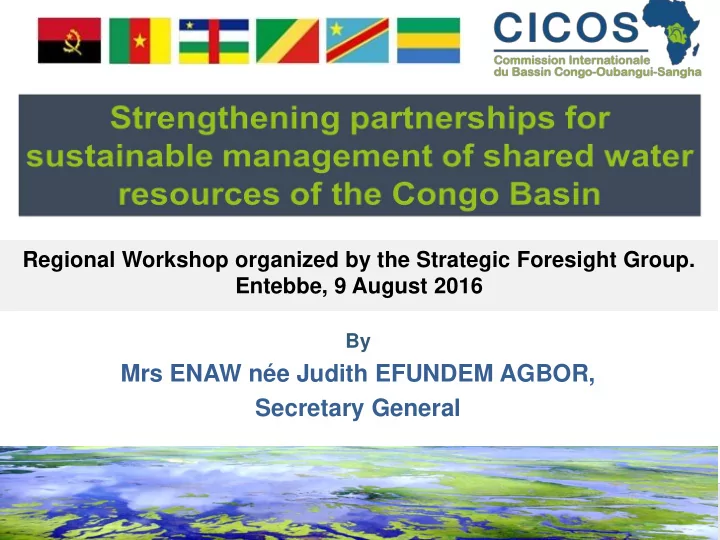
By

Mrs ENAW née Judith EFUNDEM AGBOR, Secretary General

Regional Workshop organized by the Strategic Foresight Group. Entebbe, 9 August 2016
slide-2
SLIDE 2

2

Presentation Outline

  • Key characteristics of the

Congo Basin

  • CICOS: Governance

Framework

  • CICOS: Financing Mechanism
  • Common Vision – 2035
  • Basin Development Strategies
  • Other Ongoing Projects
  • Major Challenges
  • Conclusion
slide-3
SLIDE 3

3

  • The Basin covers an

estimated area of 3,7 millions km²;

  • Has an average annual

discharge: of 41 000 m3/s;

  • The basin straddles ten

(10) countries: Angola, Burundi, Cameroon, Central African Republic, Republic

  • f Congo, Democratic

Republic of Congo, Gabon, Rwanda, Tanzania and Zambia.

Key Basin Characteristics.

slide-4
SLIDE 4

4

  • Six (6) countries are

members of the Commission; i.e Angola, Cameroon, Central African Republic, Congo, Democratic Republic of Congo, and Gabon;

  • Thus, the Congo Basin is
  • ften referred to as “earth’s

second lung” after the Amazon Basin

  • Its water resources is a key

driver for socio-economic development: - e.g. inland navigation, hydropower, eco-tourism, food production, etc.

Key Basin Characteristics (cont’d).

slide-5
SLIDE 5

5

CICOS: Governance Framework

CICOS is an intergovernmental Organisation charged with the promotion of inland waterway navigation and the Integrated Management of Water Resources (IMWR) in the Congo basin. Legal Framework : Accord (1999) and its Additif (2007) Organs :

  • Ministerial Council (Decision making organ)
  • Management Committee (Consultative body)
  • General Secretariat : (Executing organ)

Headquarters : Democratic Republic of Congo (Kinshasa)

slide-6
SLIDE 6

6

CICOS : Financing Mechanism

2 Levels of financing a) CEMAC Funding

  • CICOS is a Specialized Institution of the Economic and

Monetary Commission

  • f

Central African States (CEMAC) ;

  • The Heads of State of the CEMAC Region adopted the

system of autonomous funding through the Community Integration Tax. b) Direct Funding

  • By the DRC and Angola - Contribute directly to CICOS

through State Treasury

slide-7
SLIDE 7

7

By 2035, the Congo basin will be an example of regional integration, where united and emergent nations develop their capacities in order to make water a key driver for economic growth and a source of wellbeing, while preserving the quality

  • f

ecosystems as well as adapting its uses to climate change and encouraging cost and benefit sharing.

Common Vision: 2035

SOCIETY

Basic needs linked to health, education, habitat (housing) employment, equity, social and inter generation inclusion are satisfied

ECONOMY

Wealth creation, Ameliorate quality of life

ENVIRONMENT

Conservation of biodiversity, natural resources and energy

Equity Dependable

Sustainability

Viable

Pillars of SUSTAINABILITY

slide-8
SLIDE 8

8

Basin Development Strategies – GIZ Programme (GETRACO)

  • GIZ has supported CICOS in reforming its strategy

through the formulation of a Water Master Plan (SDAGE) for the basin.

  • Participatory

approach

  • involving

multi-level stakeholders was used in the formulation of the SDAGE.

  • The participatory approach has set the impulse for

collaboration and building of trust for the management

  • f the shared resources of the basin.
slide-9
SLIDE 9

9

Basin Development Strategies (cont’d ) MESA

  • EU through AU is supporting CICOS to access Earth

Observation (EO) data and technologies under the Monitoring for Environment and Security in Africa (MESA) programme.

  • CICOS is using MESA to deepen the mechanism for

information sharing with riparian Governments Institutions, industry (shipowners) – by providing real-time EO information

  • n water depth to aid navigation; water balance to enhance

decision making in water allocation and climate risk assessment.

  • The improvement in information sharing has provided

platform for sustainable transboundary waters management

slide-10
SLIDE 10

10

Main Ongoing Projects

  • AFD through the International Water Organization (l’OIEau), is

supporting CICOS to strengthen hydrological monitoring for IWRM in the basin, taking into account climate change adaptation;

  • Creating the Regional Observatory on inland waterway

navigation mal practice (Financed by the European Union);

  • Organization of a Donor’s Round Table.
slide-11
SLIDE 11

11

Major Challenges

  • Limited harmonization of legal frameworks for the

management of water and other natural resources of the basin;

  • Population growth;
  • Deforestation;
  • Vulnerability to Climate Change;
  • Paucity of data for planning;
  • Low involvement of stakeholders;
  • Inadequate finances for project realization.
slide-12
SLIDE 12

12

Conclusion

Through these projects, CICOS is on the path to :

  • Promote better synergy among the various users of water

resources in the Congo basin (i.e. inland waterway navigation, hydroelectricity provision, agriculture, fisheries, eco-tourism, etc.);

  • Guarantee the preservation of the natural heritage found within

the basin;

  • Prevent and forestall potential conflicts which may arise from

the use of transboundary water resources and from climate change;

  • Be an effective tool for water diplomacy in the Sub

Region.

slide-13
SLIDE 13

Thank you for your kind attention

www.cicos.int.

13 1-2-3-4