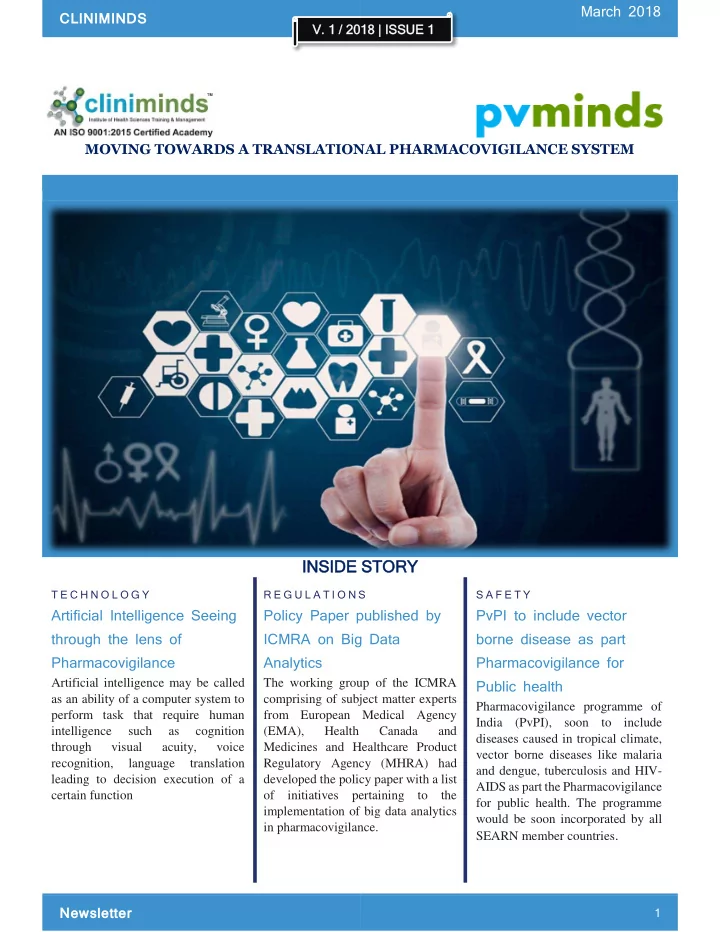
MOVING TOWARDS A TRANSLATIONAL PHARMACOVIGILANCE SYSTEM INSI SIDE - - PDF document

moving towards a translational pharmacovigilance system
SMART_READER_LITE
LIVE PREVIEW

MOVING TOWARDS A TRANSLATIONAL PHARMACOVIGILANCE SYSTEM INSI SIDE - - PDF document

March 2018 CLINIMINDS V. 1 / 20 2018 18 | | ISSUE 1 MOVING TOWARDS A TRANSLATIONAL PHARMACOVIGILANCE SYSTEM INSI SIDE ST E STOR ORY T E C H N O L O G Y R E G U L A T I O N S S A F E T Y Artificial Intelligence Seeing Policy Paper


slide-1
SLIDE 1

CLINIMINDS March 2018 Newsletter

1

  • V. 1 / 20

2018 18 | | ISSUE 1

MOVING TOWARDS A TRANSLATIONAL PHARMACOVIGILANCE SYSTEM

INSI SIDE ST E STOR ORY

T E C H N O L O G Y

Artificial Intelligence Seeing through the lens of Pharmacovigilance

Artificial intelligence may be called as an ability of a computer system to perform task that require human intelligence such as cognition through visual acuity, voice recognition, language translation leading to decision execution of a certain function

R E G U L A T I O N S

Policy Paper published by ICMRA on Big Data Analytics

The working group of the ICMRA comprising of subject matter experts from European Medical Agency (EMA), Health Canada and Medicines and Healthcare Product Regulatory Agency (MHRA) had developed the policy paper with a list

  • f initiatives pertaining to the

implementation of big data analytics in pharmacovigilance.

S A F E T Y

PvPI to include vector borne disease as part Pharmacovigilance for Public health

Pharmacovigilance programme of India (PvPI), soon to include diseases caused in tropical climate, vector borne diseases like malaria and dengue, tuberculosis and HIV- AIDS as part the Pharmacovigilance for public health. The programme would be soon incorporated by all SEARN member countries.

slide-2
SLIDE 2

CLINIMINDS March 2018 Newsletter

2

Art Artificial ial Int ntell llig igenc ence-Seeing t Seeing thro hrough t ugh the lens he lens o

  • f Pharm

Pharmac acov

  • vigi

igilanc lance e (Cont.)

Pharmacovigilance as we know is a science with a set of pre-defined functions to collect, analyse, monitor adverse event reports in understanding the safety profile of drug. The set pre-defined functions would include case processing through data entry of adverse event forms into safety database, medical review, aggregate reporting, signal detection, risk evaluation and mitigation strategies. With patient’s awareness and regulatory compliance we may have seen a surge of adverse event data over last few years, resulting in the urgent need for the application of

  • automation. Pharmacovigilance is the only discipline

where in which timelines and quality data are evaluated

  • n a benchmark of 100 % and a compromise in these two

parameters are considered to be zero tolerance. Automation of the above pre-defined function is possible through machine learning, which is an integral component

  • f Artificial Intelligence.

What is Artificial Intelligence? Artificial intelligence may be called as an ability of a computer system to perform task that require human intelligence such as cognition through visual acuity, voice recognition, language translation leading to decision execution of a certain function. Machine learning is based on reinforced data, where in which when an algorithm is executed to accomplish a specific task. If it accomplishes the algorithm ends and the entire procedure is auto stored in a program, which means next time, one does not need to manually execute the program as it would be auto executed in order to accomplish the task, if presented with the exact same variables as that of the earlier scenario. In the second case if the task is not accomplished then too the procedure would be stored in the program and next time when the program is auto executed it would not take the same path thus minimizing error This process self-learning through experience is called machine learning. For example imagine a scenario where in which you have received an email from a patient who has experienced nausea, followed by headache and bleeding from nose on lisinopril, the patient also mentions that he has a history renal impairment and also that he was a chain smoker for which he took varenicline to quit smoking An algorithm created on the principle of machine learning would have the capability to auto recognizes and identify the suspect drug from concomitant therapy, adverse event from medical history and not only this, through robotic process automation it may also integrate an email function with the safety database which would enable auto data entry, preparation of auto case narratives and auto sending of emails to patients or physician for further follow up from, the safety database. This is ‘Artificial Intelligence’, a capability attained through self-learning to process thousands of data within seconds.

RECOMMENDATIONS INTENDED ON MITIGATING THE ISSUES IN DRUG AE REPORTING

Reporting systems must act as a mechanism to document work and share information between care providers to minimize the duplication of work.

slide-3
SLIDE 3

CLINIMINDS March 2018 Newsletter

3

With automation employees engaged in manual data entry would be upskilled in the execution of AI process. Reference: An Article by on Artificial Intelligence as an Aid to Pharmacovigilance By Adam Sherlock, Christopher Rudolf (Last accessed on 10.02.2018) Automation in Pharmacovigilance Data Processing – Do You Trust Artificial Intelligence? By Dr. Vivek Ahuja, Vice President, Global Pharmacovigilance, Aris Global (Last accessed on 10.02.2018)

Poli

  • licy Paper

Paper pub publi lished by I hed by ICMRA on A on Big D Big Dat ata Anal a Analytics ics; Experts Experts from rom EM EMA, A, Healt ealth h Canada anada & M & MHRA to A to examine t examine the o he oppor pportunities unities a and li nd limitat ations

  • ns of B
  • f Big Da

ig Data and a and Analyti Analytics in Pharm in Pharmac acov

  • vigi

igilan lance e (Cont.)

The International Coalition of Medicines Regulatory Authorities’ (ICMRA) has released a policy paper which examines strengths and limitations of big data and analytics in pharmacovigilance. The working group of the ICMRA comprising of subject matter experts from European Medical Agency (EMA), Health Canada and Medicines and Healthcare Product Regulatory Agency (MHRA) have developed a policy paper with a list of initiatives pertaining to the implementation

  • f

big data analytics in pharmacovigilance. ‘Big Data’ is a sub group of ICMRA working group. One of key areas in exploring the opportunities with big data and analytics would be in the spontaneous reporting systems (SRS) (Fig. 1.0) which currently contains limited structured / unstructured data. Data collected through voluntary reporting, often has its

  • wn challenges, with limited information available about

patient’s demographics, medical history, past drug history, concomitant therapies, onset date and time of adverse event, it becomes difficult to analyze the incident rate of ADR and the total number of ADR occurring in a population with patient exposure. The members from the expert committee of ICMRA working groups have agreed to share their knowledge in identifying gaps and thus contributing to regulatory harmonization. Of the many recommendations made from Big-data sub group members to the ICMRA. Key recommendations included that all ICMRA members should be invited to share the results of research and validation studies on big data sources, along with real-world data (Fig. 2.0), EHR, EMR and AHD with traditional SRS data when developed. Reference: Big Data and Pharmacovigilance: ICMRA Working Group Looks at Opportunities and Challenges (Last accessed on 16.02.2018)

ZINBR BRYT YTA A to

  • fac

ace res restri rictions ions on

  • n use,

e, foll

  • llow
  • wing

ing a a safet ety rev review iew by by EMA A show howing s ing seri riou

  • us li

liver dam er damage age

Multiple sclerosis (MS) is condition in which the immune system attacks myelin sheath, which may eventually damage the neurons and leave scar tissue, relapsing multiple sclerosis is a type of sclerosis in which there is flare up following remission, which means during the

DID YOU KNOW ?

In 1962, Kefauver efauver Harr arris s Amen endment dment, also known as Drug ug Efficacy cacy Amen endment dment, was introduced by the Fe Fede deral al Fo Food

  • d, Drug

ug an and d Cosmet

  • smetic

c Act

  • ct. This was in response to the

Th Thali lido domide de trag aged edy in which thousands of children were born with birth defects due to the consumption of Thalidomide by the pregnant women for reducing their morning

  • sickness. This drug was prescribed without

undergoing a proper trial to determine its safety. After its passage, in addition to demonstrating safety, manufacturers were now required to provide proof of effectiveness of their drugs prior to

  • approval. The amendment also required

them to disclose accurate information about their products side effects

slide-4
SLIDE 4

CLINIMINDS March 2018 Newsletter

4

relapsing phase, the symptoms of MS will partially or completely go away. Daclizumab is a type of Interleukin 2 receptor (IL2R) antagonist which is used in the treatment of MS. (Interleukin is a type of Cytokine which binds with IL2R to generate immune responses, a type cell signalling) Daclizumab was administered as an injection under brand ZINBRYTA, which was first approved by FDA on 27th May 2016, however recently the Pharmacovigilance Risk Assessment committee (PRAC), a part of European Medical Agency recommended restrictions on using Daclizumab, due to safety issues associated with serious liver damage (as reported in a clinical trial where 1.7 % subjects developed serious liver reaction, a suspected unexpected serious adverse reaction (SUSAR) when administered with Daclizumab). Reference: FDA Steps in to Manage Withdrawal of MS Drug Daclizumab (Zinbryta) By Susan Jeffrey (Last accessed on 15.03.2018)

Pharm Pharmac acov

  • vigi

igilanc ance Mark arket et to gr grow

  • w

ex exponent ponential ially ly cros rossing 6 ng 6 Bn $ Bn $ by by 2020 2020

Pharmacovigilance is booming with its market size expected to expand at a CAGR of 14.2% through 2020. In 2014 the market was at 2,75 Bn $ which is now expected to reach 6,10 Bn $ by 2020. It is believed that the growth is attributed to CAGR of 15.5% in Phase III clinical trials, further needless to say that 57% of global pharmaceutical companies outsource their projects to contract research organization. Outsourcing trend of pharmaceutical companies has projected increase the market size of Pharmacovigilance, which in turn benefits the not only the vendor (by creating more job opportunities) , it also benefits the Pharmaceutical giants by increasing their capitalization by working on shorter turn-around time and also avoiding

  • perational cost in Talent acquisition and Infrastructure

for carrying drug safety operations. Reference: Pharmacovigilance Market Expected to Surpass US$ 6 Billion in Revenues by 2020 (Last accessed on 01.03.2018) Cliniminds, Unit of Tenet Health Edutech Pvt. Ltd., C-101, First Floor, Sector 2, NOIDA 201301 www.cliniminds.com ; Email: pharmacovigilance@cliniminds.com, 9910068241, 9560102587

Disclaimer: The views and opinions expressed in this newsletter are those of the authors and do not necessarily reflect the official policy or position of any agency or private organization. Examples of analysis performed within this newsletter are inspired from sources referenced in this paper.

DID YOU KNOW ?

The PvPI have developed an android based application called PvPI ADR for reporting side effects of drugs.

Fig 1.0 Spontaneous Reporting System (SRS) Fig 2.0 Types of Source documents