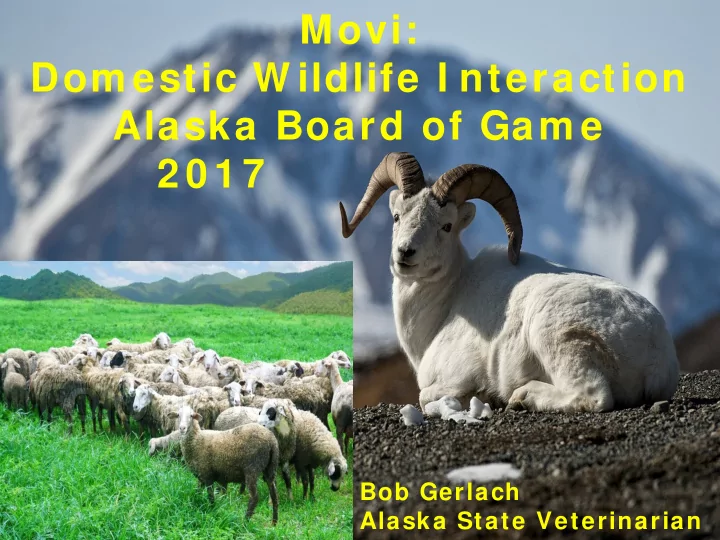
Movi: Dom estic W ildlife I nteraction Alaska Board of Gam e 2 0 1 - - PowerPoint PPT Presentation
Movi: Dom estic W ildlife I nteraction Alaska Board of Gam e 2 0 1 7 Bob Gerlach Bob Gerlach Alaska State Veterinarian Alaska State Veterinarian Domestic Wildlife Interface Greater Yellowstone Area - Brucellosis Michigan
Domestic Wildlife Interface
Greater Yellowstone Area - Brucellosis Michigan – Tuberculosis Domestic Poultry – Avian Influenza Alaskan Reindeer Herds – Caribou Livestock – Wildlife Predators Delta Farms - Plains Bison Canadian Farms – Elk Domestic Sheep – Bighorn Sheep
Reported Cause for Concern
Pneumonia outbreaks caused some
large die-offs (75-90% mortality) of bighorn sheep in western Canada and the U.S. but some report losses ~ 5%
Reduced lamb survival for years
following the pneumonia outbreaks impacts herd sustainability
Wild sheep have a low resistance to
pathogens found in the respiratory tract of domestic sheep and goats
Respiratory Disease
Pneumonia Outbreak: Multifactorial and
involve Multiple Pathogens
Mycoplasma ovipneumoniae (Movi) Pasteurella bacteria
- Pasteurella haemolytica
- P. haemolytica
- P. trehalosi
Fusobacterium necrophorum Other bacteria (Truperella pyogenes) Respiratory viruses
Alaska: Unique Situation
Alaska does not seem comparable to the
situations in western U.S. or Canada
Smaller number of farms and livestock
- 13 animals/ farm (~ 2,000 sheep, goats)
- Low density so probability for interaction
Fewer importations/ year (~ 19 imports;
< 110 animals/ year) 5 animals/ permit*
No free grazing, animals are contained
/ fenced, so some degree of separation
Must Evaluate the Whole Picture
Wild sheep populations increasing in U.S.
- 1960s ~ 18,000 / 2007 ~ 72,000 / 2014~ 85,000
Value of Wild Sheep as a resource
- Economically: Tourism, Hunting
- Very important to Alaska
Value of domestics
- Economically $ 800/ yr
(fiber, food)
- Management: state and federal land: grazing
Domestic Sheep Populations in Alaska
Wild Sheep Working Group
Organized by the Alaska Farm Bureau
and the Wild Sheep Foundation
Discuss options and strategies for
prevention of wildlife livestock interaction
- Separation – no contact
- Movi free status
Evaluate prevalence of Movi in domestic
sheep and goats – * * need for data* *
Study Outline
Using USDA, NASS statistics develop a
sampling plan to evaluate AK farms
Domestic livestock sample collection:
- Veterinarians to collect samples
Client/ patient confidentiality – used farm code
- Follow protocol established in previous
studies
Nasal, conjunctival swabs and serum
- Samples submitted:
Animal Disease Research, ARS, USDA Washington State Animal Diagnostic Lab
Study Protocol
Voluntary participation
- Sample plan to evaluate current farms
A Survey will be completed by farmer
- Focus on management husbandry practices
All animals tested on the farm, repeated
sampling at ~ 4 and 8 weeks
- Duplicate samples collected (~ 20% )
Data returned to the Veterinarian/ client
and summary data to State Veterinarian
Aleutian
- Kodiak
Islands Southcentral Kenai Peninsula Interior/ Fairbanks Southeast Total f l farms
# Farms
Anchorage- MatSu-Valdez- Cordova Delta - Yukon to Canada
Sheep 2 25 7 14 2 50 Goat 1 27 10 15 3 56 Total 3 52 17 29 5 106
# Animals
To Total anim imals ls
Sheep 42 326 147 216 42 773 Goat 6 343 52 177 18 595 Total 48 669 199 393 60 1,368
USDA NASS 2012 Farm Census
Concurrently a Second Study
ADF&G will provide samples from
- Wild Sheep, Goats, Muskox
- Wild ungulates (moose, deer, caribou)
This study will also include captive
wildlife
- Zoos, exhibitions, tourist attractions
Unique opportunity to evaluate domestic
livestock and multiple wildlife species in the same environment
Test Procedures
Nasal Sw abs: tested for Movi genetic
material using PCR
- Complex test procedure that may vary
between labs
- What does a (+ )detection mean?
Presence of bacteria not necessarily infection
Serum : tested for antibodies to Movi
- Currently no test is validated for goats
- What does a (+ ) result mean?
Exposure not infection
Preliminary Results for this Study
27 farms and 376 total animals
- 6 of 27 were sheep farms
- 2 of 27 had both sheep and goats
- 19 of 27 were goat farms
7 of 27 farms (26% ) Movi was detected
- More commonly found on sheep farms -
consistent with some other studies
20 of 27 (74% ) had no Movi detected
Preliminary Summary Data
For this study, the premises that
tested (+ ) for Movi:
- No animals were clinically ill
- Rarely did one animal test (+ ) at all 3
collection times
- In most cases the # of animals testing
(+ ) varied at each collection time
- There is a lot we do not know about this
bacteria
# MC-l Movi I ndet
1 366 303 83%
49
13%
14
4% 0% 2 330 256 78%
47
14%
18
5%
7
2% 3 265 200 75%
54
20%
7
3%
2
1% Avg:
79% 16% 4%
Preliminary Summary Data
Next Steps
Dependent on the study results
- Await results of wildlife study
- Continue to collect samples from livestock
- Use data for science based decision
Evaluate options for mitigation action
- No action
- “Disease free status”
- Separation
Continued collaboration and dialogue
What are the costs?
Summarize
All participants recognize the value of
wild life resources to Alaska
Producers participated unsure what the
results (prevalence of the pathogen)
Producers, veterinarians not totally
compensated for their time and efforts
The State has contributed considerable
efforts (time, funding, resources)
UDSA ARS also contributed greatly Use an Ecosystem approach, consider all