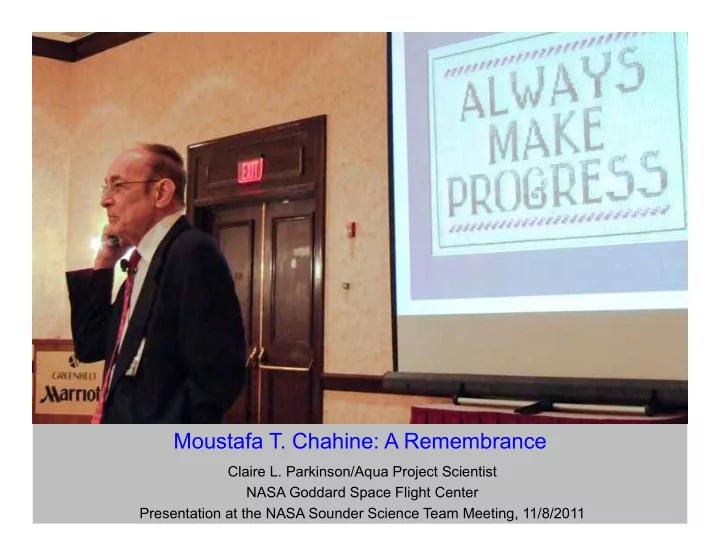
SLIDE 1
Moustafa T. Chahine: A Remembrance
Claire L. Parkinson/Aqua Project Scientist NASA Goddard Space Flight Center Presentation at the NASA Sounder Science Team Meeting, 11/8/2011
SLIDE 2 Youth
- Birth: January 1, 1935, Beirut, Lebanon.
- Childhood in Lebanon.
- Moved to the U.S. in December 1954, at age 19.
Mous as a child in Lebanon. Mous as a high school student in Lebanon.
(Photos courtesy of the Chahine family: sons Tony and Steve and wife Marina)
SLIDE 3 Studies
- Mous’s life-long dedication to intellectual
interests began in Lebanon.
- University of Washington, Seattle
– B.S., Aeronautical Engineering, 1956 – M.S., Aeronautical Engineering, 1957
- University of California at Berkeley
– Emphasis in fluid physics – Ph.D., Mechanical Engineering, 1960
A teen-age Mous studying in Lebanon. Far left: Mous as a UW freshman, 1955. Near left: Mous at Berkeley on the day of his dissertation defense, 1960.
(Photos courtesy of the Chahine family: sons Tony and Steve and wife Marina)
SLIDE 4
An Early Source of Inspiration ¡
Explorer 1, held aloft by William Pickering (Director of JPL), James van Allen, and Wernher von Braun, 1958 (from www.jpl.nasa.gov).
SLIDE 5
Family Man ¡
Mous courting his future wife, Marina, 1959. Mous and Marina in Paris, 1992. Mous with son’s Steve (left) and Tony (right), 1974. (Photos courtesy of the Chahine family: sons Tony and Steve and wife Marina) Mous with (left to right) his daughter-in-law, son Tony, and son Steve, 2010.
SLIDE 6
Traveling with Family ¡
Mous and Marina in Cairo, 1993.
(Photos courtesy of the Chahine family: sons Tony and Steve and wife Marina)
Mous and Steve on the Euro Train, 2005. Mous and Tony in Pisa, 2005.
SLIDE 7 Early Career
JPL career in 1960.
- Initial work: examining the
shock waves anticipated as a space capsule reenters the atmosphere.
deriving atmospheric information from satellites.
- Development, late 1960s,
- f the Relaxation Method
for the inverse solution of the radiative transfer equation.
– Derivation of atmospheric temperature and water vapor profiles. – Application to the atmospheres of Earth, Venus, Mars, and Jupiter.
SLIDE 8 Mid-Career
Relaxation Method.
multispectral approach to remote sensing in the presence of clouds.
to generate the first satellite-based global distribution of Earth’s temperature, 1980.
SLIDE 9 Some of Mous’s Many Roles During His 51 Years at JPL
- Scientific researcher, 1960-2011.
- Head of the JPL Planetary
Atmospheres Section, 1975-1978.
- Founder of the Division of Earth
and Space Sciences, 1978.
- Head of the Division of Earth and
Space Sciences, 1978-1984.
- JPL Chief Scientist, 1984-2001.
- First chair of the Science Steering
Group of the WMO’s GEWEX, 1989-1999.
- Guiding force behind the AIRS
instrument, and AIRS Science Team Leader.
- Scientific leader, mentor,
colleague, and friend.
WMO = World Meteorological Organization GEWEX = Global Energy and Water Cycle Experiment
Mous at JPL, 2010.
(Photo by and courtesy of Tony Chahine)
SLIDE 10 AIRS: Pre-Launch ¡
- Mous received his initial funding
for AIRS in 1978.
- Mous continued to develop and
advocate the AIRS concept, e.g., as a member of the NASA Earth System Sciences Committee (ESSC).
- In 1988, AIRS was selected as
- ne of the primary EOS
instruments, eventually placed on the Aqua spacecraft.
- Mous was selected as the first
AIRS Science Team Leader and remained in that position for over 20 years, until his death in 2011.
- Under Mous’s leadership, AIRS
was built in the 1990s to exacting standards, and algorithms were developed to derive from the AIRS data a suite of atmospheric and surface variables.
AIRS ¡under ¡construc/on ¡(courtesy ¡BAE ¡ Systems ¡and ¡JPL). ¡
SLIDE 11 AIRS: Launch and Post-Launch ¡
- AIRS was launched on Aqua on May 4, 2002.
- Since launch, the AIRS instrument has “exceeded all expectations,” delivering
an exceptional data set that has been used to derive numerous geophysical variables, including outgoing longwave radiation, cloud properties, dust, sea- surface, land-surface, and atmospheric temperatures, surface emissivity, and atmospheric carbon dioxide, carbon monoxide, methane, water vapor, ozone, and sulfur dioxide.
- Incorporation of AIRS data into forecast models has measurably increased
forecast skill.
Mous’s ¡global ¡mid-‑ tropospheric ¡CO2 ¡product, ¡ 2002-‑2009 ¡(anima/on ¡by ¡ the ¡NASA ¡SVS). ¡
SLIDE 12
Varied Moods of the Mature Mous
Mous at the Egyptian Pyramids (courtesy Tony Chahine). Mous in a spacesuit (courtesy Tony Chahine). Mous at JPL (courtesy JPL).
SLIDE 13
Mous in Italy, 2005 ¡
At ¡the ¡tomb ¡of ¡Galileo, ¡in ¡Florence. ¡ At ¡the ¡Va/can, ¡as ¡an ¡invited ¡guest. ¡
(Photos courtesy Tony Chahine)
SLIDE 14 Some of Mous’s Notable Honors
AAAS = American Association for the Advancement of Science AGU = American Geophysical Union AIAA = American Institute of Aeronautics and Astronautics AMS = American Meteorological Society COSPAR = Committee on Space Research DOI = Department of the Interior
- NASA Medal for Exceptional Scientific Achievement, 1969.
- NASA Outstanding Leadership Medal, 1984.
- William T. Pecora Award from NASA and DOI, 1989.
- Jule G. Charney Award from the AMS, 1991.
- Losey Atmospheric Sciences Award from AIAA, 1993.
- William Nordberg Medal from COSPAR, 2005.
- NASA Medal for Exceptional Scientific Achievement, 2007.
- Election to the U.S. National Academy of Engineering, 2009
- George W. Goddard Award from the International Society for Optics
and Photonics, 2010.
- Fellow of the American Physical Society,
AMS, the British Meteorological Society, AGU, and AAAS.
Mous Chahine receiving an Outstanding Presentation Award from Bob Atlas, 3/18/11. ¡
SLIDE 15
Mous being interviewed at NASA GSFC for an Aqua video, December 3, 2008.
SLIDE 16
Moustafa T. Chahine died on March 23, 2011, and is survived by his wife Marina, his sons Tony and Steve, his brother Najib, and his sisters Salma and Haifa.
SLIDE 17
Huge thanks go to Tony Chahine for contributing many wonderful photographs to this presentation.