Motivational Interviewing in a Child Welfare Context Prepared by - - PDF document

motivational interviewing in a child welfare context
SMART_READER_LITE
LIVE PREVIEW

Motivational Interviewing in a Child Welfare Context Prepared by - - PDF document

10/16/19 Motivational Interviewing in a Child Welfare Context Prepared by Rick Barinbaum, LMSW Adapted from Miller and Rollinick, Motivational Interviewing: Preparing People for Change, Guilford Press 2002 1 Child Abuse & Neglect


slide-1
SLIDE 1

10/16/19 1

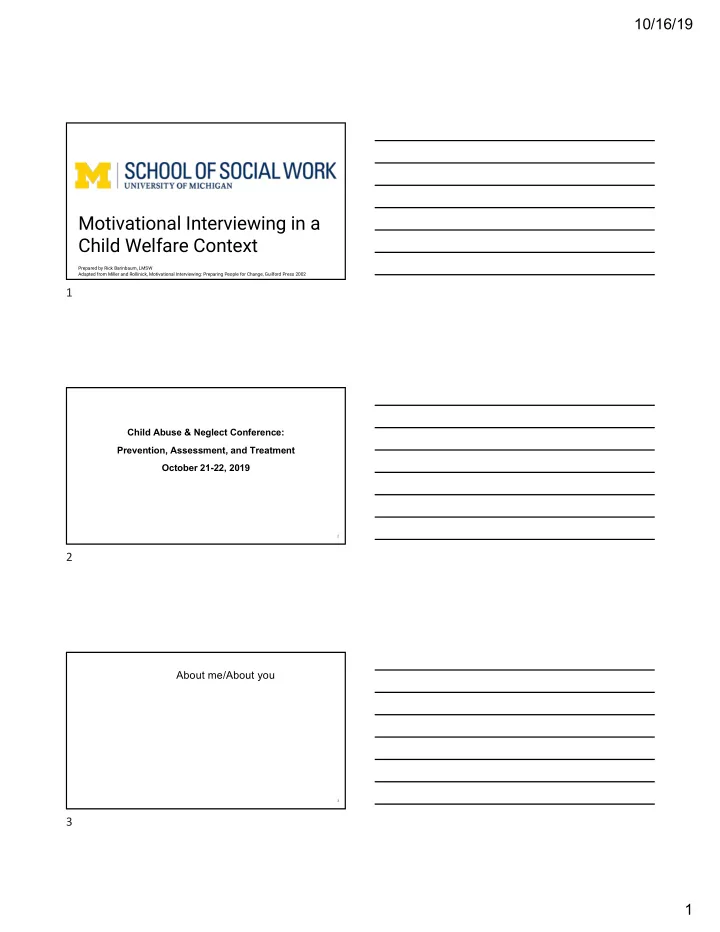
Motivational Interviewing in a Child Welfare Context

Prepared by Rick Barinbaum, LMSW Adapted from Miller and Rollinick, Motivational Interviewing: Preparing People for Change, Guilford Press 2002

1

Child Abuse & Neglect Conference: Prevention, Assessment, and Treatment October 21-22, 2019

2

2

About me/About you

3

3

slide-2
SLIDE 2

10/16/19 2

Motivational Interviewing is...

A collaborative, goal-oriented style of communication with particular attention to the language of change. It is designed to strengthen personal motivation for and commitment to a specific goal by eliciting and exploring the person’s own reasons for change within an atmosphere of acceptance and compassion. (Miller and Rollnick, 2013).

4

4

Motivational Interviewing is not...

  • Theory laden
  • A trick to make people do what you want
  • A singular technique
  • Easy to learn(but gets easier with practice)
  • What you are already doing because you recognize it
  • A one-size fits all

5

5

Who is it for?

Adults Adolescents Anybody facing change, and expressing a hesitancy to engage

6

6

slide-3
SLIDE 3

10/16/19 3

The Spirit of Motivational Interviewing

❑ Empathy ❑ Compassion ❑ Partnership and Collaboration ❑ Empowerment

7

7

What is change?

8

8

From Merriam Websters:

  • To make different in some particular way
  • To make radically different
  • To give a different position, course, or direction
  • To make a shift from one to another
  • To undergo a modification

9

9

slide-4
SLIDE 4

10/16/19 4

When have you tried to change?

10

10

The work

What are the different things you ask people to do? What are client barriers to change? How does resistance manifest?

11

11

AMBIVALENCE: A Barrier to Change

12

12

slide-5
SLIDE 5

10/16/19 5

However….

Ambivalence is:

  • Normal
  • Can be resolved
  • Alliance and collaboration is key
  • An empathic, supportive, yet directive, counseling style provides

conditions under which change can occur

13

13

Stages of Change, (Prochaska and Diclemente)

14

14

Stages of Change, (Prochaska and Diclemente)

  • Precontemplation
  • Contemplation
  • Preparation/Determination
  • Action/Willpower
  • Maintenance
  • Relapse

15

15

slide-6
SLIDE 6

10/16/19 6

The Principles of Motivational Interviewing: R.E.D.S

Roll with the Resistance Express Empathy Develop Discrepancy Support Self-Efficacy

16

16

Techniques of Motivational Interviewing: O.A.R.S.

Open Ended Questions Affirmations Reflective Listening Summarizing

17

17

Open Ended Questions

  • A good example: How is your relationship with ____?
  • A bad example: Do you have a good relationship with

_____?

18

18

slide-7
SLIDE 7

10/16/19 7

Examples

  • How can I help you with ___?
  • Help me understand ___?
  • How would you like things to be different?
  • What are the good things about ___ and what are the less good things

about it?

  • When would you be most likely to___?
  • What do you think you will lose if you try ___?
  • What do you want to do next?

19

19

Affirmations

Examples:

  • I appreciate that you are willing to talk with me about this.
  • You’ve been dealing with a lot, but you’ve made it this far.
  • You handled yourself really well in that situation.
  • If I were in your shoes, I don’t know if I could have managed nearly so well.

20

20

Reflective Listening

  • Begins with a way of thinking
  • It includes an interest in what the person has to say and a desire to truly

understand how the person sees things

  • Hypothesis testing
  • What you think a person means may not be what they mean

21

21

slide-8
SLIDE 8

10/16/19 8

Reflective Listening, continued

  • So you feel…
  • It sounds like you…
  • You’re wondering if…

22

22

Reflective Listening, continued

  • Simple reflection
  • Amplified Reflection
  • Double Sided Reflection

23

23

A simple reflection

Repeat back OR Rephrase

24

24

slide-9
SLIDE 9

10/16/19 9

Repeating back

Client: I can’t go to my visit tomorrow because I have a job interview and if I don’t find a job I’ll lose my housing! What then? They aren't going to pay my rent. CALC: It sounds like you are really frustrated because you are trying to get a job and don’t feel like you have time to fit visits. Client: yes! I want to go to visits, it’s just tough right now because I need to get a

  • job. Maybe...

25

25

Amplified Reflection

Client: I can’t go to my visit tomorrow because I have a job interview and if I don’t find a job I’ll lose my housing! What then? They aren't going to pay my rent. CALC: I see. You can’t go to visits because getting a job is more important than seeing them right now, even if that prevents you from reunifying. Client: Well no, I love them and want them back it’s just that I’m afraid of losing my housing.

26

26

Double-sided:

Client: I can’t go to my visit tomorrow because I have a job interview and if I don’t find a job I’ll lose my housing! What then? They aren't going to pay my rent. CALC: So on the one hand you love your kids and want to get them back, but on the other hand you are not visiting with them because you need to get job so you can pay your rent.

27

27

slide-10
SLIDE 10

10/16/19 10

Summaries

  • Announce that you are about to summarize
  • Include both sides of the ambivalence
  • End with any change talk heard
  • Invite client to correct anything missed
  • Give advice(with permission)

28

28

Put it all together

*Start with an empathetic statement Open Ended Question Affirmation Reflective Listening Summary(with a next step)

29

29

Practice

*Start with an empathetic statement Open Ended Question Affirmation Reflective Listening Summary(with a next step)

30

30