Motivation / Problem Optimization of behavior in respect of - - PDF document

motivation problem
SMART_READER_LITE
LIVE PREVIEW

Motivation / Problem Optimization of behavior in respect of - - PDF document

Lehrstuhl fr Knstliche Intelligenz - Univ. Wrzburg Optimization of simulated biological multi-agent systems by means of evolutionary processes Alexander Hrnlein Christoph Oechslein Frank Puppe Lehrstuhl fr Knstliche Intelligenz -


slide-1
SLIDE 1

1

Lehrstuhl für Künstliche Intelligenz - Univ. Würzburg

Optimization of simulated biological multi-agent systems by means of evolutionary processes

Alexander Hörnlein Christoph Oechslein Frank Puppe

2 / 23

Lehrstuhl für Künstliche Intelligenz - Univ. Würzburg

Optimization of simulated biological multi-agent systems by means of evolutionary processes

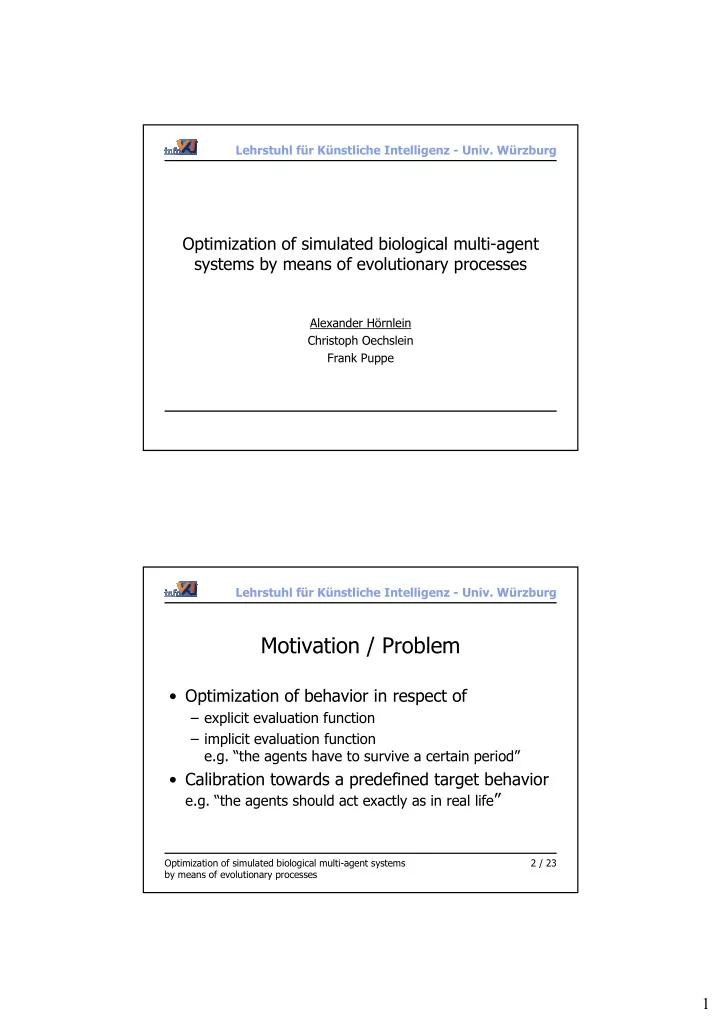
Motivation / Problem

  • Optimization of behavior in respect of

– explicit evaluation function – implicit evaluation function e.g. “the agents have to survive a certain period”

  • Calibration towards a predefined target behavior

e.g. “the agents should act exactly as in real life”

slide-2
SLIDE 2

2

3 / 23

Lehrstuhl für Künstliche Intelligenz - Univ. Würzburg

Optimization of simulated biological multi-agent systems by means of evolutionary processes

Evolution as optimization

  • Population of potential solutions
  • Evaluation by means of “natural selection”
  • Iteration: Survivors (i.e. highly fit individuals)

reproduce

4 / 23

Lehrstuhl für Künstliche Intelligenz - Univ. Würzburg

Optimization of simulated biological multi-agent systems by means of evolutionary processes

Reproduction

  • Mutation

– Offspring differs slightly - possibly advantageous – local search

  • Recombination

– Child possibly unites the advantages of both parents – global search

slide-3
SLIDE 3

3

5 / 23

Lehrstuhl für Künstliche Intelligenz - Univ. Würzburg

Optimization of simulated biological multi-agent systems by means of evolutionary processes

Behavior in SeSAm

Agent

  • Rules
  • Activities
  • Parameters
  • Memory
  • Perception

IF (in activity1) AND Condition THEN activity3 Activity1 Activity2 Activity3 Action1 Action2 ... 6 / 23

Lehrstuhl für Künstliche Intelligenz - Univ. Würzburg

Optimization of simulated biological multi-agent systems by means of evolutionary processes

GP approach: Mutation operators

activity

Parameter a += 10 Approach agent x Increase speed Parameter a += 25 Parameter b += 25 Flee from agent x Focus on earth

  • Change numeric terminals
  • Change symbolic terminals
  • Change non-terminals
  • Delete action
  • Add action
  • Add new activity
  • Add new rule
  • Change rule
  • Delete activity
  • Delete rule
slide-4
SLIDE 4

4

7 / 23

Lehrstuhl für Künstliche Intelligenz - Univ. Würzburg

Optimization of simulated biological multi-agent systems by means of evolutionary processes

Advantage

  • Extremely powerful
  • Little constraint by initial

structure of behavior

  • Development of

unnecessary or unwanted complexity

  • Restrictions are difficult

to define/set

  • Slow
  • Hard to implement within

SeSAm

Disadvantages

8 / 23

Lehrstuhl für Künstliche Intelligenz - Univ. Würzburg

Optimization of simulated biological multi-agent systems by means of evolutionary processes

GA/ES approach: Mutation operators

activity

Parameter a += 10 Approach agent x Increase speed

  • Change numeric terminals

Parameter a += 25 that’s it in principle.

slide-5
SLIDE 5

5

9 / 23

Lehrstuhl für Künstliche Intelligenz - Univ. Würzburg

Optimization of simulated biological multi-agent systems by means of evolutionary processes

Applicability of GA/ES approach within SeSAm

  • Actions

– Use numerical terminals – Can be controlled by probabilities

  • Rules

– Condition-parts use numerical terminals – Action-parts can be controlled by probabilities

10 / 23

Lehrstuhl für Künstliche Intelligenz - Univ. Würzburg

Optimization of simulated biological multi-agent systems by means of evolutionary processes

Model modification

  • Define rules for any

reasonable transient

  • Let evolution weight

them

  • Treat actions

accordingly

slide-6
SLIDE 6

6

11 / 23

Lehrstuhl für Künstliche Intelligenz - Univ. Würzburg

Optimization of simulated biological multi-agent systems by means of evolutionary processes

Advantages

  • Sufficient powerful
  • Easy to restrict:

Evolution can’t break boundaries of predefined behavior

  • Fast
  • Implementation within

SeSAm is ‘straight-forward’

  • Not extremely powerful

Disadvantage

12 / 23

Lehrstuhl für Künstliche Intelligenz - Univ. Würzburg

Optimization of simulated biological multi-agent systems by means of evolutionary processes

SeSAm genes

RULE: IF ENERGY > gene0 THEN MOVE

gene0:

(initial) value (initial) standard deviation ] upper boundary [ lower boundary

(initial) standard deviation dominance distribution (initial) value lower boundary upper boundary

slide-7
SLIDE 7

7

13 / 23

Lehrstuhl für Künstliche Intelligenz - Univ. Würzburg

Optimization of simulated biological multi-agent systems by means of evolutionary processes

SeSAm genomes

agent role behavior family attribute egg storage genome declaration

gene0 declaration gene1 declaration ...

genome

gene0 gene1 ... allele0-0 allele1-0 gene0 allele0-1 gene1 allele1-1 ... ... ... 14 / 23

Lehrstuhl für Künstliche Intelligenz - Univ. Würzburg

Optimization of simulated biological multi-agent systems by means of evolutionary processes

Polyploid genome

  • Treated threadwise
  • Treated genewise

dominance mutation dominance mutation

slide-8
SLIDE 8

8

15 / 23

Lehrstuhl für Künstliche Intelligenz - Univ. Würzburg

Optimization of simulated biological multi-agent systems by means of evolutionary processes

value0 value1 value2 meta gene

Possibilities for the gene-expression

  • weighted

i i i i i

dominance value dominance ) ( ) ( ω ω

value0

  • dominant/recessive

i i

value alleles # 1

  • ‘intermediary’

expression

Lehrstuhl für Künstliche Intelligenz - Univ. Würzburg

Application

from individuals to colonies

slide-9
SLIDE 9

9

17 / 23

Lehrstuhl für Künstliche Intelligenz - Univ. Würzburg

Optimization of simulated biological multi-agent systems by means of evolutionary processes

Insects’ behavior

from own reservoir

brood care

from nest reservoir

idle grow feed

feed on nest reservoir

feed

  • n brood

lay egg

mate

seek new nest seek marker set marker

insects

prey hunt fight

transport to nest

18 / 23

Lehrstuhl für Künstliche Intelligenz - Univ. Würzburg

Optimization of simulated biological multi-agent systems by means of evolutionary processes

Insects’ genes

idle grow lay egg mate seek new nest

queen-factor

prey hunt fight transport to nest

hunt-factor

from own reservoir brood care from nest reservoir

brood care-factor energy level genes

feed feed on nest reservoir feed on brood

egg level genes

slide-10
SLIDE 10

10

19 / 23

Lehrstuhl für Künstliche Intelligenz - Univ. Würzburg

Optimization of simulated biological multi-agent systems by means of evolutionary processes

Initial insects’ world

20 / 23

Lehrstuhl für Künstliche Intelligenz - Univ. Würzburg

Optimization of simulated biological multi-agent systems by means of evolutionary processes

Insects’ world after 150,000 ticks

slide-11
SLIDE 11

11

21 / 23

Lehrstuhl für Künstliche Intelligenz - Univ. Würzburg

Optimization of simulated biological multi-agent systems by means of evolutionary processes

Changes of gene-pool

queen-factor brood care-factor hunt-factor

22 / 23

Lehrstuhl für Künstliche Intelligenz - Univ. Würzburg

Optimization of simulated biological multi-agent systems by means of evolutionary processes

More changes of gene-pool

initial egg energy energy portion ant energy portion brood

slide-12
SLIDE 12

12

23 / 23

Lehrstuhl für Künstliche Intelligenz - Univ. Würzburg

Optimization of simulated biological multi-agent systems by means of evolutionary processes

Results & Discussion

  • Successful evaluation in three scenarios
  • ES/GA approach powerful and easy to use

? Use of explicit evaluation function for greater applicability ? Accelerate optimization (through parallelism)

Lehrstuhl für Künstliche Intelligenz - Univ. Würzburg