Motivation Patrick Cousot Radhia Cousot cole normale suprieure - - PowerPoint PPT Presentation

motivation
SMART_READER_LITE
LIVE PREVIEW

Motivation Patrick Cousot Radhia Cousot cole normale suprieure - - PowerPoint PPT Presentation

Static Analysis of Embedded Control/Command Software by Abstract Interpretation Motivation Patrick Cousot Radhia Cousot cole normale suprieure CNRS & cole polytechnique Paris, France Palaiseau, France cousot ens fr Radhia.Cousot


slide-1
SLIDE 1

Static Analysis of Embedded Control/Command Software by Abstract Interpretation Patrick Cousot

École normale supérieure Paris, France

cousot ens fr www.di.ens.fr/~cousot

Radhia Cousot

CNRS & École polytechnique Palaiseau, France

Radhia.Cousot polytechnique edu www.polytechnique.fr/enseignants/rcousot

Kestrel Technology, Palo Alto, CA, Nov. 7th, 2005

Talk Outline

  • Motivation (2 mn) . . . . . . . . . . . . . . . . . . . . . . . . . . . . . . . . . . . . . . . . . 4
  • Abstract interpretation, reminder (12 mn) . . . . . . . . . . . . . . . . . . 8
  • Applications of abstract interpretation (2 mn) . . . . . . . . . . . . . 24
  • A practical application to the ASTRÉE static analyzer (18 mn) 24
  • Examples of abstractions in ASTRÉE (12 mn) . . . . . . . . . . . . 44
  • Static analysis of systems (6 mn) . . . . . . . . . . . . . . . . . . . . . . . . . . 58
  • Conclusion (2 mn) . . . . . . . . . . . . . . . . . . . . . . . . . . . . . . . . . . . . . . . . 66

x x

§

x

  • x

x x

§

x

  • x

x

Motivation

— 3 —

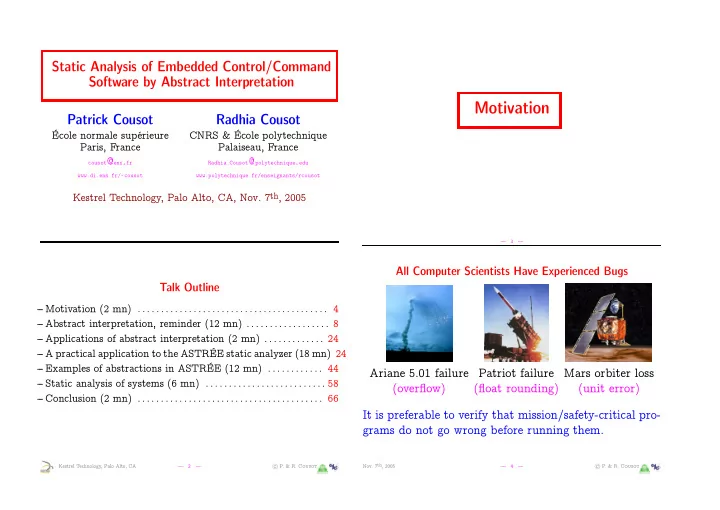
All Computer Scientists Have Experienced Bugs Ariane 5.01 failure Patriot failure Mars orbiter loss (overflow) (float rounding) (unit error) It is preferable to verify that mission/safety-critical pro- grams do not go wrong before running them.

ľ P. & R. Cousot

  • Nov. 7th, 2005

Kestrel Technology, Palo Alto, CA — 2 — — 4 — ľ P. & R. Cousot

slide-2
SLIDE 2

Static Analysis by Abstract Interpretation Static analysis: analyze the program at compile-time to verify a program runtime property Undecidability ` ! Abstract interpretation: effectively compute an abstraction/ sound approximation of the program semantics,

  • which is precise enough to imply the desired

property, and

  • coarse enough to be efficiently computable.

— 5 —

Abstract Interpretation, Reminder using a simple example

Reference [POPL ’77]

  • P. Cousot and R. Cousot. Abstract interpretation: a unified lattice model for static analysis of

programs by construction or approximation of fixpoints. In 4th ACM POPL. [Thesis ’78] P. Cousot. Méthodes itératives de construction et d’approximation de points fixes d’opérateurs monotones sur un treillis, analyse sémantique de programmes. Thèse ès sci. math. Grenoble, march 1978. [POPL ’79]

  • P. Cousot & R. Cousot. Systematic design of program analysis frameworks. In 6th ACM POPL.

Syntax of programs X

variables X 2 X

T

types T 2 T

E

arithmetic expressions E 2 E

B

boolean expressions B 2 B

D ::= T X; j T X ; D0 C ::= X = E;

commands C 2 C

j while B C0 j if B C0 else C00 j { C1 . . . Cn }, (n – 0) P ::= D C

program P 2 P

— 7 —

Postcondition semantics x(t) t

  • ľ P. & R. Cousot
  • Nov. 7th, 2005

Kestrel Technology, Palo Alto, CA — 6 — — 8 — ľ P. & R. Cousot

slide-3
SLIDE 3

States Values of given type: VT : values of type T 2 T Vint

def

= fz 2 Z j min_int » z » max_intg Program states ˚P 1: ˚D C

def

= ˚D ˚T X;

def

= fXg 7! VT ˚T X; D

def

= (fXg 7! VT) [ ˚D

— 9 —

Concrete Semantic Domain of Programs Concrete semantic domain for reachability properties: DP

def

= }(˚P) sets of states i.e. program properties where „ is implication, ; is false, [ is disjunction.

1 States  2 ˚P of a program P map program variables X to their values (X)

Concrete Reachability Semantics of Programs

SX = E; R

def

= f[X EE] j  2 R \ dom(E)g [X v](X)

def

= v; [X v](Y )

def

= (Y ) Sif B C0R

def

= SC0(BBR) [ B:BR BBR

def

= f 2 R \ dom(B) j B holds in g Sif B C0 else C00R

def

= SC0(BBR) [ SC00(B:BR) Swhile B C0R

def

= let W = lfp

„ ; –X . R [ SC0(BBX)

in (B:BW) SfgR

def

= R SfC1 : : : CngR

def

= SCn ‹ : : : ‹ SC1R n > 0 SD CR

def

= SC(˚D) (uninitialized variables) Not computable (undecidability).

— 11 —

Abstract Semantic Domain of Programs hD]P; v; ?; ti such that: hDP; „i ` ` `! ` ! ` ` ` `

¸ ‚

hD]P; vi i.e. 8X 2 DP; Y 2 D]P : ¸(X) v Y ( ) X „ ‚(Y ) hence hD]P; v; ?; ti is a complete lattice such that ? = ¸(;) and tX = ¸([ ‚(X))

ľ P. & R. Cousot

  • Nov. 7th, 2005

Kestrel Technology, Palo Alto, CA — 10 — — 12 — ľ P. & R. Cousot

slide-4
SLIDE 4

Example 1 of Abstraction Set of traces: set of finite or infinite maximal sequences

  • f states for the operational transition semantics

¸

! Strongest liberal postcondition: final states s reachable from a given precondition P ¸(X) = –P . fs j 9ff0ff1 : : : ffn 2 X : ff0 2 P ^ s = ffng We have (˚: set of states, _ „ pointwise): h}(˚1); „i ` ` `! ` ! ` ` ` `

¸ ‚

h}(˚)

[

7` ! }(˚); _ „i

— 13 —

Example 2 of Abstraction Set of traces: set of finite or infinite maximal sequences

  • f states for the operational transition semantics

¸0

! Trace of sets of states: sequence of set of states appear- ing at a given time along at least one of these traces ¸0(X) = –i . fffi j ff 2 X ^ 0 » i < jffjg

¸1

! Set of reachable states: set of states appearing at least

  • nce along one of these traces (global invariant)

¸1(˚) = Sf˚i j 0 » i < j˚jg

¸2

! Partitionned set of reachable states: project along each control point (local invariant) ¸2(fhci; ii j i 2 ´g) = –c . fi j i 2 ´ ^ c = cig

¸3

! Partitionned cartesian set of reachable states: project along each program variable (relationships between vari- ables are now lost) ¸3(–c . fi j i 2 ´cg) = –c . –X . fi(X) j i 2 ´cg

¸4

! Partitionned cartesian interval of reachable states: take min and max of the values of the variables 2 ¸4(–c . –X . fvi j i 2 ´c;Xg = –c . –X . hminfvi j i 2 ´c;Xg; maxfvi j i 2 ´c;Xgi ¸0, ¸1, ¸2, ¸3 and ¸4, whence ¸4 ‹ ¸3 ‹ ¸2 ‹ ¸1 ‹ ¸0 are lower-adjoints of Galois connections

— 15 —

Example 3: Reduced Product of Abstract Domains To combine abstractions hD; „i ` ` ` ! ` ` `

¸1 ‚1

hD]

1; v1i and hD; „i `

` ` ! ` ` `

¸2 ‚2

hD]

2; v2i

the reduced product is ¸(X)

def

= ufhx; yi j X „ ‚1(x) ^ X „ ‚2(y)g such that v

def

= v1 ˆ v2 and hD; „i ` ` ` ` ` `! ` ! ` ` ` ` ` ` `

¸ ‚1ˆ‚2

h¸(D); vi Example: x 2 [1; 9] ^ x mod 2 = 0 reduces to x 2 [2; 8] ^

x mod 2 = 0

2 assuming these values to be totally ordered.

ľ P. & R. Cousot

  • Nov. 7th, 2005

Kestrel Technology, Palo Alto, CA — 14 — — 16 — ľ P. & R. Cousot

slide-5
SLIDE 5

Approximate Fixpoint Abstraction

F F Concrete domain Abstract domain F F F F F F F

F

F

F

Approximation relation ⊥ ⊥

]

F ‹ ‚ v ‚ ‹ F ] ) lfp F v ‚(lfp F ])

— 17 —

Abstract Reachability Semantics of Programs

S]X = E; R

def

= ¸(f[X EE] j  2 ‚(R) \ dom(E)g) S]if B C0R

def

= S]C0(B]BR) t B]:BR B]BR

def

= ¸(f 2 ‚(R) \ dom(B) j B holds in g) S]if B C0 else C00R

def

= S]C0(B]BR) t S]C00(B]:BR) S]while B C0R

def

= let W = lfp

v ? –X . R t S]C0(B]BX)

in (B]:BW) S]fgR

def

= R S]fC1 : : : CngR

def

= S]Cn ‹ : : : ‹ S]C1R n > 0 S]D CR

def

= S]C(>) (uninitialized variables)

Convergence Acceleration with Widening

F Concrete domain Abstract domain F F F F F F Approximation relation ⊥ ⊥

]

♯ ▽

F

F

♯ ▽

F

F

— 19 —

Abstract Semantics with Convergence Acceleration 3

S]X = E; R

def

= ¸(f[X EE] j  2 ‚(R) \ dom(E)g) S]if B C0R

def

= S]C0(B]BR) t B]:BR B]BR

def

= ¸(f 2 ‚(R) \ dom(B) j B holds in g) S]if B C0 else C00R

def

= S]C0(B]BR) t S]C00(B]:BR) S]while B C0R

def

= let F] = –X . let Y = R t S]C0(B]BX) in if Y v X then X else X

  • Y

and W = lfp

v ? F]

in (B]:BW) S]fgR

def

= R S]fC1 : : : CngR

def

= S]Cn ‹ : : : ‹ S]C1R n > 0 S]D CR

def

= S]C(>) (uninitialized variables)

3 Note: F] not monotonic!

ľ P. & R. Cousot

  • Nov. 7th, 2005

Kestrel Technology, Palo Alto, CA — 18 — — 20 — ľ P. & R. Cousot

slide-6
SLIDE 6

Applications of Abstract Interpretation

— 21 —

A few applications of Abstract Interpretation (Cont’d)

  • Static Program Analysis [POPL ’77], [POPL ’78], [POPL ’79]

including a.o. Dataflow Analysis [POPL ’79], [POPL ’00], Set-based Analysis [FPCA ’95], Predicate Abstraction [Manna’s festschrift ’03], . . .

  • Syntax Analysis [TCS 290(1) 2002]
  • Hierarchies of Semantics (including Proofs) [POPL ’92],

[TCS 277(1–2) 2002]

  • Typing & Type Inference [POPL ’97]

A few applications of Abstract Interpretation (Cont’d)

  • (Abstract) Model Checking [POPL ’00]
  • Program Transformation [POPL ’02]
  • Software Watermarking [POPL ’04]
  • Bisimulations [RT-ESOP ’04]
  • . . .

All these techniques involve sound approximations that can be formalized by abstract interpretation

— 23 —

A Practical Application

  • f Abstract Interpretation

to the ASTRÉE Static Analyzer

Reference [1] http://www.astree.ens.fr/ P. Cousot, R. Cousot, J. Feret, L. Mauborgne, A. Miné, D. Monniaux, X. Rival

ľ P. & R. Cousot

  • Nov. 7th, 2005

Kestrel Technology, Palo Alto, CA — 22 — — 24 — ľ P. & R. Cousot

slide-7
SLIDE 7

Programs analysed by ASTRÉE

  • Application Domain: large safety critical embedded real-

time synchronous software for non-linear control of very complex control/command systems.

  • C programs:
  • with
  • basic numeric datatypes, structures and arrays
  • pointers (including on functions),
  • floating point computations
  • tests, loops and function calls
  • limited branching (forward goto, break, continue)

— 25 —

  • without
  • union (new memory model in progress 4)
  • dynamic memory allocation
  • recursive function calls
  • backward branching
  • conflicting side effects
  • C libraries, system calls (parallelism)

4 Thanks A. Miné

Concrete Operational Semantics

  • International norm of C (ISO/IEC 9899:1999)
  • restricted by implementation-specific behaviors depend-

ing upon the machine and compiler (e.g. encoding of integers, IEEE 754-1985 norm for floats and doubles)

  • restricted by user-defined programming guidelines (such

as no modular arithmetic for signed integers, even though this might be the hardware choice)

  • restricted by program specific user requirements (e.g.

volatile environment specified by a trusted configura- tion file, assert, execution stops on first runtime error 5,)

— 27 —

Implicit Specification: Absence of Runtime Errors

  • No violation of the norm of C (e.g. array index out of

bounds, division by zero)

  • No implementation-specific undefined behaviors (e.g.

maximum short integer is 32767, no float NaN)

  • No violation of the programming guidelines (e.g. static

variables cannot be assumed to be initialized to 0)

  • No violation of the programmer assertions (must all be

statically verified).

5 semantics of C unclear after an error, equivalent if no alarm

ľ P. & R. Cousot

  • Nov. 7th, 2005

Kestrel Technology, Palo Alto, CA — 26 — — 28 — ľ P. & R. Cousot

slide-8
SLIDE 8

Abstraction

  • Set of traces of relational state abstractions of subtraces

for the concrete trace operational semantics

— 29 —

Requirements on the Abstract Semantics

  • Soundness: absolutely essential for verification
  • Precision: few or no false alarm 6 (full certification)
  • Efficiency: rapid analyses and fixes during develop-

ment

6 Potential runtime error signaled by the analyzer due to overapproximation but impossible in any actual program run compatible with the configuration file.

Example of Industrial applications

  • Primary flight control software of the Airbus A340 family/A380

fly-by-wire system

  • C program, automatically generated from a proprietary high-

level specification (à la Simulink/Scade)

  • A340 family: 132,000 lines, 75,000 LOCs after preprocessing,

10,000 global variables, over 21,000 after expansion of small ar- rays

  • A380: ˆ 3/7 (up to 1.000.000 LOCs)

— 31 —

The Class of Considered Periodic Synchronous Programs

declare volatile input, state and output variables; initialize state and output variables; loop forever

  • read volatile input variables,
  • compute output and state variables,
  • write to output variables;

__ASTREE_wait_for_clock (); end loop

Task scheduling is static:

  • Requirements: the only interrupts are clock ticks;
  • Execution time of loop body less than a clock tick

[EMSOFT ’01].

ľ P. & R. Cousot

  • Nov. 7th, 2005

Kestrel Technology, Palo Alto, CA — 30 — — 32 — ľ P. & R. Cousot

slide-9
SLIDE 9

Challenging aspects

  • Size: > 100 kLOC, > 10 000 variables
  • Floating point computations

including interconnected networks of filters, non linear control with feedback, interpolations...

  • Interdependencies among variables:
  • Stability of computations should be established
  • Complex relations should be inferred among nu-

merical and boolean data

  • Very long data paths from input to outputs

— 33 —

Characteristics of the ASTRÉE Analyzer (Cont’d) Static: compile time analysis (6= run time analysis Rational Purify, Parasoft Insure++) Program Analyzer: analyzes programs not micromodels of programs (6= PROMELA in SPIN or Alloy in the Alloy Analyzer) Automatic: no end-user intervention needed (6= ESC Java, ESC Java 2) Sound: covers the whole state space (6= MAGIC, CBMC) so never omit potential errors (6= UNO, CMC from coverity.com) or sort most probable ones (6= Splint) Characteristics of the ASTRÉE Analyzer (Cont’d) Multiabstraction: uses many numerical/symbolic abstract domains (6= symbolic constraints in Bane or the canonical abstraction of TVLA) Infinitary: all abstractions use infinite abstract domains with widening/narrowing (6= model checking based analyzers such as VeriSoft, Bandera, Java PathFinder) Efficient: always terminate (6= counterexample-driven au- tomatic abstraction refinement BLAST, SLAM)

— 35 —

Characteristics of the ASTRÉE Analyzer (Cont’d) Specializable: can easily incorporate new abstractions (and reduction with already existing abstract domains) (6= general-purpose analyzers PolySpace Verifier) Domain-Aware: knows about control/command (e.g. dig- ital filters) (as opposed to specialization to a mere programming style in C Global Surveyor) Parametric: the precision/cost can be tailored to user needs by options and directives in the code

ľ P. & R. Cousot

  • Nov. 7th, 2005

Kestrel Technology, Palo Alto, CA — 34 — — 36 — ľ P. & R. Cousot

slide-10
SLIDE 10

Characteristics of the ASTRÉE Analyzer (Cont’d) Automatic Parametrization: the generation of parametric directives in the code can be programmed (to be specialized for a specific application domain) Modular: an analyzer instance is built by selection of O- CAML modules from a collection, each module im- plementing an abstract domain Precise: very few or no false alarm when adapted to an application domain ` ! it is a VERIFIER!

— 37 —

Example of Analysis Session Benchmarks (Airbus A340 Primary Flight Control Software)

  • 132,000 lines, 75,000 LOCs after preprocessing
  • Comparative results (commercial software):

4,200 (false?) alarms, 3.5 days;

  • Our results:

0 alarms,

40mn on 2.8 GHz PC, 300 Megabytes ` ! A world première!

— 39 —

(Airbus A380 Primary Flight Control Software)

  • 350,000 lines
  • 0 alarms (Nov. 2004),

7h 7 on 2.8 GHz PC, 1 Gigabyte ` ! A world grand première!

7 We are still in a phase where we favour precision rather than computation costs, and this should go down. For example, the A340 analysis went up to 5 h, before being reduced by requiring less precision while still getting no false alarm.

ľ P. & R. Cousot

  • Nov. 7th, 2005

Kestrel Technology, Palo Alto, CA — 38 — — 40 — ľ P. & R. Cousot

slide-11
SLIDE 11

Examples of Abstractions

— 41 —

General-Purpose Abstract Domains: Intervals and Octagons

X Y Intervals:  1 » x » 9 1 » y » 20 Octagons [10]: 8 > > < > > : 1 » x » 9 x + y » 77 1 » y » 20 x ` y » 04 Difficulties: many global variables, arrays (smashed or not), IEEE 754 floating-point arithmetic (in program and analyzer) [POPL ’77, 10, 11]

Floating-Point Computations

/* float-error.c */ int main () { float x, y, z, r; x = 1.000000019e+38; y = x + 1.0e21; z = x - 1.0e21; r = y - z; printf("%f\n", r); } % gcc float-error.c % ./a.out 0.000000

(x + a) ` (x ` a) 6= 2a

/* double-error.c */ int main () { double x; float y, z, r; /* x = ldexp(1.,50)+ldexp(1.,26); */ x = 1125899973951488.0; y = x + 1; z = x - 1; r = y - z; printf("%f\n", r); } % gcc double-error.c % ./a.out 134217728.000000

— 43 —

Floating-Point Computations

/* float-error.c */ int main () { float x, y, z, r; x = 1.000000019e+38; y = x + 1.0e21; z = x - 1.0e21; r = y - z; printf("%f\n", r); } % gcc float-error.c % ./a.out 0.000000

(x + a) ` (x ` a) 6= 2a

/* double-error.c */ int main () { double x; float y, z, r; /* x = ldexp(1.,50)+ldexp(1.,26); */ x = 1125899973951487.0; y = x + 1; z = x - 1; r = y - z; printf("%f\n", r); } % gcc double-error.c % ./a.out 0.000000

— 43 —

Explanation of the huge rounding error

ľ P. & R. Cousot

  • Nov. 7th, 2005

Kestrel Technology, Palo Alto, CA — 42 — — 44 — ľ P. & R. Cousot

slide-12
SLIDE 12

(1)

x

  • x
  • x
  • x
  • (2)

x

  • x

x x

  • Floating-point linearization [11, 12]
  • Approximate arbitrary expressions in the form

[a0; b0] + P

k([ak; bk] ˆ Vk)

  • Example:

Z = X - (0.25 * X) is linearized as

Z = ([0:749 ´ ´ ´ ; 0:750 ´ ´ ´]ˆX)+(2:35 ´ ´ ´ 10`38ˆ[`1; 1])

  • Allows simplification even in the interval domain

if X 2 [-1,1], we get jZj » 0:750 ´ ´ ´ instead of jZj » 1:25 ´ ´ ´

  • Allows using a relational abstract domain (octagons)
  • Example of good compromize between cost and preci-

sion

— 45 —

Symbolic abstract domain [11, 12]

  • Interval analysis: if x 2 [a; b] and y 2 [c; d] then x`y 2

[a ` d; b ` c] so if x 2 [0; 100] then x ` x 2 [`100; 100]!!!

  • The symbolic abstract domain propagates the symbolic

values of variables and performs simplifications;

  • Must maintain the maximal possible rounding error for

float computations (overestimated with intervals);

% cat -n x-x.c 1 void main () { int X, Y; 2 __ASTREE_known_fact(((0 <= X) && (X <= 100))); 3 Y = (X - X); 4 __ASTREE_log_vars((Y)); 5 } astree –exec-fn main –no-relational x-x.c Call main@x-x.c:1:5-x-x.c:1:9: <interval: Y in [-100, 100]> astree –exec-fn main x-x.c Call main@x-x.c:1:5-x-x.c:1:9: <interval: Y in {0}> <symbolic: Y = (X -i X)>

ľ P. & R. Cousot

  • Nov. 7th, 2005

Kestrel Technology, Palo Alto, CA — 46 — ľ P. & R. Cousot

slide-13
SLIDE 13

Boolean Relations for Boolean Control

  • Code Sample:

/* boolean.c */ typedef enum {F=0,T=1} BOOL; BOOL B; void main () { unsigned int X, Y; while (1) { ... B = (X == 0); ... if (!B) { Y = 1 / X; } ... } }

  • The boolean relation abstract do-

main is parameterized by the height

  • f the decision tree (an analyzer
  • ption) and the abstract domain at

the leafs

— 47 —

Control Partitionning for Case Analysis

  • Code Sample:

/* trace_partitionning.c */ void main() { float t[5] = {-10.0, -10.0, 0.0, 10.0, 10.0}; float c[4] = {0.0, 2.0, 2.0, 0.0}; float d[4] = {-20.0, -20.0, 0.0, 20.0}; float x, r; int i = 0; ... found invariant `100 » x » 100 ... while ((i < 3) && (x >= t[i+1])) { i = i + 1; } r = (x - t[i]) * c[i] + d[i]; }

Control point partitionning: Trace partitionning: Delaying abstract unions in tests and loops is more precise for non-distributive abstract domains (and much less expensive than disjunctive completion).

Ellipsoid Abstract Domain for Filters

2d Order Digital Filter:

j

Switch

  • a

b i z-1

Unit delay

z-1 B

+ + +

t x(n)

Unit delay Switch Switch

  • Computes Xn =

 ¸Xn`1 + ˛Xn`2 + Yn In

  • The concrete computation is bounded, which

must be proved in the abstract.

  • There is no stable interval or octagon.
  • The simplest stable surface is an ellipsoid.

X U F(X) X F(X) F(X) X X U F(X)

execution trace unstable interval stable ellipsoid

— 49 —

Filter Example [7]

typedef enum {FALSE = 0, TRUE = 1} BOOLEAN; BOOLEAN INIT; float P, X; void filter () { static float E[2], S[2]; if (INIT) { S[0] = X; P = X; E[0] = X; } else { P = (((((0.5 * X) - (E[0] * 0.7)) + (E[1] * 0.4)) + (S[0] * 1.5)) - (S[1] * 0.7)); } E[1] = E[0]; E[0] = X; S[1] = S[0]; S[0] = P; /* S[0], S[1] in [-1327.02698354, 1327.02698354] */ } void main () { X = 0.2 * X + 5; INIT = TRUE; while (1) { X = 0.9 * X + 35; /* simulated filter input */ filter (); INIT = FALSE; } }

ľ P. & R. Cousot

  • Nov. 7th, 2005

Kestrel Technology, Palo Alto, CA — 50 — ľ P. & R. Cousot

slide-14
SLIDE 14

Arithmetic-geometric progressions 8 [8]

  • Abstract domain: (R+)5
  • Concretization:

‚ 2 (R+)5 7` ! }(N 7! R) ‚(M; a; b; a0; b0) = ff j 8k 2 N : jf(k)j » “ –x . ax + b ‹ (–x . a0x + b0)k” (M)g i.e. any function bounded by the arithmetic-geometric progression.

— 51 —

Arithmetic-Geometric Progressions (Example 1)

% cat count.c typedef enum {FALSE = 0, TRUE = 1} BOOLEAN; volatile BOOLEAN I; int R; BOOLEAN T; void main() { R = 0; while (TRUE) { __ASTREE_log_vars((R)); if (I) { R = R + 1; } else { R = 0; } T = (R >= 100); __ASTREE_wait_for_clock(()); }} % cat count.config __ASTREE_volatile_input((I [0,1])); __ASTREE_max_clock((3600000)); % astree –exec-fn main –config-sem count.config count.c|grep ’|R|’ |R| <= 0. + clock *1. <= 3600001.

potential overflow!

8 here in R

Arithmetic-geometric progressions (Example 2)

% cat retro.c typedef enum {FALSE=0, TRUE=1} BOOL; BOOL FIRST; volatile BOOL SWITCH; volatile float E; float P, X, A, B; void dev( ) { X=E; if (FIRST) { P = X; } else { P = (P - ((((2.0 * P) - A) - B) * 4.491048e-03)); }; B = A; if (SWITCH) {A = P;} else {A = X;} } void main() { FIRST = TRUE; while (TRUE) { dev( ); FIRST = FALSE; __ASTREE_wait_for_clock(()); }} % cat retro.config __ASTREE_volatile_input((E [-15.0, 15.0])); __ASTREE_volatile_input((SWITCH [0,1])); __ASTREE_max_clock((3600000));

|P| <= (15. + 5.87747175411e-39 / 1.19209290217e-07) * (1 + 1.19209290217e-07)ˆclock

  • 5.87747175411e-39 /

1.19209290217e-07 <= 23.0393526881

— 53 —

(Automatic) Parameterization

  • All abstract domains of ASTRÉE are parameterized,

e.g.

  • variable packing for octagones and decision trees,
  • partition/merge program points,
  • loop unrollings,
  • thresholds in widenings, . . . ;
  • End-users can either parameterize by hand (analyzer
  • ptions, directives in the code), or
  • choose the automatic parameterization (default options,

directives for pattern-matched predefined program schemata).

ľ P. & R. Cousot

  • Nov. 7th, 2005

Kestrel Technology, Palo Alto, CA — 54 — ľ P. & R. Cousot

slide-15
SLIDE 15

The main loop invariant for the A340 A textual file over 4.5 Mb with

  • 6,900 boolean interval assertions (x 2 [0; 1])
  • 9,600 interval assertions (x 2 [a; b])
  • 25,400 clock assertions (x+clk 2 [a; b]^x`clk 2 [a; b])
  • 19,100 additive octagonal assertions (a » x + y » b)
  • 19,200 subtractive octagonal assertions (a » x ` y » b)
  • 100 decision trees
  • 60 ellipse invariants, etc . . .

involving over 16,000 floating point constants (only 550 appearing in the program text) ˆ 75,000 LOCs.

— 55 —

Possible origins of imprecision and how to fix it In case of false alarm, the imprecision can come from:

  • Abstract transformers (not best possible) `

! improve algorithm;

  • Automatized parametrization (e.g. variable packing) `

! improve pattern-matched program schemata;

  • Iteration strategy for fixpoints `

! fix widening

9;

  • Inexpressivity i.e. indispensable local inductive invari-

ant are inexpressible in the abstract ` ! add a new abstract domain to the reduced product (e.g. filters).

9 This can be very hard since at the limit only a precise infinite iteration might be able to compute the proper abstract invariant. In that case, it might be better to design a more refined abstract domain.

Static analysis of systems

— 57 —

System analysis & verification, Avenue 1

  • Abstractions: program ! precise, system ! precise

ľ P. & R. Cousot

  • Nov. 7th, 2005

Kestrel Technology, Palo Alto, CA — 58 — ľ P. & R. Cousot

slide-16
SLIDE 16
  • Exhaustive (contrary to current simulations)
  • The plant model discretization errors are similar to those
  • f simulation methods (but for the use of the actual

control program instead of a model!)

  • In general, polyhedral abstractions are unstable or of

very high complexity

  • New abstractions have to be studied (e.g. ellipsoidal

abstractions)!

— 59 —

System analysis & verification, Avenue 2

  • Abstractions: program ! precise, system ! precise
  • The control-theoretic ‘static analysis‘ is easier on the

plant/controller model using continuous optimization methods

  • The in/variant hypotheses on the controlled plant are

assumed to be true in the analysis of the plant control program

  • It is now sufficient to perform the analysis analysis con-

trol program under these in/variant hypotheses

  • The results can then be checked on the whole system

(plant simulation + control program)

— 61 —

System analysis & verification, Avenue 3

  • Abstractions: program ! precise, system ! precise

ľ P. & R. Cousot

  • Nov. 7th, 2005

Kestrel Technology, Palo Alto, CA — 62 — ľ P. & R. Cousot

slide-17
SLIDE 17
  • The translated in/variants can be checked for the plant

simulator/control program (easier than in/variant dis- covery)

  • Should scale up (since these complex in/variants are

relevant to a small part of the control program only 10)

— 63 —

Conclusion

10 e.g. the plant model assumes perfect sensors/actuators/computers whereas the control program must be made dependable by using redundant failing sensors/actuators/computers

Conclusions (cont’d)

  • 1. On soundness and completeness:
  • Software checking (e.g. [abstract] testing): unsound
  • Software static analysis (for a language): sound but

unprecise

  • Software verification (for a well-defined family of pro-

grams): theoretically possible [SARA ’00], practically feasible [PLDI ’03]

Reference [SARA ’00] P. Cousot. Partial Completeness of Abstract Fixpoint Checking, invited paper. In 4th Int. Symp. SARA ’2000, LNAI 1864, Springer, pp. 1–25, 2000. [PLDI ’03]

  • B. Blanchet, P. Cousot, R. Cousot, J. Feret, L. Mauborgne, A. Miné, D. Monniaux, and X. Rival.

A static analyzer for large safety-critical software. PLDI’03, San Diego, June 7–14, ACM Press, 2003.

— 65 —

Conclusions (cont’d)

  • 2. On specifications for static verification:
  • Implicit: e.g. from a language semantics (e.g. RTE) !

extremely easy for engineers

  • Explicit:
  • By a logic ! very hard for engineers
  • By a model ! easy for engineers / hard for static

analysis

  • By a program automatically generated from a model

! easy for engineers / easy for static analysis

ľ P. & R. Cousot

  • Nov. 7th, 2005

Kestrel Technology, Palo Alto, CA — 66 — ľ P. & R. Cousot

slide-18
SLIDE 18

THE END, THANK YOU

More references at URL www.di.ens.fr/~cousot www.astree.ens.fr.

— 67 —

References

[2] www.astree.ens.fr [4, 5, 6, 7, 8, 9, 10, 11, 12] [3]

  • P. Cousot. Méthodes itératives de construction et d’approximation de points fixes d’opérateurs mono-

tones sur un treillis, analyse sémantique de programmes. Thèse d’État ès sciences mathématiques, Université scientifique et médicale de Grenoble, Grenoble, France, 21 March 1978. [4]

  • B. Blanchet, P. Cousot, R. Cousot, J. Feret, L. Mauborgne, A. Miné, D. Monniaux, and X. Ri-

val. Design and implementation of a special-purpose static program analyzer for safety-critical real-time embedded software. The Essence of Computation: Complexity, Analysis, Transformation. Essays Dedi- cated to Neil D. Jones, LNCS 2566, pp. 85–108. Springer, 2002. [5]

  • B. Blanchet, P. Cousot, R. Cousot, J. Feret, L. Mauborgne, A. Miné, D. Monniaux, and X. Rival.

A static analyzer for large safety-critical software. PLDI’03, San Diego, pp. 196–207, ACM Press, 2003. [POPL ’77]

  • P. Cousot and R. Cousot.

Abstract interpretation: a unified lattice model for static analysis of programs by construction or approximation of fixpoints. In Conference Record of the Fourth Annual ACM SIGPLAN-SIGACT Symposium on Principles of Programming Languages, pages 238–252, Los Angeles, California, 1977. ACM Press, New York, NY, USA. [PACJM ’79]

  • P. Cousot and R. Cousot. Constructive versions of Tarski’s fixed point theorems. Pacific Journal
  • f Mathematics 82(1):43–57 (1979).

[POPL ’78]

  • P. Cousot and N. Halbwachs.

Automatic discovery of linear restraints among variables of a pro-

  • gram. In Conference Record of the Fifth Annual ACM SIGPLAN-SIGACT Symposium on Principles of

Programming Languages, pages 84–97, Tucson, Arizona, 1978. ACM Press, New York, NY, U.S.A. [POPL ’79]

  • P. Cousot and R. Cousot. Systematic design of program analysis frameworks. In Conference Record
  • f the Sixth Annual ACM SIGPLAN-SIGACT Symposium on Principles of Programming Languages, pages

269–282, San Antonio, Texas, 1979. ACM Press, New York, NY, U.S.A. [POPL ’92]

  • P. Cousot and R. Cousot. Inductive Definitions, Semantics and Abstract Interpretation. In Con-

ference Record of the 19th ACM SIGACT-SIGMOD-SIGART Symposium on Principles of Programming Languages, pages 83–94, Albuquerque, New Mexico, 1992. ACM Press, New York, U.S.A. [FPCA ’95] P. Cousot and R. Cousot. Formal Language, Grammar and Set-Constraint-Based Program Analysis by Abstract Interpretation. In SIGPLAN/SIGARCH/WG2.8 7th Conference on Functional Programming and Computer Architecture, FPCA’95. La Jolla, California, U.S.A., pages 170–181. ACM Press, New York, U.S.A., 25-28 June 1995. [POPL ’97]

  • P. Cousot. Types as Abstract Interpretations. In Conference Record of the 24th ACM SIGACT-

SIGMOD-SIGART Symposium on Principles of Programming Languages, pages 316–331, Paris, France,

  • 1997. ACM Press, New York, U.S.A.

[POPL ’00]

  • P. Cousot and R. Cousot. Temporal abstract interpretation. In Conference Record of the Twen-

tyseventh Annual ACM SIGPLAN-SIGACT Symposium on Principles of Programming Languages, pages 12–25, Boston, Mass., January 2000. ACM Press, New York, NY. [POPL ’02]

  • P. Cousot and R. Cousot. Systematic Design of Program Transformation Frameworks by Abstract
  • Interpretation. In Conference Record of the Twentyninth Annual ACM SIGPLAN-SIGACT Symposium on

Principles of Programming Languages, pages 178–190, Portland, Oregon, January 2002. ACM Press, New York, NY. [TCS 277(1–2) 2002] P. Cousot. Constructive Design of a Hierarchy of Semantics of a Transition System by Abstract Interpretation. Theoretical Computer Science 277(1–2):47–103, 2002.

— 69 —

[TCS 290(1) 2002]

  • P. Cousot and R. Cousot. Parsing as abstract interpretation of grammar semantics. Theo-
  • ret. Comput. Sci., 290:531–544, 2003.

[Manna’s festschrift ’03] P. Cousot. Verification by Abstract Interpretation. Proc. Int. Symp. on Verification – Theory & Practice – Honoring Zohar Manna’s 64th Birthday, N. Dershowitz (Ed.), Taormina, Italy, June 29 – July 4, 2003. Lecture Notes in Computer Science, vol. 2772, pp. 243–268. ľ Springer-Verlag, Berlin, Germany, 2003. [6]

  • P. Cousot, R. Cousot, J. Feret, L. Mauborgne, A. Miné, D. Monniaux, and X. Rival. The ASTRÉE analyser.

ESOP 2005, Edinburgh, LNCS 3444, pp. 21–30, Springer, 2005. [7]

  • J. Feret. Static analysis of digital filters. ESOP’04, Barcelona, LNCS 2986, pp. 33—-48, Springer, 2004.

[8]

  • J. Feret. The arithmetic-geometric progression abstract domain. In VMCAI’05, Paris, LNCS 3385, pp. 42–

58, Springer, 2005. [9] Laurent Mauborgne & Xavier Rival. Trace Partitioning in Abstract Interpretation Based Static Analyzers. ESOP’05, Edinburgh, LNCS 3444, pp. 5–20, Springer, 2005. [10]

  • A. Miné. A New Numerical Abstract Domain Based on Difference-Bound Matrices. PADO’2001, LNCS

2053, Springer, 2001, pp. 155–172. [11] A. Miné. Relational abstract domains for the detection of floating-point run-time errors. ESOP’04, Barcelona, LNCS 2986, pp. 3—17, Springer, 2004. [12]

  • A. Miné. Weakly Relational Numerical Abstract Domains. PhD Thesis, École Polytechnique, 6 december

2004.

ľ P. & R. Cousot

  • Nov. 7th, 2005

Kestrel Technology, Palo Alto, CA — 70 — ľ P. & R. Cousot
slide-19
SLIDE 19

[POPL ’04]

  • P. Cousot and R. Cousot. An Abstract Interpretation-Based Framework for Software Watermarking.

In Conference Record of the Thirtyfirst Annual ACM SIGPLAN-SIGACT Symposium on Principles of Programming Languages, pages 173–185, Venice, Italy, January 14-16, 2004. ACM Press, New York, NY. [DPG-ICALP ’05] M. Dalla Preda and R. Giacobazzi. Semantic-based Code Obfuscation by Abstract Interpretation. In Proc. 32nd Int. Colloquium

  • n

Automata, Languages and Pro- gramming (ICALP’05 – Track B). LNCS, 2005 Springer-Verlag. July 11-15, 2005, Lisboa, Portugal. To appear. [EMSOFT ’01]

  • C. Ferdinand, R. Heckmann, M. Langenbach, F. Martin, M. Schmidt, H. Theiling, S. Thesing,

and R. Wilhelm. Reliable and precise WCET determination for a real-life processor. EMSOFT (2001), LNCS 2211, 469–485. [RT-ESOP ’04]

  • F. Ranzato and F. Tapparo. Strong Preservation as Completeness in Abstract Interpretation.

ESOP 2004, Barcelona, Spain, March 29 - April 2, 2004, D.A. Schmidt (Ed), LNCS 2986, Springer, 2004,

  • pp. 18–32.

ľ P. & R. Cousot

  • Nov. 7th, 2005

Kestrel Technology, Palo Alto, CA — 70 — — 71 — ľ P. & R. Cousot