Motivation We reason about programs statically, but we are really - - PowerPoint PPT Presentation

motivation
SMART_READER_LITE
LIVE PREVIEW

Motivation We reason about programs statically, but we are really - - PowerPoint PPT Presentation

Motivation We reason about programs statically, but we are really trying to make predictions about their dynamic behaviour. Why not examine this behaviour directly? It isnt generally feasible (e.g. termination, inputs) to run an entire


slide-1
SLIDE 1

Motivation

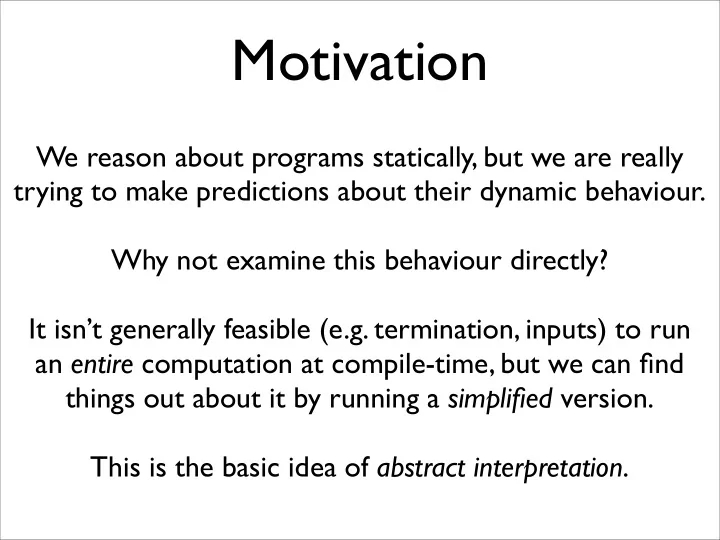
We reason about programs statically, but we are really trying to make predictions about their dynamic behaviour. Why not examine this behaviour directly? It isn’t generally feasible (e.g. termination, inputs) to run an entire computation at compile-time, but we can find things out about it by running a simplified version. This is the basic idea of abstract interpretation.

slide-2
SLIDE 2

Abstract interpretation

Warning: this will be a heavily simplified view

  • f abstract interpretation; there is only time to

give a brief introduction to the ideas, not explore them with depth or rigour.

slide-3
SLIDE 3

Abstract interpretation

The key idea is to use an abstraction: a model of (otherwise unmanageable) reality, which

  • discards enough detail that the model becomes

manageable (e.g. small enough, computable enough), but

  • retains enough detail to provide useful insight into

the real world.

slide-4
SLIDE 4

Abstract interpretation

For example, to plan a trip, you might use a map.

  • A road map sacrifices a lot of detail —
  • trees, road conditions, individual buildings;
  • an entire dimension —
  • but it retains most of the information which is

important for planning a journey:

  • place names;
  • roads and how they are interconnected.
slide-5
SLIDE 5

Abstract interpretation

Crucially, a road map is a useful abstraction because the route you plan is probably still valid back in reality.

  • A cartographer creates an abstraction of reality

(a map),

  • you perform some computation on that

abstraction (plan a route),

  • and then you transfer the result of that

computation back into the real world (drive to your destination).

slide-6
SLIDE 6

Abstract interpretation

Trying to plan a journey by exploring the concrete world instead of the abstraction (i.e. driving around aimlessly) is either very expensive or virtually impossible. A trustworthy map makes it possible — even easy. This is a real application of abstract intepretation, but in this course we’re more interested in computer programs.

slide-7
SLIDE 7

Multiplying integers

A canonical example is the multiplication of integers. If we want to know whether −1515 × 37 is positive

  • r negative, there are two ways to find out:
  • Compute in the concrete world (arithmetic),

using the standard interpretation of multiplication. −1515 × 37 = −56055, which is negative.

  • Compute in an abstract world, using an abstract

interpretation of multiplication: call it ⊗.

slide-8
SLIDE 8

(−) = { z ∈ ℤ | z < 0 } (+) = { z ∈ ℤ | z > 0 }

Multiplying integers

In this example the magnitudes of the numbers are insignificant; we care only about their sign, so we can use this information to design our abstraction. (0) = { 0 } In the concrete world we have all the integers; in the abstract world we have only the values (−), (0) and (+).

slide-9
SLIDE 9

Multiplying integers

We need to define the abstract operator ⊗. Luckily, we have been to primary school.

⊗ (−) (0) (+) (−) (0) (+) (+) (+) (0) (0) (0) (0) (0) (−) (−)

slide-10
SLIDE 10

Multiplying integers

Armed with our abstraction, we can now tackle the

  • riginal problem.

abs(−1515) = (−) abs(37) = (+) (−) ⊗ (+) = (−) So, without doing any concrete computation, we have discovered that −1515 × 37 has a negative result.

slide-11
SLIDE 11

Multiplying integers

This is just a toy example, but it demonstrates the methodology: state a problem, devise an abstraction that retains the characteristics of that problem, solve the problem in the abstract world, and then interpret the solution back in the concrete world. This abstraction has avoided doing arithmetic; in compilers, we will mostly be interested in avoiding expensive computation, nontermination or undecidability.

slide-12
SLIDE 12

Safety

As always, there are important safety issues. Because an abstraction discards detail, a computation in the abstract world will necessarily produce less precise results than its concrete counterpart. It is important to ensure that this imprecision is safe.

slide-13
SLIDE 13

Safety

We consider a particular abstraction to be safe if, whenever a property is true in the abstract world, it must also be true in the concrete world. Our multiplication example is actually quite precise, and therefore trivially safe: the magnitudes

  • f the original integers are irrelevant, so when the

abstraction says that the result of a multiplication will be negative, it definitely will be. In general, however, abstractions will be more approximate than this.

slide-14
SLIDE 14

Adding integers

A good example is the addition of integers. How do we define the abstract operator ⊕?

⊕ (−) (0) (+) (−) (0) (+) (−) (+) (−) (0) (+) (−) (+) (?) (?)

slide-15
SLIDE 15

Adding integers

When adding integers, their (relative) magnitudes are important in determining the sign of the result, but

  • ur abstraction has discarded this information.

As a result, we need a new abstract value: (?). (−) = { z ∈ ℤ | z < 0 } (+) = { z ∈ ℤ | z > 0 } (0) = { 0 } (?) = ℤ

slide-16
SLIDE 16

Adding integers

(?) is less precise than (–), (0) and (+); it means “I don’t know”, or “it could be anything”. Because we want the abstraction to be safe, we must put up with this weakness.

slide-17
SLIDE 17

= (+)

Adding integers

19, 23 42 (+)

+

abs

abs(19 + 23) = abs(42)

slide-18
SLIDE 18

= (+) = (+)

Adding integers

19, 23 (+), (+) 42 (+)

+

abs ⊕ abs

abs(19 + 23) = abs(42) abs(19) ⊕ abs(23) = (+) ⊕ (+)

slide-19
SLIDE 19

(–)

= (–)

Adding integers

–1515, 37

–1478

+

abs

abs(–1515 + 37) = abs(–1478)

slide-20
SLIDE 20

= (?) = (–)

Adding integers

–1515, 37

(–), (+) –1478

+

abs ⊕ abs

abs(–1515 + 37) = abs(–1478) abs(–1515) ⊕ abs(37) = (–) ⊕ (+)

(?)

slide-21
SLIDE 21

Safety

Here, safety is represented by the fact that (–) ⊆ (?):

{ z ∈ ℤ | z < 0 } ⊆ ℤ

The result of doing the abstract computation is less precise, but crucially includes the result of doing the concrete computation (and then abstracting), so the abstraction is safe and hasn’t missed anything.

slide-22
SLIDE 22

Abstraction

Formally, an abstraction of some concrete domain D (e.g. ℘(ℤ)) consists of

  • an abstract domain D# (e.g. { (–), (0), (+), (?) }),
  • an abstraction function α : D → D# (e.g. abs), and
  • a concretisation function γ : D# → D, e.g.:
  • (–) ↦ { z ∈ ℤ | z < 0 },
  • (0) ↦ { 0 }, etc.
slide-23
SLIDE 23

Abstraction

concrete abstract

γ α

slide-24
SLIDE 24

Abstraction

+({ 2, 5 }, { –3, –7 }) = { –1, –5, 2, –2 } ^ ⊕((+), (–)) = (?) Given a function f from one concrete domain to another (e.g. + : ℘(ℤ) × ℘(ℤ) → ℘(ℤ)), we require an abstract function f # (e.g. ⊕) between ^ the corresponding abstract domains.

slide-25
SLIDE 25

Abstraction

ℤ × ℤ ℤ + + ^ ⊕ D D × D α1 γ1 D# × D# D# α2 γ2 So, for D = ℘(ℤ) and D# = { (–), (0), (+), (?) }, we have: where α1,2 and γ1,2 are the appropriate abstraction and concretisation functions.

slide-26
SLIDE 26

Abstraction

These mathematical details are formally important, but are not examinable on this course. Abstract interpretation can get very theoretical, but what’s significant is the idea of using an abstraction to safely model reality. Recognise that this is what we were doing in data- flow analysis: interpreting 3-address instructions as

  • perations on abstract values — e.g. live variable sets

— and then “executing” this abstract program.

slide-27
SLIDE 27

Summary

  • Abstractions are manageably simple models of

unmanageably complex reality

  • Abstract interpretation is a general technique for

executing simplified versions of computations

  • For example, the sign of an arithmetic result can be

sometimes determined without doing any arithmetic

  • Abstractions are approximate, but must be safe
  • Data-flow analysis is a form of abstract interpretation